Aditya Chaudhary
Key takeaways
- Automation saves money only when aimed at a specific loss that has been measured in money first.
- Predictive maintenance, automated inspection and system integration are among the most practical starting points for cutting downtime, scrap and waste.
- Robots and cobots suit repetitive, heavy or continuous work on stable processes, and their total cost goes well beyond the machine.
- Back-office automation and energy monitoring often deliver returns faster than hardware, but simplify the process before automating it.
- Pilot on one line or machine, compare against a baseline and give the project a named owner before scaling.
- Track payback, scrap, downtime, OEE and cost per unit over three years, and do not count saved time as saved cash.
A factory rarely loses money in one dramatic place. It loses it in small, repeated ways: a machine that stops without warning, a batch scrapped at the end of the line, a rush order shipped by air because the stock count was wrong, a clerk retyping the same purchase order into a second system. Each leak looks minor. Together they decide whether a plant earns a healthy margin or just stays busy.
Automation is the usual answer, but it is not a single purchase. It covers sensors and maintenance software, robots and cobots, camera-based inspection, system integration, document handling and energy monitoring. Each one reduces cost only when it is aimed at a specific, measured loss. Applied to the wrong problem, it adds capital cost and complexity without a return.
This guide is for owners, plant managers, operations heads, CTOs and managing directors of small and mid-sized manufacturers, as well as larger plants planning their next investment. It explains where manufacturers are actually saving money, what each approach depends on, where it falls short, and how to sequence the work so the results can be measured.
It does not promise a standard percentage saving, because results depend on the plant, the product and the starting condition of the process. It aims to help you choose the right first project and judge it honestly.
Where a factory's money actually leaks
Automation saves money only when it targets a named cost. A plant that buys robots, sensors or software without knowing which loss it wants to remove usually ends up with new equipment and the same cost base.
The leaks are familiar: unplanned stoppages, scrap and rework, slow changeovers and scheduling gaps, excess or missing stock, manual data entry, wasted energy, and repetitive or physically hard tasks. Downtime alone is large at scale. Siemens and Senseye's The True Cost of Downtime 2024 (opens in a new tab) puts unplanned downtime at about $1.4 trillion a year for the world's 500 largest companies, or 11% of their revenues, up from 8% (about $864 billion) in 2019 and 2020. Those figures cover Fortune Global 500 firms and should not be applied directly to a small plant.
Why the biggest leak is often the least visible
Most plants cannot say which leak is largest, because the evidence sits in spreadsheets, paper logs and separate systems. Stoppages get noticed. Small, constant losses such as re-keying data or waiting on a changeover rarely do.
Start with the cost, not the technology
Baseline each leak in money first: cost per hour of line stoppage, scrap rate, hours spent re-keying data. The method is covered in our guide to measuring ROI on an automation investment. Then match the tool to the leak:
- Stoppages: predictive maintenance
- Scrap and rework: automated inspection
- Scheduling and stock: connected planning systems
- Paperwork: workflow automation
- Manual strain: robots and cobots
Predictive maintenance: the most proven way to cut downtime costs
Maintenance follows one of three strategies. Reactive means running equipment until it fails. Preventive means servicing on a fixed schedule. Predictive is condition-based: sensors track vibration, temperature and motor current, and software flags change before failure.
How it works in practice
The savings come from fewer emergency repairs, less lost production, parts ordered in advance and no servicing of healthy machines. The US Department of Energy's FEMP O&M Best Practices Guide (opens in a new tab) estimates that a well-run preventive programme saves 12% to 18% over a purely reactive one, and predictive saves a further 8% to 12%. These are estimates for facilities in general, not guarantees. Siemens also credits mainstream predictive maintenance as a critical factor in reducing downtime losses.
Illustrative example, not real data: a line stops for 30 unplanned hours a year at an assumed $4,000 an hour of lost output. That is about $120,000.
Where it does not pay
It needs sensor data and some history. Start with critical, expensive or bottleneck machines. Cheap, easily replaced equipment is not worth fitting.
Connecting alerts to maintenance work
- Pick the 3 to 5 machines whose failure stops the plant.
- Add condition monitoring to them.
- Connect alerts to the maintenance work-order system so each warning becomes a scheduled job.
Robots and cobots for repetitive and physically demanding work
Robots cut cost where work is repetitive, heavy or continuous: palletising, machine tending, welding, packing, repetitive assembly and material transfer. The gains are consistent cycle times, less rework from fatigue errors, longer running hours and fewer injuries. The technology is mainstream. The International Federation of Robotics (opens in a new tab) reports 542,000 industrial robots installed in 2024, more than double the 221,000 a decade earlier. Its president's report (opens in a new tab) notes installations trended sideways in 2024, so this is a settled practice, not a surge.
Industrial robots vs cobots
Traditional industrial robots are fenced, fast and suited to high-volume work. Collaborative robots work beside people, are easier to redeploy and suit smaller batches.
The robot is only part of the expense. Budget for fixtures, grippers, integration, safety assessment, programming and downtime during commissioning.
When a robot is the wrong first step
Robots rarely pay with highly variable products, very short runs or processes that are not yet stable. Fix the process first. A cell is ready for a robot when the process is stable, parts arrive in a repeatable position, volume justifies the investment and one named person owns the result.
Automated quality inspection and process monitoring
Poor quality costs money in several places: scrap, rework, warranty claims, returns and the labour of people inspecting parts by eye. Automated inspection moves detection to the station that made the defect.
What automated inspection checks
Machine vision cameras with trained models check surface defects, dimensions and whether an assembly is complete. Inline sensors feed statistical process control, so drift is visible before parts fall out of tolerance. Software logs each defect with its batch, machine and shift.
Catching a fault at source means fewer bad parts built on top of it, and none reaching the customer. Traceability also narrows a recall to one batch rather than a whole product run. The logged data shows patterns too, such as a worn tool or a problem supplier lot, so you can fix the cause.
Why it needs human review at first
Models need good labelled examples of both good and bad parts. Lighting and part presentation affect results as much as the software does. False rejects add their own cost, so a person should review borderline cases while the system learns.
To measure the result, compare scrap rate and rework hours on one line, before and after, over several weeks.
Connecting planning, inventory and the shop floor
Why disconnected systems cost money
In many mid-sized plants, orders sit in one system, stock in a spreadsheet and machine status on a whiteboard. Planners schedule against numbers that are already out of date, so the cost appears as stock-outs, expedited freight and idle machines.
Connected data removes much of that. Automated scheduling and material requirements planning flag shortages before they stop a line. Real-time production tracking replaces end-of-shift paper logs. Automatic stock updates reduce over-ordering, because purchasing sees what is actually on hand.
Integrate before you replace
The usual architecture has four parts: an ERP at the core, a manufacturing execution or shop-floor layer, machine data collection, and APIs or integration software joining them. Custom shop-floor tools often sit beside a good ERP, as covered in custom ERP-adjacent software and when you need it.
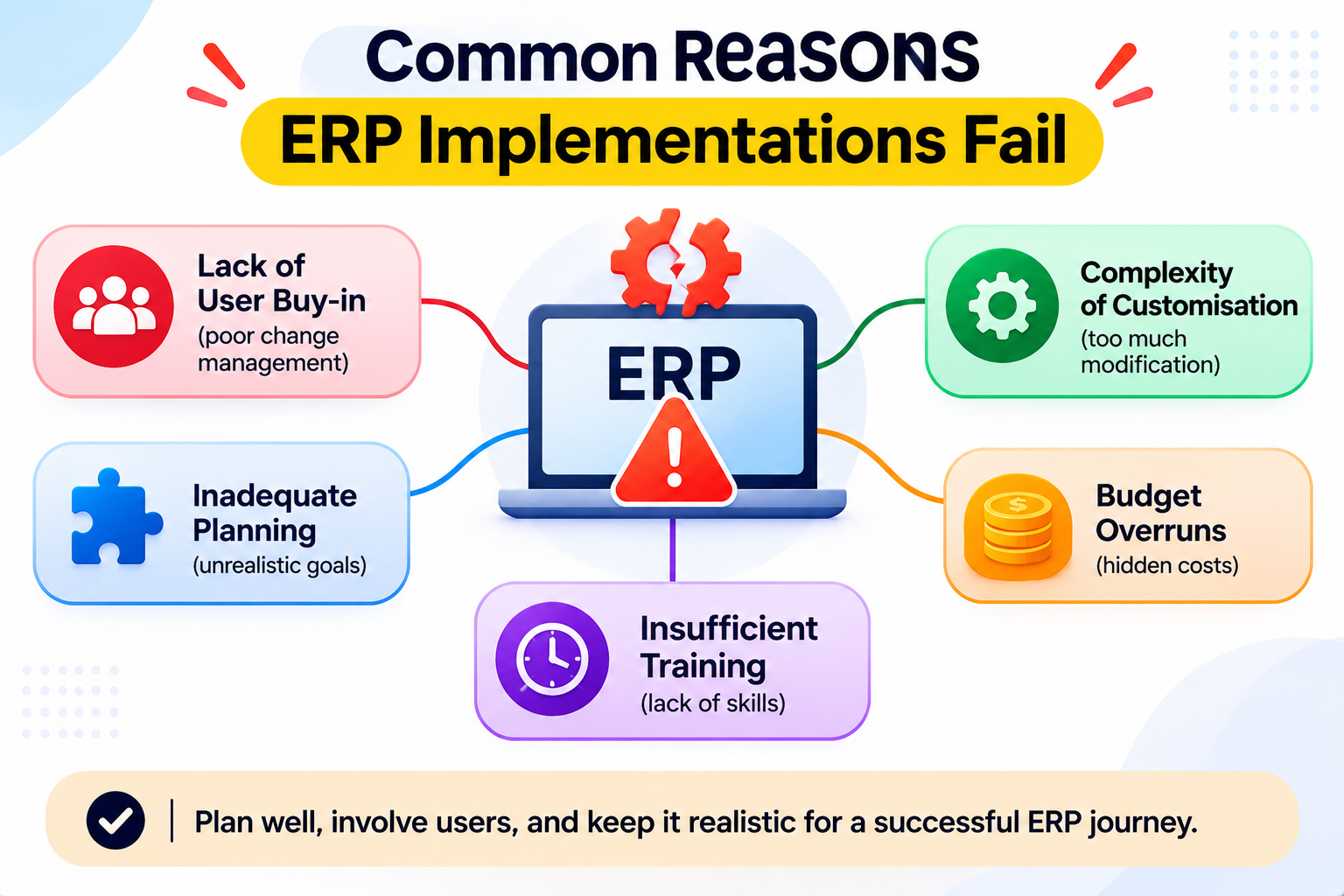
Be realistic about ERP work. Projects usually fail for process and data reasons, not software reasons, as explained in why ERP implementations fail. If you have outgrown a CRM, when to move from CRM to ERP sets out the decision.
This is where Zero One Creation's business automation, API integration and custom software work applies, as a technology and digital transformation partner.
Back-office and paperwork automation inside the plant
Production depends on a layer of administrative work that rarely gets scrutiny: purchase orders, supplier invoices, goods-received notes, delivery documents, quality certificates, compliance records and production reports. Each one is typed, checked or chased by someone, and each handoff is a chance for delay or error.
Documents, approvals and reporting
Automation removes the manual steps. Incoming documents are read and matched against purchase orders and goods-received notes without re-keying. Approvals follow routing rules, so an invoice within tolerance moves on and only exceptions reach a person. Reports are generated from system data rather than compiled by hand, and supplier and customer records stay synchronised through APIs. See how AI-powered document processing handles the reading step.
The saving comes from the mechanism: fewer hours spent on entry and chasing, fewer entry errors, faster payment cycles and fewer shipping mistakes caused by wrong or missing documents.
Simplify before you automate
Automating a messy approval chain only makes the mess faster. Before building anything, remove approvals nobody uses, agree who signs off what, and settle on one version of each document. Plants still running on paper should start with migrating paper-based processes to digital systems, then add automation to a process that is already clean.
Energy and utilities
Energy is often treated as a fixed overhead, but much of it is controllable. Typical waste includes compressed air leaks, machines left idling between shifts, oversized motors running far below their rating and peak demand that nobody manages. Automated sub-metering, scheduling and alerts make these losses visible.
The US Department of Energy and PNNL Operations & Maintenance Best Practices Guide estimates that O&M programmes targeting energy efficiency (opens in a new tab) can save 5% to 20% on energy bills without significant capital investment. It is a general estimate, not a forecast for any one plant.
Measure consumption per unit produced
Total kilowatt-hours say little when output changes. Energy per unit produced shows whether a line is getting less efficient. Practical measures include:
- Shutting down idle equipment automatically after a set period.
- Staggering start-ups so machines do not create a demand spike together.
- Monitoring compressed-air pressure to catch leaks and over-pressurised systems.
- Alerting when consumption per unit moves outside its normal range.
Energy data also feeds maintenance. A machine drawing unusual power often has a developing fault, such as a worn bearing or a failing motor, so these alerts can link to the same work orders as predictive maintenance.
Savings depend on the plant, its equipment and its tariffs. Measure first, and invest only where the data shows a real loss.
A practical order of work, and how to measure the result
A sequence that limits risk
- Baseline costs and pick one high-cost problem.
- Get data flowing from the machines and systems involved.
- Pilot on one line or process.
- Measure against the baseline.
- Scale what worked.
- Assign an owner for maintenance and monitoring.
Mistakes that erase the savings
Avoid automating an unstable process, buying hardware before fixing data, and neglecting maintenance of the automation itself. Plan operator training early, because adoption fails without buy-in. Do not count time saved as cash saved unless spending falls, a distinction the ROI guide explains.
What to measure
Track payback period, scrap rate, downtime hours and cost per unit. Add overall equipment effectiveness (OEE), which is availability times performance times quality. Review results over three years, as in this adoption plan.
Zero One Creation supports this work through technology consulting and business automation.
Frequently Asked Questions
Start with the single most expensive measured problem, not with a technology. For many small plants that is unplanned downtime on one critical machine, scrap on one line, or manual re-entry of orders and paperwork. Baseline that loss in money, then pick the simplest tool that addresses it.
It varies widely with scope. A machine data collection pilot, a document automation workflow and a robotic cell sit at very different price points, and a robot's total cost includes tooling, integration, safety and training. Ask for a full cost estimate over three years, including maintenance and support, and compare it with the baseline loss you measured.
Software and data projects, such as order synchronisation or document processing, can show results within a few months of a pilot. Robotics and inspection systems usually take longer because of installation, tuning and staff training. Track payback month by month so you can see whether the project is on course.
Not necessarily. Many projects remove repetitive, heavy or error-prone tasks and let the same team handle more volume or move to work that needs judgement, such as maintenance planning or process improvement. Time saved only becomes a cost saving if it reduces overtime, outsourcing or avoided hiring, so decide in advance how the released capacity will be used.
Predictive maintenance uses sensor data, such as vibration, temperature and current, to service a machine when its condition requires it. It tends to pay on critical machines where a stoppage is costly, and less so on cheap or easily replaced equipment. Start with a few important assets and link alerts to work orders so the data leads to action.
Often yes. APIs, middleware and machine data collection devices can connect many older machines and existing ERP systems without a full replacement. Integrating what you already have is usually faster and less disruptive than replacing it, although very old equipment may need retrofit sensors or controllers.
Neither is better in general. Software automation is typically cheaper and quicker to deploy, and suits paperwork, planning and data flow. Robots pay where work is repetitive, heavy or continuous and the process is stable. Compare both against the measured loss you are trying to remove.