Gourav Dhiman
Most companies don't fail at AI because the technology doesn't work. They fail because they never had a plan beyond "we should probably be doing something with AI." A tool gets purchased, a pilot gets run, enthusiasm fades when it doesn't transform the business overnight, and eighteen months later nobody can say what happened to the budget.
That pattern is common enough that it shows up clearly in the data. Nearly nine in ten organizations now use AI in at least one business function, yet an estimated 80 to 95 percent of AI projects fail to deliver their promised return, and more than half of CEOs report zero measurable ROI from AI despite active deployment. The gap isn't between companies that adopt AI and companies that don't. It's between companies that adopt AI with a structured plan and companies that adopt it as a series of disconnected experiments.
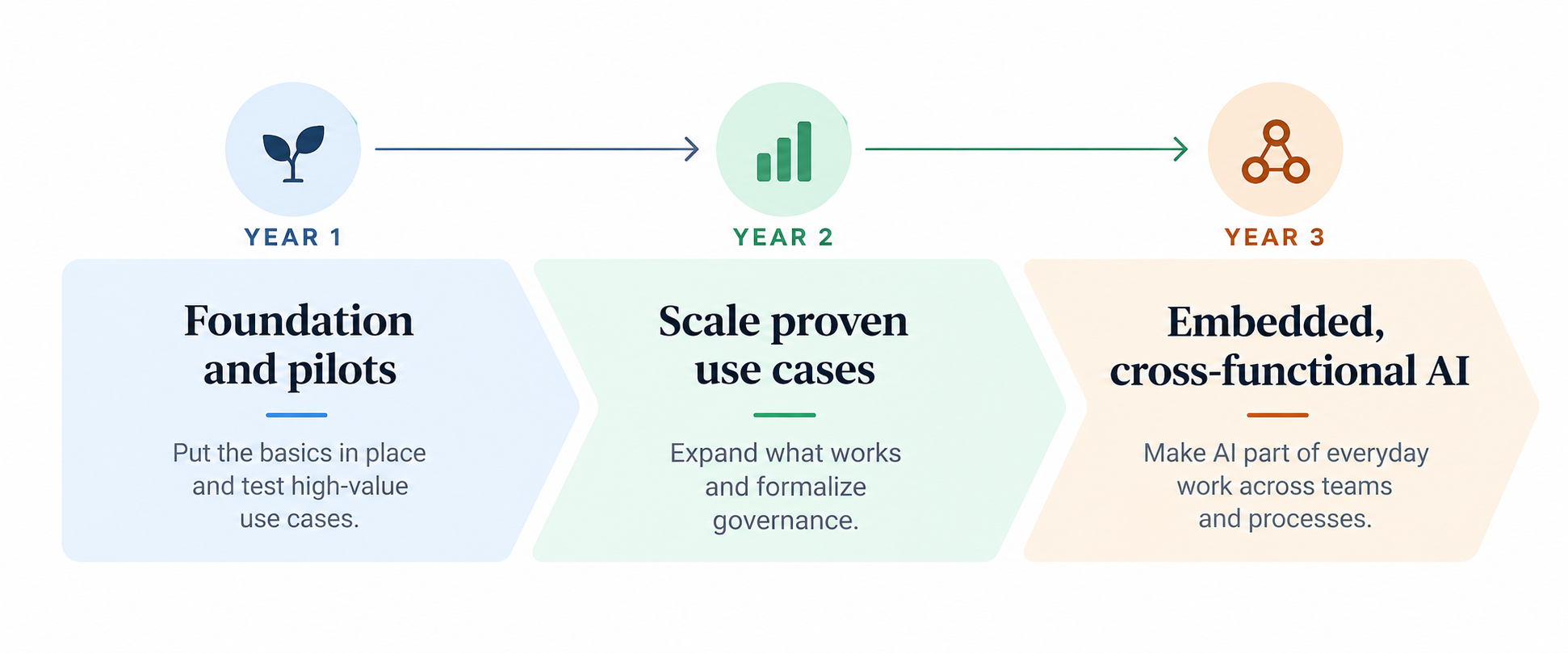
A three-year horizon matters here because AI adoption isn't a single project with a start and end date. It's closer to building a new operational capability, the same way a company builds a sales function or a data team. That takes sequencing, budget discipline, and a willingness to get the first year mostly right before expanding. This is what a realistic plan looks like, broken down by what should actually happen in each phase.
Why a Multi-Year Plan Beats a Single Big Push
The instinct to move fast on AI is understandable. Competitors are talking about it, vendors are pitching it, and the fear of being left behind is real. But speed without sequencing is exactly how companies end up in the failure statistics.
Part of the problem is structural. Data quality is the single biggest barrier enterprises report when adopting AI, cited by roughly six in ten organizations, ahead of talent shortages, integration complexity, and cost concerns. That's a foundational issue, not something a better prompt or a newer model fixes. If a company's customer records live in three disconnected systems with inconsistent formatting, no AI tool is going to produce reliable output from that data on day one. A rushed rollout tends to expose this problem in the worst possible way, in front of customers or executives who then conclude "AI doesn't work for us" when the real issue was never AI.
There's also a governance dimension that's easy to underestimate. Among small and mid-sized businesses specifically, roughly 43 percent report having no AI adoption plan at all, which means a large share of SME AI spending right now is happening reactively, tool by tool, without anyone tracking whether it's actually working. A phased plan forces the opposite discipline: define what success looks like before spending money, prove it in a narrow area, then expand.
None of this argues for moving slowly out of caution. It argues for moving deliberately, so that year one builds the foundation year two and three actually depend on.
Year One: Build the Foundation, Not the Showcase
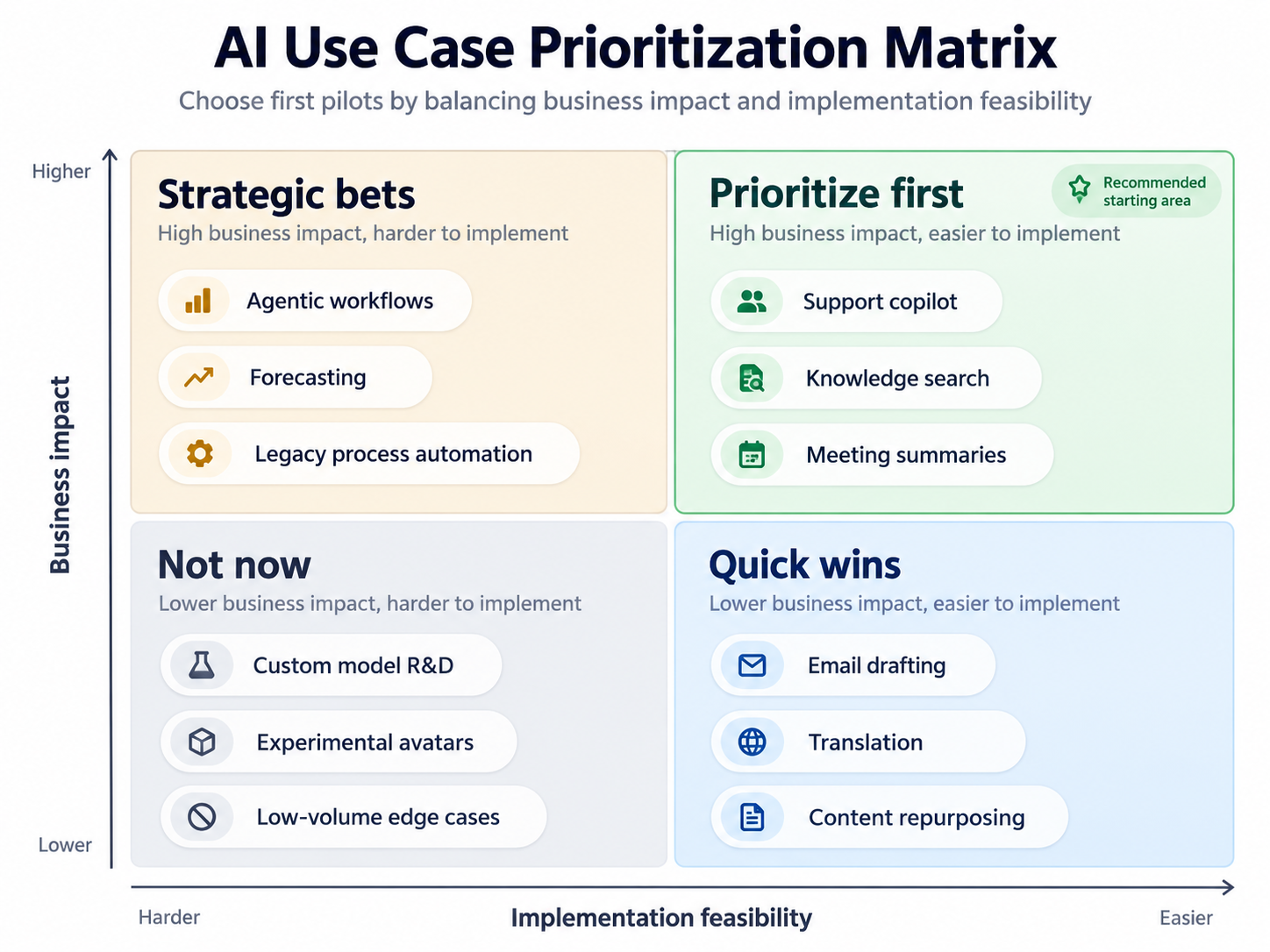
The biggest mistake companies make in year one is choosing the most impressive AI use case instead of the most instructive one. A flashy generative AI showcase for the board looks good in a slide deck, but it rarely teaches the organization anything repeatable. The goal of year one isn't to impress anyone. It's to learn, cheaply, what actually works inside your specific business.
Start with an honest readiness assessment
Before selecting any tool, take stock of three things: where your data actually lives and how clean it is, which processes are documented well enough that an AI system could reasonably be trained or configured around them, and who on staff has the bandwidth to own this work. Companies frequently skip this step because it feels like delay, but skipping it is precisely why so many pilots stall. If nobody owns the initiative full time, even part time, it will lose momentum the moment its champion gets pulled onto something else.
Pick two or three narrow, measurable use cases
Resist the temptation to run parallel pilots across every department. Choose problems that are painful, well understood, and bounded, things like automating repetitive customer service replies, cleaning up invoice processing, or summarizing internal documents for a specific team. Narrow scope matters because it lets you measure results honestly. A vague goal like "improve customer service with AI" can't be evaluated. "Reduce average first-response time on tier-one support tickets by using an AI-assisted draft response" can be.
Set a real budget, including the parts people forget
Software licensing is usually the smallest line item. The larger, less visible costs are staff time for training and adjustment, data cleanup work that has to happen before a tool can be useful, and a buffer for the fact that early implementations rarely go exactly as planned. Broader industry estimates put realistic AI ROI at roughly $3.70 returned per dollar invested when productivity gains are properly factored in, with payback typically materializing over twelve to twenty-four months, not weeks. Budgeting for year one with that timeline in mind prevents the premature judgment that kills otherwise promising pilots.
Build the measurement habit early
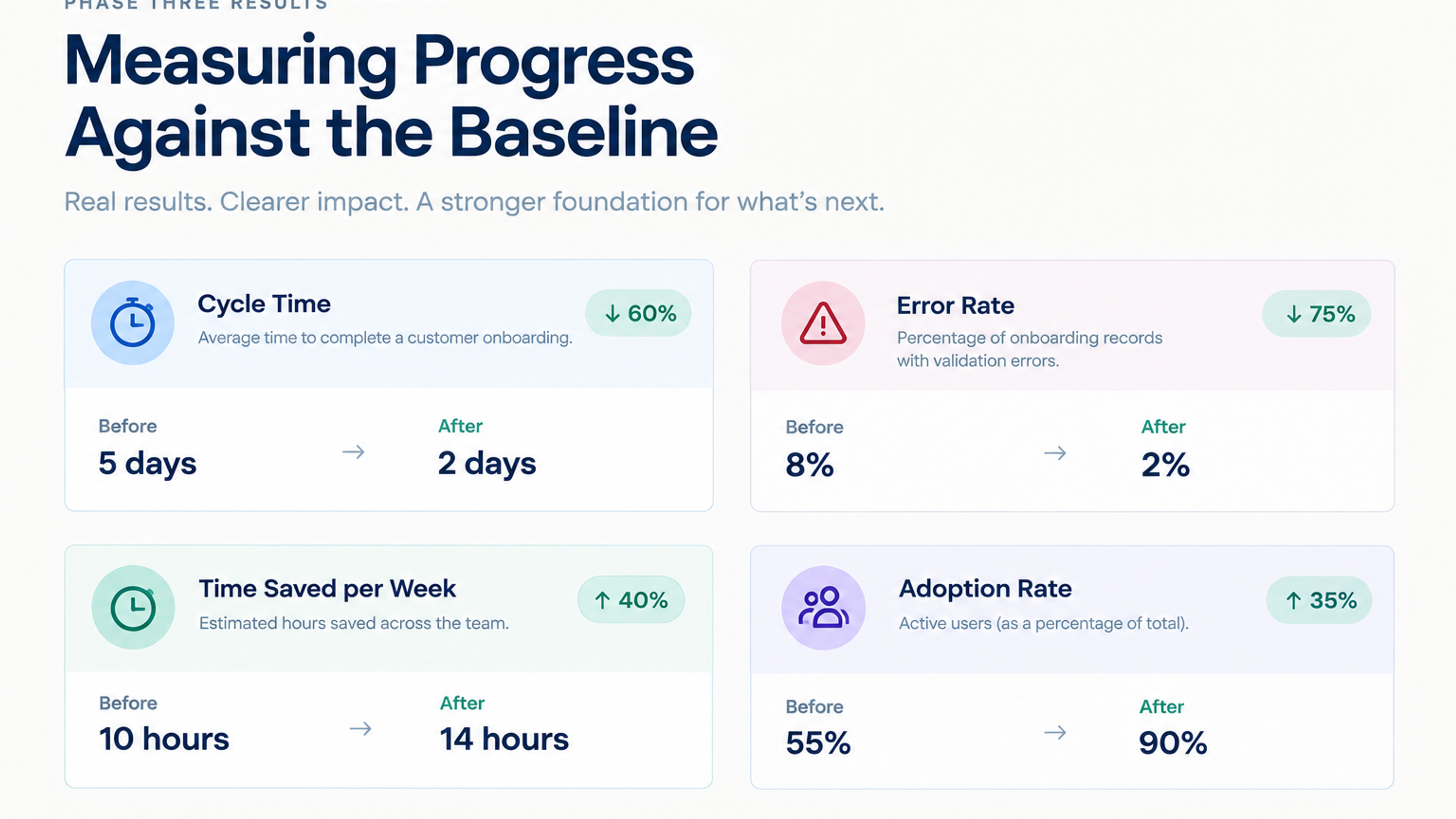
Before a single pilot launches, decide what "working" means in numbers: hours saved, error rate reduced, tickets resolved faster, revenue influenced. Track a baseline for at least a few weeks before AI touches the process, so the comparison afterward means something. Companies that skip baseline measurement almost always end up arguing about whether a pilot worked based on anecdotes instead of evidence.
By the end of year one, the goal is not company-wide transformation. It's two or three working, measured examples, a clearer picture of your data gaps, and a team that has actually done this once and knows what to expect the second time.
Year Two: Scale What Worked, Retire What Didn't
Year two starts with an honest audit of year one, not a fresh wish list. Some pilots will have clearly paid off. Others will have quietly underperformed, and the temptation to keep funding them out of sunk-cost momentum is strong. Kill the ones that didn't work before adding new ones. This is also where a company's tolerance for admitting failure gets tested, and it's worth building a culture where a pilot ending is treated as useful information, not a personal failure for whoever ran it.
Expand proven use cases across adjacent teams
If an AI-assisted workflow reduced processing time in one department, the same underlying approach often transfers to a neighboring team with a similar process. This is usually cheaper and faster than starting a brand-new use case from scratch, because the data integration work and staff training patterns are already understood.
Formalize governance before it becomes urgent
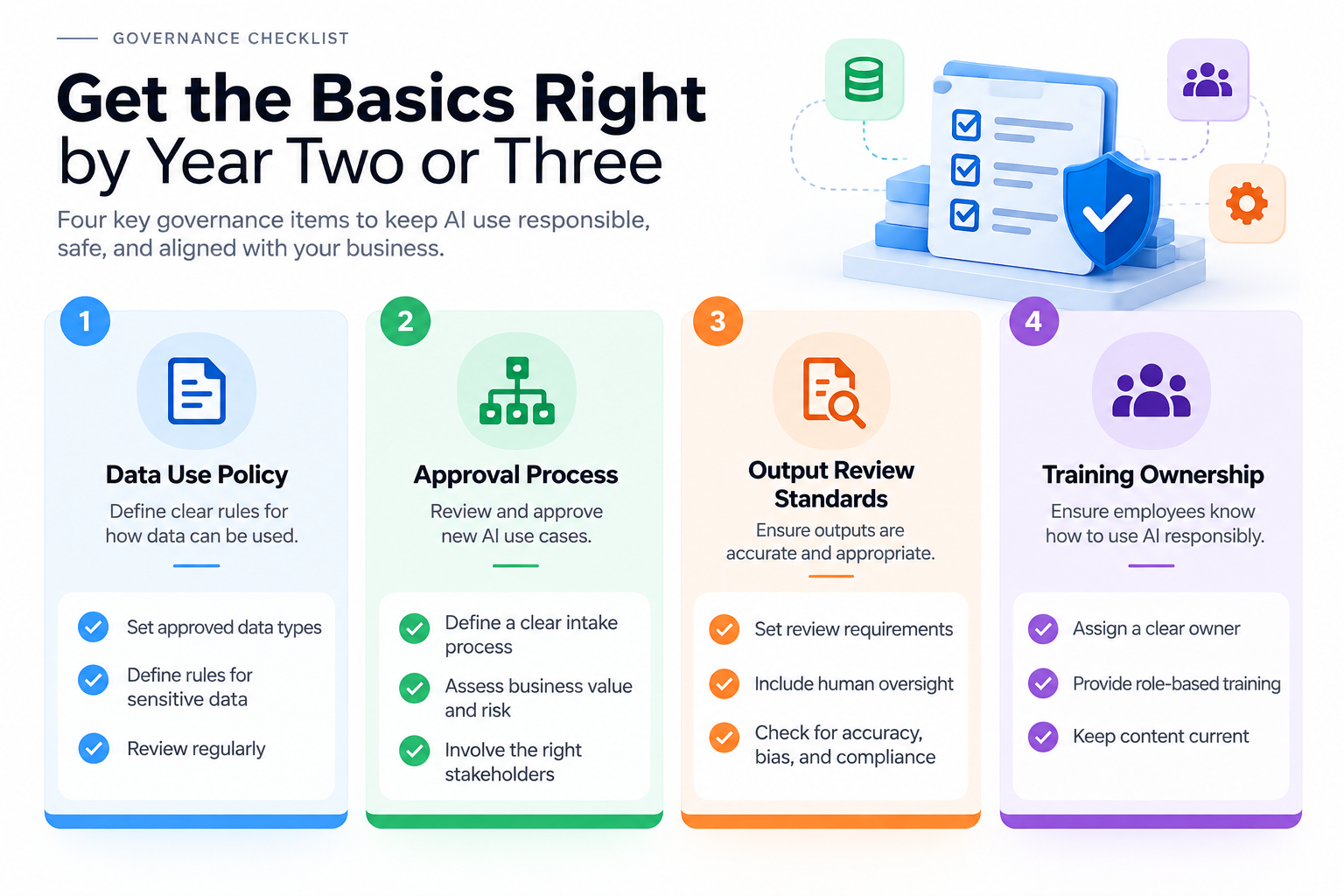
By year two, enough people across the organization are touching AI tools that informal, ad hoc usage becomes a real risk. This is the point to establish clear policies: what data can and cannot be entered into external AI tools, who approves a new AI use case before it touches customer-facing work, and how outputs get reviewed before they're trusted. Waiting until an incident forces this conversation is a common and avoidable mistake. Deloitte's research consistently flags governance and compliance uncertainty as a top-five barrier to scaling AI, and it tends to bite hardest right around the point where usage moves from a few pilots to organization-wide adoption.
Invest in the skills gap directly
A persistent barrier across company sizes is a shortage of people who know how to evaluate, configure, and responsibly manage AI tools, not just use them. Rather than assuming existing staff will pick this up passively, year two is the right time for structured training, whether that's formal courses, vendor-led sessions, or simply giving a designated internal owner real time to build expertise rather than treating AI oversight as a side task.
Watch for the agentic AI trap
As AI tools move from answering questions to taking autonomous actions, like automatically processing a refund or updating a record without human review, the stakes of getting scope wrong rise sharply. Industry forecasts suggest that a substantial share of these more autonomous, agent-style AI projects, on the order of 40 percent, will be canceled by 2027 due to escalating costs, unclear business value, or inadequate risk controls. Year two is the point where many companies start experimenting with this category, and the safest approach is to expand agent autonomy gradually, with clear human checkpoints, rather than granting full autonomy on day one because a demo looked impressive.
By the end of year two, AI should be a normal, budgeted part of how two or three departments operate, with clear governance in place before the next wave of expansion begins.
Year Three: Integration, Not Just Expansion
By year three, the question shifts from "where else can we apply AI" to "how does AI fit into how the business actually runs." This is a subtler, more important shift than simply adding more tools.
Connect AI initiatives to strategic goals, not isolated tasks
Early pilots are usually justified task by task: this saves time on this specific job. By year three, the more useful framing is whether AI capabilities are supporting the company's actual strategic priorities, whether that's faster customer response as a competitive differentiator, tighter margins through operational efficiency, or better decision-making through data analysis that wasn't previously possible. Initiatives that can't be tied back to a real strategic priority are the ones most likely to get quietly defunded when budgets tighten, and rightly so.
Build cross-functional workflows, not departmental silos
Where year one and two typically produce pockets of AI use within individual teams, year three is when those pockets should start connecting. A sales team's AI-assisted lead scoring should feed into the same data the marketing team uses for campaign targeting. A customer service AI system should be able to draw on the same product knowledge base that the support documentation team maintains. This integration work is unglamorous and rarely gets its own press release, but it's usually where the compounding value actually shows up.
Reassess vendor and build decisions
Two or three years into an AI adoption plan, the market itself has usually shifted. Tools that were the only viable option in year one may have been overtaken by better, cheaper alternatives, or the company's own needs may have grown sophisticated enough that a custom-built solution finally makes more sense than a general-purpose tool. This is a reasonable point to formally revisit "buy versus build" decisions rather than defaulting to whatever was chosen years earlier out of inertia.
Institutionalize measurement
By this stage, AI performance metrics should sit alongside other standard operating metrics, reviewed on the same cadence as sales figures or customer satisfaction scores, not treated as a special innovation project that gets a separate quarterly update. This normalization is itself a sign of a mature adoption plan.
Common Mistakes That Derail a Multi-Year Plan
A few patterns show up repeatedly in companies whose AI plans stall out before year three.
The first is treating year one pilots as permanent decisions rather than experiments. Locking into a specific vendor or workflow too early, based on limited pilot data, makes it harder to course-correct once real usage patterns emerge.
The second is underinvesting in the unglamorous data work. Data cleanup, integration between systems, and documentation of existing processes rarely make it into a pitch deck, but they're consistently the difference between a pilot that scales and one that quietly dies in its second month.
The third is measuring activity instead of outcomes. A high number of employees "using" an AI tool is not the same as that tool producing measurable business value, and conflating the two is part of why so many companies report AI adoption without corresponding ROI.
The fourth is skipping change management. Employees who feel AI is being imposed on them, rather than something they had a hand in shaping, tend to underuse or quietly work around new tools, which shows up later as disappointing adoption numbers that have nothing to do with the technology itself.
Making the Plan Fit Your Business Size
A three-year plan for a two-hundred-person company and a twenty-person company will look structurally similar but operationally different. Smaller organizations generally benefit from concentrating year one entirely on a single, well-chosen use case rather than two or three, simply because there isn't spare capacity to manage multiple pilots at once. Larger organizations can afford to run parallel pilots but need governance structures in place earlier, since informal AI usage spreads faster across more people and more systems.
What doesn't change with size is the underlying discipline: define success in advance, measure honestly, expand only what's proven, and treat governance as part of the plan from the start rather than a fix applied after something goes wrong.
Frequently Asked Questions
Most credible estimates put realistic payback at twelve to twenty-four months for well-scoped initiatives, not weeks. Plans that expect faster returns often abandon promising pilots too early.
For very small teams, a part-time designated owner with protected time tends to work better than spreading responsibility thin across people who already have full workloads. Ownership without dedicated time is one of the most common reasons pilots stall.
Data quality and integration issues are the most consistently cited barrier across enterprise research, ahead of the AI technology itself. A plan that doesn't address data readiness in year one is likely to struggle regardless of which tools it adopts.
Adoption speed matters less than adoption quality. A company starting a disciplined, measured plan today is generally better positioned than one that adopted quickly but never established governance or measurement, since the latter often ends up needing to unwind and redo earlier work.
There's no fixed ratio, but companies frequently underfund training relative to software licensing, then wonder why adoption is uneven. Treating staff training as a first-year budget line, not an afterthought, tends to produce more durable results.