Manufacturing website design that turns buyers into RFQs

We design websites for manufacturers that engineers and purchase teams actually use: clear product catalogues, specifications and data sheets, and enquiry forms that reach the right person.

  • Free strategy call
  • Custom quotation, never a fixed package
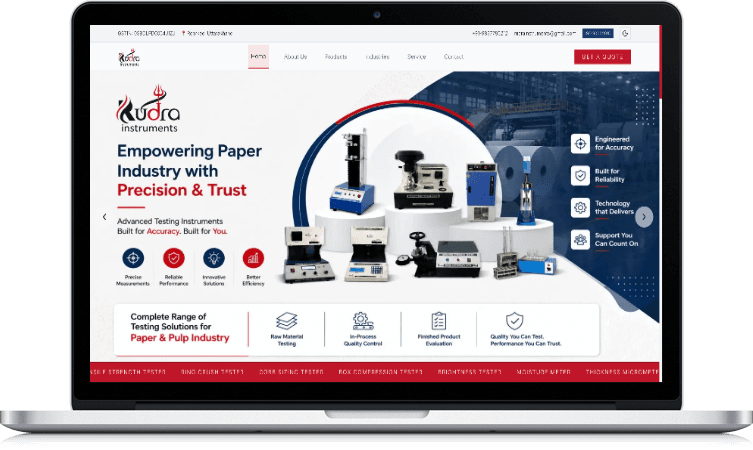
Rudra Instruments website on a laptop
Rudra Instruments: a manufacturer website we built.

Worked with

Problems we solve

Does your website undersell your factory?

Buyers often judge a manufacturer by its website before they ever visit the plant.

  1. 01

    A brochure, not a catalogue

    Products are listed without specifications, sizes or data sheets.

  2. 02

    Hard to find the right product

    Large ranges with no search, filters or clear categories.

  3. 03

    Enquiries that go nowhere

    A single contact form with no product details or routing.

  4. 04

    No trust signals

    Certifications, quality processes and industries served are missing.

Our solution

A website built for technical buyers

We design around how engineers, purchase teams and dealers evaluate suppliers.

  • Searchable product catalogue

    Categories, filters and product pages with specifications and downloadable documents.

  • RFQs that arrive complete

    Enquiry forms that capture product, quantity and application, routed to the right team.

  • Credibility on every page

    Certifications, industries served, quality processes and plant photos.

What we build

Manufacturing website features

Start with the essentials, add catalogue depth and integrations as you grow.

01

Product catalogue

Product categories and pages with specifications, variants, drawings, images and downloadable data sheets, managed by your team.

  • Categories and filters
  • Specification tables
  • Data sheets and drawings
  • Product images
  • Related products
  • Search
02

RFQ and enquiry forms

Request-for-quote forms that capture product, quantity, application and location, with routing to sales and an enquiry tracker.

  • Product-specific RFQs
  • Quantity and application
  • File uploads
  • Routing by region
  • Email and WhatsApp alerts
  • Enquiry tracking
03

Industries and applications

Pages that explain which industries and applications your products serve, written for the searches buyers make.

  • Industry pages
  • Application notes
  • Use cases
  • Search-friendly copy
  • Internal links
  • Calls to action
04

Company and quality

Certifications, quality control, facilities and capacity presented clearly to support supplier evaluations.

  • Certifications
  • Quality process
  • Facilities and machines
  • Plant photos
  • Leadership
  • Export capability
05

Dealer and distributor pages

Dealer locators, dealer enquiry forms and a path to a dealer portal when you need one.

  • Dealer locator
  • Dealer enquiries
  • Downloads area
  • Price list requests
  • Portal integration
  • Regional contacts
06

Search visibility

Technical SEO, product structured data and content plans so buyers searching for your products find you.

  • Technical SEO
  • Product schema
  • Fast pages
  • Search Console
  • Content plan
  • Analytics

What you get

What a good manufacturer website changes

A website that supports sales instead of just existing.

  • Found by buyers

    Product and application pages for real searches.

  • Complete RFQs

    Enquiries with the details sales needs.

  • A usable catalogue

    Products easy to find and compare.

  • Credibility

    Certifications and quality on show.

  • Easy updates

    Your team adds products and documents.

  • Yours to keep

    Domain, hosting and code in your name.

Why us

Why manufacturers choose Zero One Creation

  • Manufacturing work

    Our work includes the Rudra Instruments website.

  • Website to ERP

    We also build ERPs, dealer systems and B2B portals.

  • Near industrial belts

    Based in Roorkee, close to Haridwar's SIDCUL area.

  • Clear written scope

    A proposal with scope and a customised quotation.

Send us your current website or catalogue, and we'll show you how buyers would experience it.

A free strategy call, then a written proposal with a customised quotation.

Our approach

How we design manufacturer websites

Open each step to see what it covers.

  1. 01.Understand products and buyers

    Your range, industries, buyer roles and how enquiries are handled.

  2. 02.Catalogue structure

    Categories, attributes and documents planned with your team.

  3. 03.Design

    Product, industry and RFQ pages designed and reviewed.

  4. 04.Build

    Development with a CMS for products and documents.

  5. 05.Content and migration

    Products, specifications and documents entered or imported.

  6. 06.Launch and support

    SEO set-up, Search Console and ongoing improvements.

Common situations

Where manufacturer website projects usually start

Most projects begin with one of these situations.

  • Catalogue only in PDF

    What you notice
    The full product range lives in a large PDF that nobody can search.
    How we fix it
    Product pages with specifications and individual downloads.
  • Export enquiries rising

    What you notice
    International buyers find the company but the site doesn't support them.
    How we fix it
    Clear capability pages, certifications and RFQ forms that work for overseas buyers.
  • Sales team re-sends the same documents

    What you notice
    Catalogues and certificates are emailed again and again.
    How we fix it
    A downloads area and product pages with documents attached.
  • Dealers ask for prices and stock

    What you notice
    Dealer calls take up the sales office's day.
    How we fix it
    Dealer pages now, with a path to a B2B portal later.

Options

Custom website, template or a B2B marketplace listing?

How the main options compare.

Custom website, template or a B2B marketplace listing?
CriteriaCustom manufacturer websiteTemplate websiteMarketplace listing only
Product catalogue depthBuilt for your rangeLimitedMarketplace format
RFQ qualityProduct-specificGeneric formShared with competitors
Brand and trustFully yoursPartlyNext to competitors
Best forManufacturers building direct demandVery small rangesSupplementary lead source

Marketplace listings can sit alongside your own website.

Segments

Websites for different kinds of manufacturers

Common segments we design for.

  • Instruments and testing equipment

    Technical specifications and applications.

    See the work
  • Components and fittings

    Large catalogues and dealer networks.

    See the work
  • Industrial machinery

    Capabilities, videos and RFQs.

  • Packaging and consumables

    Product ranges and bulk enquiries.

  • Chemicals and materials

    Data sheets and compliance documents.

  • Food and FMCG units

    Brands, certifications and distributor enquiries.

How we work together

Three ways to work with us

Every engagement starts with a written proposal and a customised quotation.

  • New website

    Catalogue, RFQs and company pages.

    Best for: Manufacturers starting fresh

  • Redesign

    Rebuild an existing site without losing rankings.

    Best for: Outdated websites

  • Website plus systems

    Website connected to CRM, ERP or a dealer portal.

    Best for: Growing manufacturers

Guide

Manufacturing website design: a practical guide

Who visits a manufacturer's website

Engineers check specifications and suitability. Purchase teams compare suppliers, certifications and capacity. Dealers look for products, prices and contacts. Job seekers and partners look for credibility.

Design for the first two first: they decide whether you get on the shortlist.

Product pages that answer technical questions

Each product page should show what it is, key specifications, sizes or models, materials, standards, applications and downloadable documents. Clear tables beat long paragraphs for technical buyers.

Where pricing depends on configuration, make the RFQ button prominent.

RFQ forms that sales teams love

Ask for the product, quantity, application, location and timeline, and allow file uploads for drawings. Route enquiries by product or region, and track them so none are missed.

Short forms get more submissions; ask only what sales needs to respond.

Showing credibility

Certifications, quality processes, testing facilities, industries served and photos of the plant all help buyers trust a supplier they haven't met.

Keep these current: an expired certificate on the website raises doubts.

SEO for manufacturers

Buyers search for specific products, specifications and applications. Product and application pages that match those searches, with structured data and fast loading, bring qualified visitors.

Content such as application notes and selection guides helps buyers and search engines alike.

Export buyers have different needs

Overseas buyers look for certifications, quality systems, capacity, lead times and export experience, often in English with metric and imperial units. Make these easy to find.

Fast-loading pages matter even more for buyers on distant networks.

Connecting the website to sales

RFQs should land in a CRM or tracker, with the product and source recorded. That lets you see which products and pages bring real business.

Over time, connect the website to your ERP for stock or product data where useful.

Photography and video

Real photos of products, machines and the plant build more trust than stock images. Short videos of processes or testing can be powerful for technical buyers.

Plan a photo shoot as part of the project.

Structuring a large product range

Group products by how buyers think, which may be by application, industry or product type, rather than by internal codes. Filters for key specifications help engineers narrow down quickly.

Each product should have one canonical page, even if it appears in several categories.

Downloads and document control

Data sheets, manuals and certificates should be easy to download and always current. A CMS that links documents to products, with version dates, prevents outdated files circulating.

Consider gating only detailed documents, if at all; most buyers expect specifications to be freely available.

Multi-language websites for export markets

If you sell abroad, key pages in buyers' languages can help, but only if translations are accurate and maintained. Start with English done well, then add languages for your largest markets.

Use proper language tags so search engines show the right version.

Case pages and application stories

Short pages describing how your products solved a problem in a specific application, without confidential client details if needed, are persuasive for technical buyers.

Include the challenge, the product used, and the result in practical terms.

Keeping catalogue data accurate

Specifications change. Agree who updates product data, how changes are approved and how old data sheets are retired, so buyers never see conflicting information.

A single source of product data, shared with your ERP where possible, prevents errors.

Videos and virtual plant tours

A short video of your plant, testing lab or production line shows capability in a way photos cannot. Keep videos short, captioned and hosted properly so pages stay fast, and place them on the pages where buyers judge capacity and quality.

A simple virtual tour, built from photos and short clips, helps overseas buyers who cannot visit before ordering.

Lead nurturing after an RFQ

Many RFQs are early research. A quick acknowledgement, a clear next step and a follow-up with relevant data sheets or case pages keeps you in the buyer's shortlist while they compare suppliers.

Track which products and pages generate RFQs that become orders, and invest in those pages first.

What affects the cost of a manufacturer website

Costs depend on catalogue size, product attributes and documents, custom design, RFQ and dealer features, integrations and content entry.

We don't publish fixed prices or packages. After a strategy call, we send a written proposal with a customised quotation.

Before you talk to us

Frequently asked questions

Do you build websites for manufacturers?

Yes. Our work includes the website for Rudra Instruments, a manufacturer of testing and control systems.

Can our team add products and data sheets?

Yes. We set up a CMS so your team manages products, specifications and documents.

Can you import our existing catalogue?

Yes, from spreadsheets or PDFs, depending on how the data is structured.

Can RFQs go to different sales teams?

Yes. Enquiries can be routed by product, region or industry.

Can the website connect to our CRM or ERP?

Yes. Enquiries can flow into your CRM, and product data can sync from your ERP where supported.

Can you add a dealer portal later?

Yes. The website can link to or grow into a B2B dealer portal.

Do you help with SEO?

Yes. We build search-friendly product pages, structured data and set up Search Console.

Can the website support export buyers?

Yes. Pages for certifications, capacity and export documentation, with RFQs that work for overseas buyers.

Do you arrange product photography?

We plan what to shoot and can coordinate a photographer; real photos make a big difference.

Can product data come from our ERP?

Where the ERP supports it, yes.

Can the website be in multiple languages?

Yes, with proper translations and language settings for search engines.

Can we publish application stories without naming clients?

Yes. Application pages can describe the problem and solution without confidential details.

Who keeps product data updated?

Your team, through an easy CMS, with an approval step if you need one.

How much does a manufacturer website cost?

It depends on catalogue size, features, integrations and content. We do not publish fixed prices; we send a customised quotation after a strategy call.

Contact us

Tell us about your products and buyers.

Share a few details. Our team reviews every enquiry and gets back to you to set up a call.

We use your details only to reply to this enquiry. See our privacy policy.