Aisha Sharma
A teacher who spends an evening wrestling with a new AI platform to generate a single quiz isn't using AI efficiently.
They're doing unpaid software training on top of an already full day, for a result they could often get faster with a simpler tool or no tool at all. This is the quiet failure mode behind a lot of AI adoption in schools and universities right now: not resistance to the technology, but institutions reaching for complex, comprehensive AI platforms when a narrow, well-chosen tool applied to one specific task would have delivered most of the benefit with a fraction of the setup and training burden.
Gallup's survey of 2,232 US public K-12 teachers, conducted with the Walton Family Foundation, found that six in ten teachers had used AI for their work, and that those using it weekly saved an average of 5.9 hours per week, roughly six weeks of time reclaimed across a school year. That's a genuinely meaningful number. The same research found that only 18 percent of teachers receive any formal written policy on how to use AI, and 34 percent receive no guidance of any kind. The gap between those two figures, real time savings available, and almost no structured support for capturing it well, is exactly where overcomplication creeps in. This article is about closing that gap simply: what AI actually helps with in a school setting, what to deliberately avoid, and how to roll it out without turning a time-saving tool into another source of confusion and extra work.
Why schools tend to overcomplicate this
The instinct to build something comprehensive is understandable. A school district facing pressure to "do something about AI" often responds by commissioning a broad policy, evaluating a dozen platforms, and planning a district-wide rollout before a single classroom has actually tried anything. This produces exactly the kind of long planning cycle that outpaces how fast the underlying tools are changing, and it frequently results in a rollout that arrives eighteen months after the problem was first identified, built around assumptions that may already be outdated by the time it launches.
Meanwhile, teachers facing a real, immediate task, lesson planning, drafting parent communication, generating practice questions, are already finding their own tools and workarounds, mostly without guidance, because the need doesn't wait for institutional process. This is precisely the governance gap Gallup's research captured: adoption happening fast and informally, while the structures meant to guide it lag years behind. The practical lesson isn't that institutions should abandon planning. It's that the planning should start from a small, specific use case that's already proven useful, rather than from a comprehensive vision that tries to anticipate every possible application before anyone's actually tested one.
Administrative and planning tasks, not instruction itself
The clearest, least complicated wins sit in the parts of a teacher's or administrator's job that are repetitive and don't require pedagogical judgment in the moment: drafting a first version of a lesson plan outline, generating a bank of practice questions at a specified difficulty level, writing a first draft of a parent newsletter or a routine email, or summarizing a long document into key points for a staff meeting. These tasks share a useful property: a human is reviewing and editing the output before it reaches a student or parent, which means a reasonably good first draft from an AI tool, even an imperfect one, saves real time without requiring the tool to be flawless.
Notably, Gallup's research found teachers drawing a clear line around where they're willing to apply AI directly: a large majority have not used it for one-on-one tutoring, have not used it for analyzing student data, and have resisted handing over grading entirely to automated tools. That instinct is worth respecting rather than overriding with an ambitious platform that pushes AI into every corner of the classroom. The highest-value, lowest-risk use cases are consistently the ones furthest from direct, unsupervised contact with individual student performance or wellbeing.
Simple, focused tools over comprehensive platforms
A school considering AI adoption faces a real choice between a single-purpose tool, something that does one task well, like generating differentiated reading passages at different levels, and a broad, all-in-one AI education platform promising to handle everything from grading to tutoring to administrative reporting in one system. The single-purpose option is almost always the simpler, faster path to actual value: less training required, a narrower set of things that can go wrong, and a much shorter path from "we decided to try this" to "teachers are actually using it."
Comprehensive platforms aren't inherently bad, but they carry proportionally more setup, more integration work with existing student information systems, and more that needs to be vetted for data privacy and accuracy before a single teacher benefits from any of it. For most institutions starting out, especially smaller ones without a dedicated technology team, starting with one narrow, well-chosen tool solving one clear problem produces faster, more visible results than committing to a comprehensive platform before anyone's confirmed it's genuinely needed at that scale.
What to keep simple on purpose, not by accident
A short, clear policy beats a long, comprehensive one
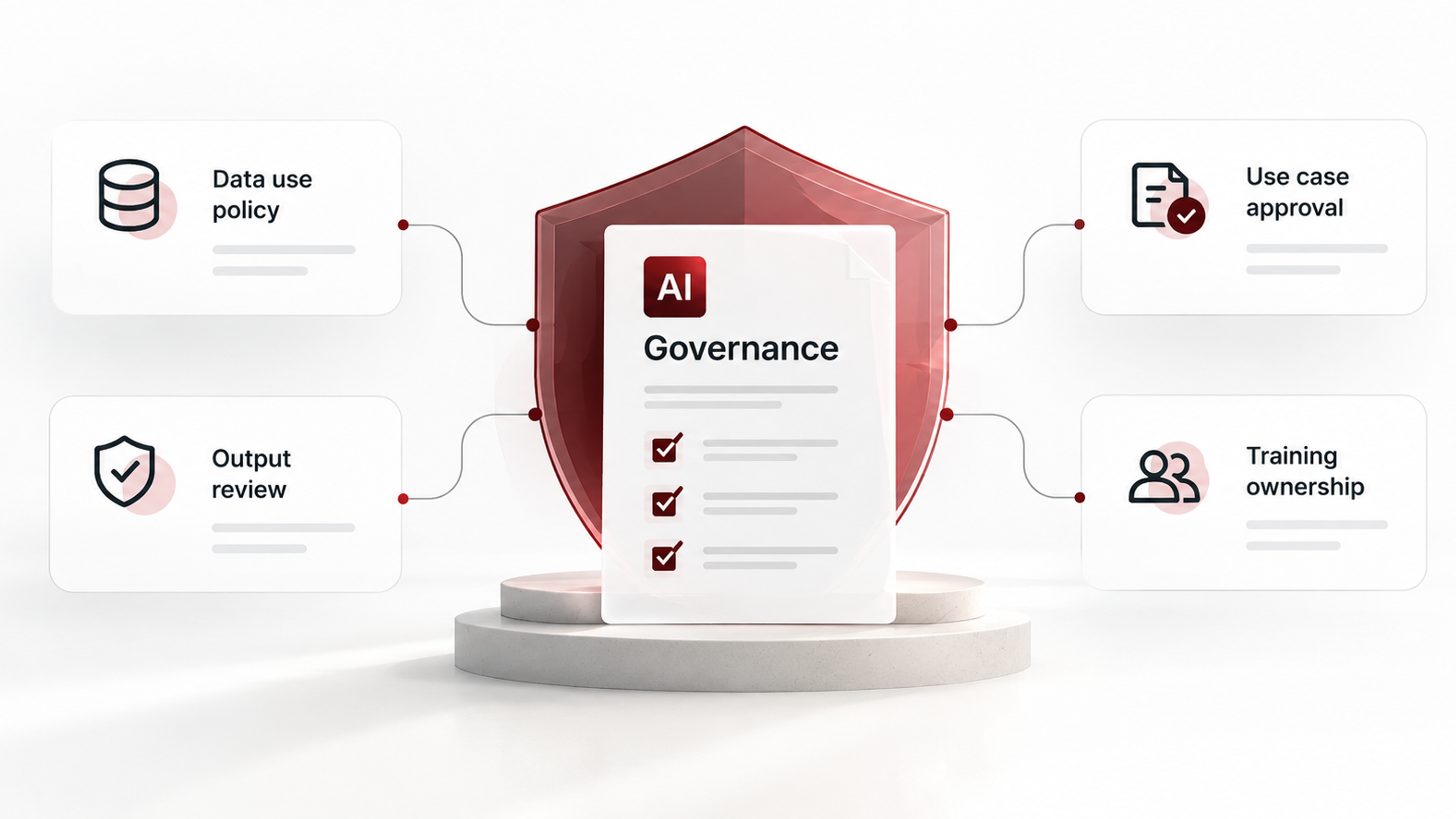
Given how large the governance gap already is, the instinct to finally close it with an exhaustive, carefully worded policy covering every conceivable scenario is understandable and usually counterproductive. A policy that takes a committee eight months to draft, and that staff then need a training session just to understand, arrives too late and gets used too little relative to a shorter document that states clearly which tasks AI can be used for, which it can't, and where staff should ask if they're unsure. Gallup's data on where guidance is weakest is instructive here: grading and feedback is the task with the thinnest guidance of all, with the overwhelming majority of teachers receiving either informal or no guidance specifically on that task. A short policy that addresses the two or three highest-stakes tasks clearly, grading, handling of student data, and use in direct instruction, covers far more practical ground than a lengthy document that tries to anticipate every scenario and ends up vague about the ones that matter most.
Treat student data with the same caution as any other sensitive system
This is the one area where simplicity shouldn't mean casualness. Any AI tool that touches student records, grades, behavioral notes, or personally identifiable information needs to be evaluated against FERPA obligations in the US, or the equivalent student data protection framework elsewhere, before it's adopted, not after a teacher has already started feeding student information into a consumer AI tool that was never vetted for that purpose. The practical risk here isn't abstract: a free AI tool a teacher adopts independently, with no institutional review, may retain or use the data it's given in ways that violate student privacy protections without anyone at the school realizing it until well after the fact.
Keeping this simple doesn't mean skipping it. It means having one clear, short rule, which specific categories of student data are never to be entered into any AI tool that hasn't been specifically reviewed and approved, rather than a lengthy data governance document nobody reads in full. That one rule, communicated clearly and repeated often, does more protective work than a comprehensive policy framework that's technically thorough and practically ignored.
Pilot with volunteers, not a mandate
Rolling out a new AI tool to an entire school or department at once, with everyone required to use it starting a specific date, tends to generate resistance and confusion disproportionate to the actual complexity of the tool itself. A small, voluntary pilot with a handful of interested teachers, run for a defined period with a specific, named task in mind, produces something far more useful: real feedback from people who chose to try it, genuine examples of what worked and what didn't, and a credible internal case for wider adoption built on actual results rather than a mandate issued from the top down before anyone's confirmed the tool is worth using.
This also protects against the specific failure Gallup's broader workload data hints at: roughly half of teachers who've used AI say it hasn't clearly reduced their workload, with meaningful numbers reporting no clear effect either way. A mandate applied broadly before this kind of mixed result is understood risks forcing adoption of a tool that genuinely doesn't help as many people as it should, simply because nobody piloted it narrowly enough first to find out.
A realistic path for an institution starting from nothing
Start by identifying the single most time-consuming, repetitive, non-instructional task causing real frustration right now, whether that's drafting weekly parent communications, generating differentiated practice materials, or summarizing long policy documents for staff meetings. Choose one narrow, well-reviewed tool aimed specifically at that task, rather than evaluating a dozen platforms simultaneously. Run a short, voluntary pilot with a small group of genuinely interested staff, and set a specific point, four to six weeks is often enough, to gather honest feedback on whether it actually saved time and produced usable output.
Write the policy covering this specific use case in a page or less: what the tool is for, what data can never be entered into it, and who to ask with questions. Expand only once this first use case has demonstrated real, specific value, and treat each subsequent expansion the same way, one clear task, one well-chosen tool, a short pilot, a short policy update, rather than attempting a comprehensive institution-wide AI strategy before a single use case has actually proven itself.
Common mistakes that turn a simple opportunity into a complicated one
Committing to a comprehensive platform before piloting a narrow use case. A broad AI education platform purchased on the strength of a sales demo, before any teacher has actually used a narrower tool for a specific task, tends to arrive with far more setup burden and training requirement than the institution actually needed to solve its first real problem.
Writing policy in a vacuum, disconnected from how staff are already using AI. A policy drafted entirely by administrators, with no input from the teachers already experimenting informally, tends to miss the actual points of confusion and friction that matter most, which is part of why so much existing guidance sits unread or ignored: it doesn't reflect the real, specific situations staff are already navigating.
Letting the absence of institutional guidance become the default policy. With over a third of teachers receiving no guidance at all on AI use, the most common actual policy in many schools right now is silence, and silence doesn't prevent risky use, it just leaves each teacher to independently decide where the lines are, often without the information needed to make that call safely, particularly around student data.
Treating every AI use case as equally high-stakes. Applying the same intensive scrutiny to a tool generating practice math problems that you'd apply to one touching student grades or personal data wastes review effort on low-risk applications while potentially under-scrutinizing the genuinely sensitive ones. Calibrating the level of review to the actual stakes of the specific task keeps the process proportionate rather than either reckless or paralyzingly slow everywhere.
Assuming more AI automatically means less workload. Given that roughly half of teachers who've tried AI tools report no clear workload reduction, assuming adoption alone guarantees time savings, without checking whether a specific tool actually reduces effort for a specific task, risks expanding use of something that isn't genuinely helping, simply because it's labeled AI and sounds efficient in principle.
Frequently Asked Questions
Administrative and planning tasks that don't involve direct student data or instruction, drafting routine communications, generating a first pass at practice materials, or summarizing long documents, tend to offer the clearest time savings with the least institutional risk, making them a sensible first pilot.
No, and waiting for one often means staff keep using AI informally with no guidance at all in the meantime. A short, specific policy addressing the highest-stakes concerns, particularly student data handling and grading, covers the most important ground faster than a lengthy, comprehensive document.
Unrestricted individual choice carries real risk, particularly around student data ending up in tools that were never reviewed for that purpose. A middle path, a short, approved list of vetted tools for common tasks, balances flexibility with the oversight that student data protection genuinely requires.
Running a short, defined pilot with a specific group and a clear task, then asking directly whether it saved time and produced usable output, is more reliable than assuming adoption itself proves value. Given that a meaningful share of teachers report no clear workload benefit from AI they've tried, this check matters more than it might initially seem.
Yes, more so than most other classroom applications, which is exactly why most teachers surveyed have avoided handing those specific tasks over to AI tools. Any use touching student records or grades needs clear institutional review against relevant student data protection requirements before adoption, not informal, individual experimentation.