Aditya Chaudhary
Should you build your own AI solution or use a tool someone else has already built?
For most businesses, the honest answer is to start with off-the-shelf tools for common tasks, such as writing assistance, meeting notes, customer support chat or document search, and build something custom only where AI touches a process that is specific to your business, depends on your own data and creates a real competitive advantage. Even then, "custom" rarely means training your own model from scratch. It usually means building an application on top of an existing foundation model, connected to your data and systems.
The choice matters because the costs, risks and timelines are very different. Off-the-shelf tools can be running in days, but they solve generic problems in generic ways and leave you dependent on a vendor's roadmap and data practices. Custom solutions can fit your processes precisely, but they take longer, cost more upfront and need ongoing ownership. Many AI projects that stall do so because the wrong option was chosen for the problem: an expensive custom build for something a standard tool already does well, or a generic tool forced onto a process it was never designed for.
This guide explains the full range of options, when each makes sense, how costs compare over time, the risks on both sides, a practical decision framework and how to get started without over-committing.
The options are a spectrum
"Build or buy" makes the decision sound binary. In practice, there are at least five distinct options, and the right answer is often somewhere in the middle.
AI features in tools you already use. Many business platforms now include AI capabilities: email and document assistants in productivity suites, AI summaries in CRM and help desk software, automated insights in analytics tools. These need little or no setup and work within systems your team already knows.
Standalone off-the-shelf AI tools. These are dedicated products for specific jobs, such as general-purpose AI assistants, transcription and meeting-note tools, AI writing and design tools, customer service chatbots and document processing services. You subscribe, configure and use them as they are.
Configurable AI platforms. Some platforms let you build assistants, chatbots or automated workflows without writing much code, connecting them to your own documents and systems through settings and integrations. They offer more tailoring than a standard tool while avoiding most development work.
Custom applications built on foundation models. Here, developers build software that uses a large language model or other AI model through an API, combined with your data, business rules and systems. The model itself comes from a provider, but the application, the data connections and the user experience are your own. This is what most businesses mean by a custom AI solution today.
Custom-trained or fine-tuned models. At the far end, you adapt a model on your own data through fine-tuning, or train a model from scratch. This is necessary in some specialised cases, such as unique prediction problems with proprietary data, but it is far more demanding in data, expertise and cost.
Moving along the spectrum, control and fit increase, but so do cost, time, required expertise and ongoing responsibility.
When off-the-shelf AI tools are the right choice
Off-the-shelf tools are the right starting point for a large share of business AI needs. They are worth choosing first whenever the following conditions apply.
The task is common across many businesses. Drafting emails and documents, summarising meetings, transcribing calls, answering routine customer questions, translating text, generating first drafts of marketing content and extracting data from standard documents such as invoices are needs shared by thousands of organisations. Vendors serving that market have invested heavily in making their tools reliable and easy to use, and it is rarely sensible to rebuild what they offer.
Speed matters. Most off-the-shelf tools can be trialled within days. That lets you test whether AI actually helps with a task before committing significant money, and start learning how your team works with AI.
You do not have AI expertise in-house. Running a custom AI system involves skills in software engineering, data, security and AI evaluation. Off-the-shelf tools shift much of that responsibility to the vendor.
The process does not differentiate you. If AI is supporting an activity that customers do not see and that works much the same way in every business, such as internal note-taking, a standard tool is usually good enough. Spending heavily to make it slightly better rarely pays back.
Predictable costs are important. Subscription pricing, often per user per month, is easy to budget for, although usage-based pricing for some AI tools can rise with heavy use.
There is also evidence that buying can be the more reliable route for many organisations. The 2025 report from MIT's NANDA initiative on enterprise generative AI, which found that most pilots it studied were producing no measurable financial return, also reported that purchased solutions from specialised vendors succeeded considerably more often than internally built ones. Its methodology has been debated, and results will vary by organisation, but the finding is consistent with the practical reality that building well is harder than it looks.
What to check before choosing a tool
Even when buying, due diligence matters. Check how the vendor handles your data, including whether it is used to train models, where it is stored and how long it is kept. Confirm security credentials such as SOC 2 or ISO 27001, look for single sign-on and admin controls, review integration options with your existing systems and understand the pricing at realistic usage levels. Business and enterprise plans from major AI vendors usually offer stronger data protections than free or consumer versions.
When a custom AI solution makes sense
Custom development becomes worthwhile when AI is applied to something that is specific to your business and where generic tools fall short in ways that matter.
The process is distinctive. If your quoting process involves complex pricing rules, your products require specialist technical knowledge or your operations follow procedures that no standard tool understands, a custom solution can encode that knowledge in ways an off-the-shelf product cannot. Examples include an assistant that drafts technical quotes using your product catalogue and pricing rules, a tool that checks contracts against your organisation's own playbook, or a system that triages maintenance requests using your asset history.
Your data is the advantage. When the value comes from combining AI with proprietary data, such as years of customer interactions, engineering records, inspection images or transaction histories, a custom solution lets you use that data fully, securely and in ways competitors cannot easily copy.
Deep integration is required. Many valuable AI applications need to read from and write to several internal systems, such as a CRM, ERP, document management system and ticketing tool, and to respect detailed permissions. Off-the-shelf tools may offer some integrations, but not always the specific connections, data flows or controls you need.
You need control over data, behaviour or compliance. Regulated industries may need to control where data is processed, how outputs are logged, how decisions are explained and which model versions are used. A custom solution gives you more control over these factors, although it also gives you more responsibility for them.
AI is part of your product. If you are building AI features into a product you sell, using a generic third-party tool rarely provides the experience, branding or economics you need.
Off-the-shelf costs no longer make sense at scale. Per-user or per-transaction pricing that is reasonable for a small team can become expensive at high volumes. At some point, a custom solution using model APIs directly may be more economical, although this calculation should include the full cost of building and running it.
What custom almost never means for most businesses is training a large AI model from scratch. Foundation models from major providers have become so capable that, for most business tasks, it is far more effective to build on them. A well-known illustration is BloombergGPT, a large language model that Bloomberg trained on financial data and announced in 2023. Subsequent independent evaluations suggested that newer general-purpose models matched or outperformed it on many financial tasks, a reminder of how quickly a costly custom model can be overtaken.
The middle path: building on foundation models
Most modern custom AI solutions combine a foundation model from a provider with custom software that adds your data, rules and integrations. Understanding the main building blocks helps you judge proposals and estimate effort.
Prompting and business logic
At the simplest level, a custom application sends carefully designed instructions, known as prompts, to a model through an API, along with the relevant information for each request. Surrounding code applies business rules, validates outputs and handles errors. Much of the quality of a custom AI application comes from this design work rather than from the model itself.
Retrieval-augmented generation
Retrieval-augmented generation (RAG) is the most common way to give a model access to your own information. When a user asks a question, the system searches your documents, databases or knowledge base for relevant material and passes it to the model, which then answers using that material. This lets the model work with current, company-specific information without retraining, and allows answers to cite their sources. The quality of a RAG system depends heavily on the quality and organisation of the underlying content and on respecting access permissions.
Tools, integrations and agents
Models can also be given access to tools, such as the ability to look up an order, check stock, create a ticket or draft an email in a CRM. Systems that let a model decide which tools to use in sequence are often described as AI agents. These can automate multi-step tasks, but they need careful limits on what actions the model can take, especially actions that change data or affect customers.
Fine-tuning
Fine-tuning adjusts a pre-trained model using your own examples so that it follows a particular style, format or specialised behaviour more consistently. It can help with narrow, repetitive tasks, but it requires good-quality training examples, adds cost and must be repeated when you change the underlying model. For many business applications, good prompting and retrieval achieve similar results more cheaply, so fine-tuning is usually worth considering only after those approaches have been tried.
Evaluation and monitoring
Custom AI systems need ways to measure whether they are working: test sets of realistic questions with known good answers, checks for accuracy and safety, human review of samples and monitoring of real usage. Without evaluation, it is impossible to know whether changes, including changes the model provider makes, have improved or worsened results.
Comparing costs over time
Off-the-shelf and custom solutions have very different cost shapes. Off-the-shelf tools are cheap to start but often scale with the number of users or volume of use. Custom solutions cost more upfront but can have lower running costs per user at scale. Comparing them fairly means looking at total cost over several years, not just the first invoice.
What goes into each
For an off-the-shelf tool, costs typically include subscription fees per user or per usage, any premium tiers needed for security or integration features, configuration and setup time, training and change management, and the internal time spent managing the vendor.
For a custom solution, costs include design and development, data preparation and integration work, model API usage, which is usually charged by the amount of text processed, hosting and infrastructure, security and compliance work, evaluation and testing, and ongoing maintenance. That maintenance is substantial: model providers update and retire models, integrations change, and prompts and retrieval need tuning as usage grows. A custom AI system is never truly finished.
An illustrative comparison
Consider a simplified, hypothetical example. A business wants an AI assistant for its customer support team. An off-the-shelf add-on costs $40 per user per month, plus $5,000 to set up. A custom assistant, connected to the business's own knowledge base and order system, costs $60,000 to build and around $15,000 a year to run and maintain, rising to $30,000 a year at higher volumes. The figures are illustrative, not quotes.
With 50 support staff, the off-the-shelf tool costs about $77,000 over three years, while the custom solution costs about $105,000. Buying is cheaper. With 150 staff, the off-the-shelf tool costs about $221,000 over three years, while the custom option, with higher running costs, comes to about $150,000. At that scale, building becomes cheaper, even before considering any extra value from closer integration.
The example is simplified. It ignores differences in quality, the time it takes to build, the risk of the custom project running over and the possibility that the vendor changes its pricing. But it illustrates why scale and time horizon are central to the decision.
Risks to weigh on each side
Neither approach is risk-free. The risks are simply different, and the right choice depends on which ones your business is better placed to manage.
Risks of off-the-shelf tools
Data exposure. Using a third-party tool means sending your data to that vendor. Consumer and free tiers may have looser terms about retention and model training than business plans. Check where data goes, how it is used and whether staff are using unapproved tools with company information.
Poor fit. Generic tools may handle 80 percent of a task well and fail on the 20 percent that matters most to your business, leaving staff to work around them.
Vendor dependency. Your experience depends on the vendor's roadmap, pricing and continued existence. Many AI tools are young businesses in a fast-moving market. Prices can change, features can disappear and some vendors will not survive.
Limited control over quality. You often cannot see or adjust how the tool reaches its answers, which can be a problem for regulated or customer-facing uses.
Risks of custom solutions
Delivery risk. Custom AI projects can take longer and cost more than planned, and some never reach production. Gartner predicted in 2024 that at least 30 percent of generative AI projects would be abandoned after proof of concept by the end of 2025, citing issues including poor data quality, inadequate risk controls, escalating costs and unclear business value.
Ongoing ownership. Someone must maintain the system, monitor quality, update it when models change and fix problems. Without a clear owner, custom solutions degrade.
Accuracy and accountability. You are directly responsible for what your custom AI says and does. When Air Canada's website chatbot gave a customer incorrect information about bereavement fares, a Canadian tribunal ruled in 2024 that the airline was responsible for the chatbot's statements. The same principle applies to any AI system a business deploys, custom or bought, but with a custom system there is no vendor to share the work of testing and safeguarding.
Model provider dependency. Building on a foundation model still creates dependency on that provider. Designing the application so the underlying model can be swapped reduces this risk.
Risks common to both
Regulation applies whichever route you take. Data protection laws such as the UK GDPR and EU GDPR apply when AI processes personal data, and the EU AI Act places obligations on both providers and deployers of AI systems, with the heaviest requirements for high-risk uses such as recruitment and credit decisions. Using an off-the-shelf tool does not transfer your own obligations as a deployer to the vendor.
A decision framework
A handful of questions usually point clearly towards the right option. Work through them for each AI use case separately, because a business may sensibly buy for some needs and build for others.
How specific is the process? If the task is common across many businesses, such as summarising meetings or drafting general content, start with off-the-shelf tools. If it depends on your particular products, rules or expertise, a custom or configured solution becomes more attractive.
How much does your own data matter? If the AI needs only general knowledge, a standard tool is likely to be enough. If its value depends on proprietary information, such as your product catalogue, past cases or internal procedures, you will need retrieval from your own data, either through a configurable platform or a custom build.
Is it a source of competitive advantage? Build where AI helps you do something better than competitors in ways customers notice. Buy for everything else.
What integration is needed? Light integration, such as connecting to email or cloud storage, is often available in off-the-shelf tools. Deep, two-way integration with several internal systems usually points towards custom development.
What are the data and compliance constraints? Highly sensitive or regulated data may require tighter control over where data goes and how outputs are logged and reviewed. Check whether an enterprise plan from a trusted vendor meets your requirements before assuming you must build.
What scale and time horizon are involved? Small teams and short time horizons favour buying. Large user numbers, high volumes and long-term use can make building more economical.
What capability do you have? Custom AI needs product ownership, engineering, data and security skills, either in-house or through a partner, plus someone to own the system after launch. Without that capacity, buying or configuring is usually safer.
Getting started without over-committing
The build-or-buy decision does not have to be made all at once. A staged approach reduces risk and produces evidence before large sums are committed.
1.Start with the problem, not the technology
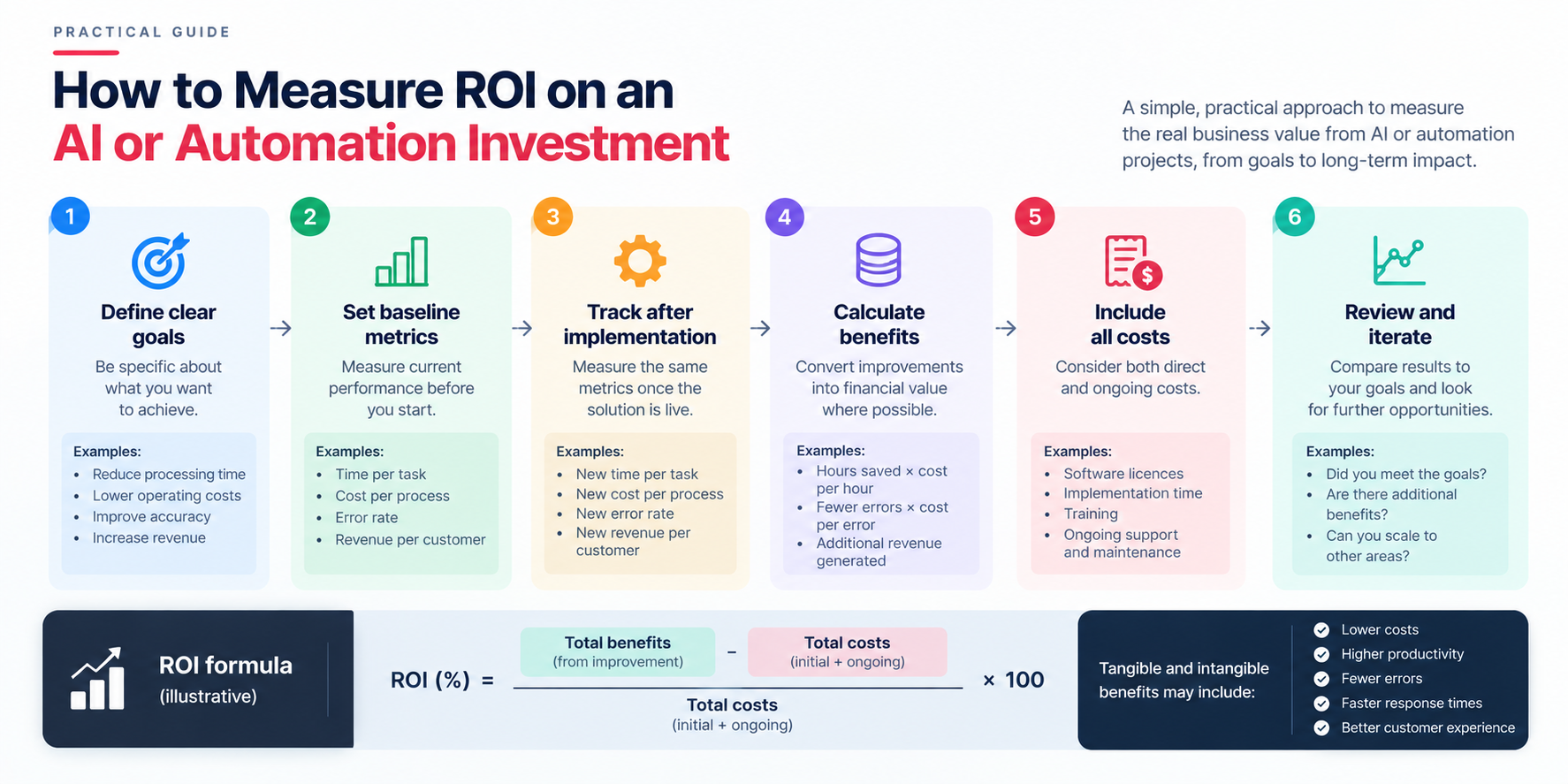
Define the business problem in concrete terms: what task takes too long, costs too much, produces errors or limits growth, and how you will measure improvement. A clear problem makes it much easier to judge whether a standard tool is good enough.
2.Try off-the-shelf options first
For most use cases, trial one or two off-the-shelf or configurable tools with a small group of real users and real tasks for a few weeks. Measure the results against a baseline. Even if you eventually build, this trial shows what good looks like, where generic tools fall short and what users actually need.
3.Build a focused prototype if needed
If off-the-shelf tools clearly fall short in ways that matter, build a small prototype of a custom solution focused on the most valuable part of the problem. Test it with real users and real data, measure accuracy and time saved and identify the integration and data work that a full version would need.
4.Decide with evidence
Compare the trial and prototype results, costs and risks before committing to a full build. Consider a hybrid: an off-the-shelf tool for general use, combined with a custom component for the specific workflow that justifies it.
5.Design for change
AI tools and models change quickly. Whichever route you choose, avoid locking yourself in more than necessary. Keep your own data in formats you control, document prompts, rules and integrations, and, for custom solutions, design the application so the underlying model can be replaced. Review the decision periodically, because a tool that was the right choice a year ago may no longer be.
Common mistakes
Building what you could buy. Custom development for a common task, such as meeting summaries or general writing help, usually costs more and works less well than mature off-the-shelf tools. Reserve custom work for what genuinely differentiates you.
Buying a tool that does not fit the process. Forcing a generic tool onto a specialist workflow leads to workarounds, low adoption and staff quietly returning to old methods.
Assuming custom means training a model. For most businesses, a custom solution means a well-designed application on top of a foundation model, not a model trained from scratch. Training your own model is expensive and is often overtaken by better general models.
Underestimating data work. Custom AI that depends on your documents and systems is only as good as that data. Poorly organised content, outdated documents and loose permissions undermine results and create risks.
Forgetting ongoing costs. Model usage, hosting, monitoring, maintenance and updates continue for as long as the system runs. Budget for them from the start.
Skipping evaluation. Without test sets and regular quality checks, you cannot tell whether a custom system is accurate, or whether a vendor update has changed an off-the-shelf tool's behaviour.
Letting staff use unapproved tools. When approved options are missing or poor, staff often turn to free consumer AI tools, sending company data outside your control. Providing suitable approved tools, with clear guidance, is part of the solution.
Making the decision once for everything. The right answer varies by use case. Most businesses end up with a mix of off-the-shelf tools for general needs and targeted custom solutions where they create real value.
If you are weighing up whether to build or buy, it helps to talk to a partner who is willing to recommend an off-the-shelf tool when that is the better answer. An experienced AI and automation partner can assess your use cases, test existing tools, prototype custom solutions where they make sense and help you build something maintainable when you do decide to build.
Frequently Asked Questions
For common tasks, buying is usually better: off-the-shelf tools are quicker, cheaper to start and maintained by specialists. Building makes sense when AI is applied to a process specific to your business, depends on your proprietary data, needs deep integration with your systems or creates competitive advantage. Many businesses do both, for different use cases.
Costs vary widely with scope, integrations, data preparation and compliance requirements. A focused prototype may be relatively modest, while a production system connected to several business systems costs considerably more. Remember to include ongoing costs, such as model usage, hosting, monitoring and maintenance, which continue for as long as the system runs.
Rarely. Most custom business AI applications are built on existing foundation models from major providers, combined with your data through retrieval, carefully designed prompts and integrations. Fine-tuning or training your own model is usually justified only for specialised tasks with large amounts of suitable proprietary data.
Retrieval-augmented generation, or RAG, is a technique in which an AI system searches your own documents or data for relevant information and gives it to a language model, which uses it to answer a question or complete a task. It allows AI to work with current, company-specific information without retraining the model.
Many are, particularly business and enterprise plans from established vendors, which typically offer stronger commitments on data use, security and retention. Check each tool's terms, security certifications and admin controls, and avoid using free consumer tools for sensitive company or customer information.
A focused prototype can often be built in a few weeks. A production-ready system with integrations, security, evaluation and user testing commonly takes several months, depending on complexity and data readiness. Off-the-shelf tools can usually be trialled in days.