Gourav Dhiman
If your business uses AI in any form, from a chatbot on your website to a staff member pasting customer emails into a writing assistant, you are already making decisions about data privacy and ethics. The only question is whether you are making them deliberately.
The core of what business owners need to understand is simpler than the headlines suggest. Existing data protection law, such as the GDPR in the UK and Europe, already applies to AI whenever personal data is involved. New AI-specific rules, led by the EU AI Act, add obligations based on how risky a particular use of AI is. And beyond the law, customers, employees and partners increasingly judge businesses on whether they use AI fairly and openly. You are responsible for all of this even when the AI comes from a third-party vendor.
This guide explains where the real risks sit in a typical business, which laws are likely to apply to you, what ethical AI looks like in practice, how to vet AI tools before you adopt them, and how a smaller organisation can put sensible governance in place without a legal department. It is a practical overview, not legal advice. For decisions with significant legal consequences, speak to a qualified data protection or technology lawyer.
Why AI ethics and privacy are business issues, not just technical ones
It is easy to treat AI ethics as an abstract debate for technology companies and regulators. A handful of well-documented cases show why it lands squarely on ordinary businesses.
In 2023, Samsung restricted staff use of generative AI tools after reports that employees had pasted confidential source code and internal meeting notes into ChatGPT. No hacker was involved. Well-meaning staff simply used a convenient tool without understanding where the data went. Most businesses face exactly the same risk.
In early 2024, a Canadian tribunal ruled against Air Canada after its website chatbot gave a customer incorrect information about bereavement fares. The airline argued, in effect, that the chatbot was responsible for its own statements. The tribunal disagreed and held the company liable. The lesson for any business deploying a customer-facing AI tool is clear: what your AI says on your behalf is treated as what you said.
In the United States, the Federal Trade Commission banned the pharmacy chain Rite Aid from using facial recognition technology for surveillance for five years, following findings that its system had falsely flagged customers as shoplifters, with errors falling disproportionately on certain groups. In a separate case, the Equal Employment Opportunity Commission settled with tutoring company iTutorGroup in 2023 over hiring software that automatically rejected older applicants. Both cases show that unfair outcomes from automated systems can be treated as the business's own discrimination.
European data protection authorities have also shown they will act against AI providers. Italy's regulator temporarily blocked ChatGPT in 2023 and later fined OpenAI 15 million euros over data protection failures. Several European regulators have fined the facial recognition company Clearview AI for scraping images of people without a lawful basis.
The pattern is consistent. Regulators and courts are not creating special excuses for AI. They are applying existing principles of responsibility, fairness and transparency, and the business that deploys the tool carries the consequences.
There is a security angle too. IBM's 2025 Cost of a Data Breach report found that a meaningful minority of organisations had already experienced security incidents involving AI models or applications, and that most of those lacked proper access controls for AI. It also highlighted "shadow AI", meaning tools used by staff without approval, as a factor that added to breach costs.
Where AI creates privacy risk inside a typical business
Most privacy problems with AI do not come from futuristic systems. They come from everyday data moving to places nobody planned for. It helps to follow the data through four stages.
What goes in
The first risk is the information people feed into AI tools. Staff paste customer emails into chat assistants to draft replies, upload spreadsheets for analysis, record meetings for automatic transcription and drop contracts into summarisers. Each of these may involve personal data, confidential business information or both. If the tool is a free consumer version, the terms may allow the provider to retain that data or use it to improve its models. Business and enterprise plans from the major providers generally offer stronger commitments, such as not training on your data by default, but the details differ and need checking.
Where it is processed and stored
The second stage is where the data goes once submitted. AI services may process data in other countries, rely on sub-processors and keep logs for set periods. Under the GDPR, sending personal data outside the UK or European Economic Area requires appropriate safeguards. You need to know which provider holds the data, where, for how long and who else can access it.
How it is used to train or improve models
The third stage is training. If your data is used to train or fine-tune a model, it can become difficult or impossible to fully remove later. This matters for the right to erasure under the GDPR and for confidentiality more generally. Businesses building their own models, or customising existing ones with company data, need a clear lawful basis and should minimise the personal data involved.
What comes out
The final stage is output. AI systems can generate inaccurate statements about real people, reveal information from their inputs in unexpected ways, or make inferences that are themselves sensitive, such as guessing someone's health status or financial difficulty from their behaviour. Outputs used to make decisions about people, such as screening job applicants or assessing creditworthiness, carry the highest legal and ethical stakes.
The laws that apply to business use of AI
AI regulation is moving quickly, and the details depend on where you operate and where your customers are. The following overview covers the frameworks most relevant to businesses in the UK, Europe and the United States. Check current guidance before relying on any specific date, because several timelines have been revised.
Data protection law already covers AI
The most important point is that you do not have to wait for AI-specific laws. If an AI system processes personal data, data protection law applies now. In the UK this means the UK GDPR and the Data Protection Act 2018, as amended by the Data (Use and Access) Act 2025. In the EU it means the GDPR.
Several GDPR principles are particularly relevant. You need a lawful basis for processing, such as consent, contract or legitimate interests. You must tell people how their data is used, including when AI is involved. You should collect and use only the data you actually need. You must keep data accurate and secure, and respect individuals' rights to access, correct and delete their information.
Two provisions deserve special attention. Article 22 of the GDPR restricts decisions based solely on automated processing that have legal or similarly significant effects on people, such as rejecting a loan or job application without human involvement. The UK's 2025 reforms relaxed these restrictions somewhat, but kept requirements for safeguards such as the right to human review and to contest a decision, with stricter rules where sensitive data is involved. Second, a Data Protection Impact Assessment (DPIA) is required for processing likely to result in high risk to individuals, and regulators such as the UK Information Commissioner's Office (ICO) generally expect one for many uses of AI involving personal data. The ICO publishes detailed guidance on AI and data protection that is worth reading.
Fines under the GDPR can reach 20 million euros or 4 percent of global annual turnover, whichever is higher, although most enforcement against smaller businesses involves lower penalties, reprimands or orders to change practices.
The EU AI Act
The EU AI Act entered into force in August 2024 and is being phased in. It applies to businesses outside the EU too, if they place AI systems on the EU market or their AI outputs are used in the EU.
The Act sorts AI uses by risk. A small number of practices are banned outright, including manipulative techniques that cause harm, social scoring and, with limited exceptions, certain uses of biometric identification. Those prohibitions have applied since February 2025, alongside a requirement for businesses to ensure staff using AI have a sufficient level of AI literacy.
High-risk uses face the heaviest obligations. These include AI used in recruitment and worker management, access to education, creditworthiness assessment and access to essential services, among other areas. Obligations cover risk management, data quality, documentation, human oversight, accuracy and cybersecurity. Most of these were originally scheduled to apply from August 2026, but the European Commission has proposed delaying some of them, so confirm the current timetable.
Limited-risk uses carry transparency duties. People should be told when they are interacting with a chatbot, and certain AI-generated or manipulated content, such as deepfakes, must be labelled. Most everyday business tools, like spam filters or AI used for internal drafting, fall into the minimal-risk category with no specific new obligations, although data protection law still applies.
Penalties for the most serious breaches can reach 35 million euros or 7 percent of global turnover, with lower caps and proportionate treatment for smaller businesses.
The UK approach
The UK has not passed a single AI law equivalent to the EU AI Act. Instead, it relies on existing regulators, including the ICO, the Financial Conduct Authority and the Competition and Markets Authority, to apply principles such as safety, transparency, fairness, accountability and contestability within their own areas. For most UK businesses, data protection law and sector rules are the main practical constraints. UK businesses selling into the EU may also fall within the EU AI Act.
The United States
The US has no comprehensive federal AI or privacy law. Instead, businesses face a mix of federal enforcement and state legislation. The Federal Trade Commission has made clear it will treat deceptive claims about AI and unfair uses of AI as violations of existing consumer protection law. Employment discrimination law applies to hiring tools. New York City requires bias audits for automated employment decision tools. A growing number of states have comprehensive privacy laws with rights relating to automated decision-making or profiling, California has adopted regulations on automated decision-making technology, and Colorado has passed a broader AI law aimed at high-risk systems, with its start date pushed back. Expect this picture to keep changing.
Ethics beyond compliance: what responsible AI looks like in practice
Legal compliance sets the minimum. Ethical use of AI is about the wider question of whether your use of the technology is fair to the people it affects and whether you would be comfortable explaining it to them. In practice, four themes matter most.
Fairness and bias
AI systems learn patterns from data, and if that data reflects past inequalities, the system can repeat or amplify them. A widely reported example is Amazon's experimental recruitment tool, which the company abandoned after finding it downgraded CVs that included indicators associated with women, because it had learned from a decade of applications dominated by men.
For a smaller business, the risk usually arises through bought-in tools rather than models you build yourself. If you use AI to screen applicants, prioritise customer enquiries, set prices or assess risk, ask the vendor how the system was tested for bias, against which groups, and with what results. Then check outcomes yourself. Look at who is being accepted, rejected or flagged, and whether any pattern would be hard to justify.
Transparency
People generally have a right to know when AI is being used in ways that affect them, and many expect it. Tell customers when they are talking to a chatbot rather than a person. Explain in your privacy notice, in plain language, where AI is used and what data it relies on. Where AI contributes to a significant decision about someone, be ready to explain the main factors behind it.
Transparency also applies internally. Staff should know which AI tools are approved, what data they may use with them and why the rules exist.
Human oversight and accountability
AI can draft, sort, summarise and recommend. It should not be left to make important decisions about people unchecked. Meaningful human oversight means the person reviewing an AI output has the authority, time and information to disagree with it. A manager who signs off hundreds of AI recommendations a day without reading them is not providing oversight.
Accountability means a named person in the business owns each AI system: they understand its purpose, know its limitations and are responsible for its outcomes. The Air Canada case is a reminder that "the AI did it" is not a defence.
Accuracy and honesty
Generative AI tools can produce confident, plausible and wrong answers. Any content that reaches customers, such as product descriptions, advice, contract terms or support responses, should be checked by someone qualified to spot errors. Be careful about marketing claims too. Describing a product as "AI-powered" when it is not, or overstating what an AI feature can do, can attract regulatory attention. The FTC in particular has taken action against misleading AI claims.
These themes are reflected in recognised frameworks that businesses can draw on, including the OECD AI Principles, the US NIST AI Risk Management Framework and the international standard ISO/IEC 42001 for AI management systems. A small business does not need certification to ISO/IEC 42001, but the frameworks offer useful structure and vocabulary.
How to vet AI vendors and tools before you adopt them
Most businesses buy AI rather than build it, whether as standalone tools or as features inside software they already use. Your CRM, help desk, accounting package and video conferencing platform may all have added AI features in the past year, sometimes switched on by default. That makes vendor due diligence one of the most effective controls you have.
Before approving a tool, get clear answers to a short set of questions. The first concerns training: will the vendor use your data, or your customers' data, to train or improve its models, and can you opt out in writing? The second concerns retention: how long are inputs, outputs and logs kept, and can you delete them? The third concerns location: where is data processed and stored, which sub-processors are involved, and what safeguards cover international transfers?
Ask about security too. Look for independent evidence such as ISO/IEC 27001 certification or a SOC 2 Type II report, and check whether the tool supports single sign-on, multi-factor authentication and role-based access. For tools that make or support decisions about people, ask how the system was tested for accuracy and bias, what documentation is available, and how a human can review or override its outputs.
Finally, review the contract. If the vendor processes personal data on your behalf, you need a data processing agreement. Check who is liable if the AI produces harmful or infringing output, and whether the vendor offers any indemnity, for example against copyright claims. Note how much notice you will get of significant changes to the model or terms.
Pay particular attention to the difference between free and paid plans. Consumer versions of popular AI tools often have looser data terms than business editions. A staff member using a personal account for work may unknowingly agree to terms your business would never accept.
A practical AI governance framework for smaller businesses
AI governance sounds like something only large companies can afford. In reality, a small or medium-sized business can cover most of the ground with a few documents, a named owner and a regular review. The aim is to know what AI you use, use it within clear rules and catch problems early.
1.Take an inventory
Start by listing every AI tool and AI feature in use across the business, including those built into existing software and those staff use on their own initiative. A short anonymous survey often uncovers far more than managers expect. For each one, record what it does, who uses it, what data it touches and who owns the relationship with the vendor.
2.Classify by risk
Sort the inventory into simple tiers. Low-risk uses involve no personal or confidential data, such as brainstorming marketing ideas or summarising public reports. Medium-risk uses involve personal or confidential data but no significant decisions about people, such as drafting customer replies or transcribing meetings. High-risk uses influence decisions with real consequences for people, such as hiring, performance management, credit, pricing for individuals or access to services. Apply more scrutiny as you move up the tiers.
3.Write a short AI use policy
A useful policy is often two or three pages, not twenty. It should list approved tools, state clearly what data may and may not be entered into them, require human review of AI output before it reaches customers or informs important decisions, explain how to request approval for a new tool, and say who to contact with concerns. Plain language will get far better compliance than legal wording.
4.Assess the higher-risk uses properly
For medium- and high-risk uses involving personal data, complete a Data Protection Impact Assessment. The ICO and other regulators publish templates. The assessment should describe the processing, explain why it is necessary, identify risks to individuals and record the measures you will take to reduce them. For high-risk uses, include bias testing and a clear route for people to challenge decisions.
5.Update your privacy notices and contracts
Make sure your privacy notice explains how AI is used with personal data in terms a customer would understand. Put data processing agreements in place with AI vendors, and check that your customer contracts and terms reflect any AI-generated deliverables.
6.Train your people
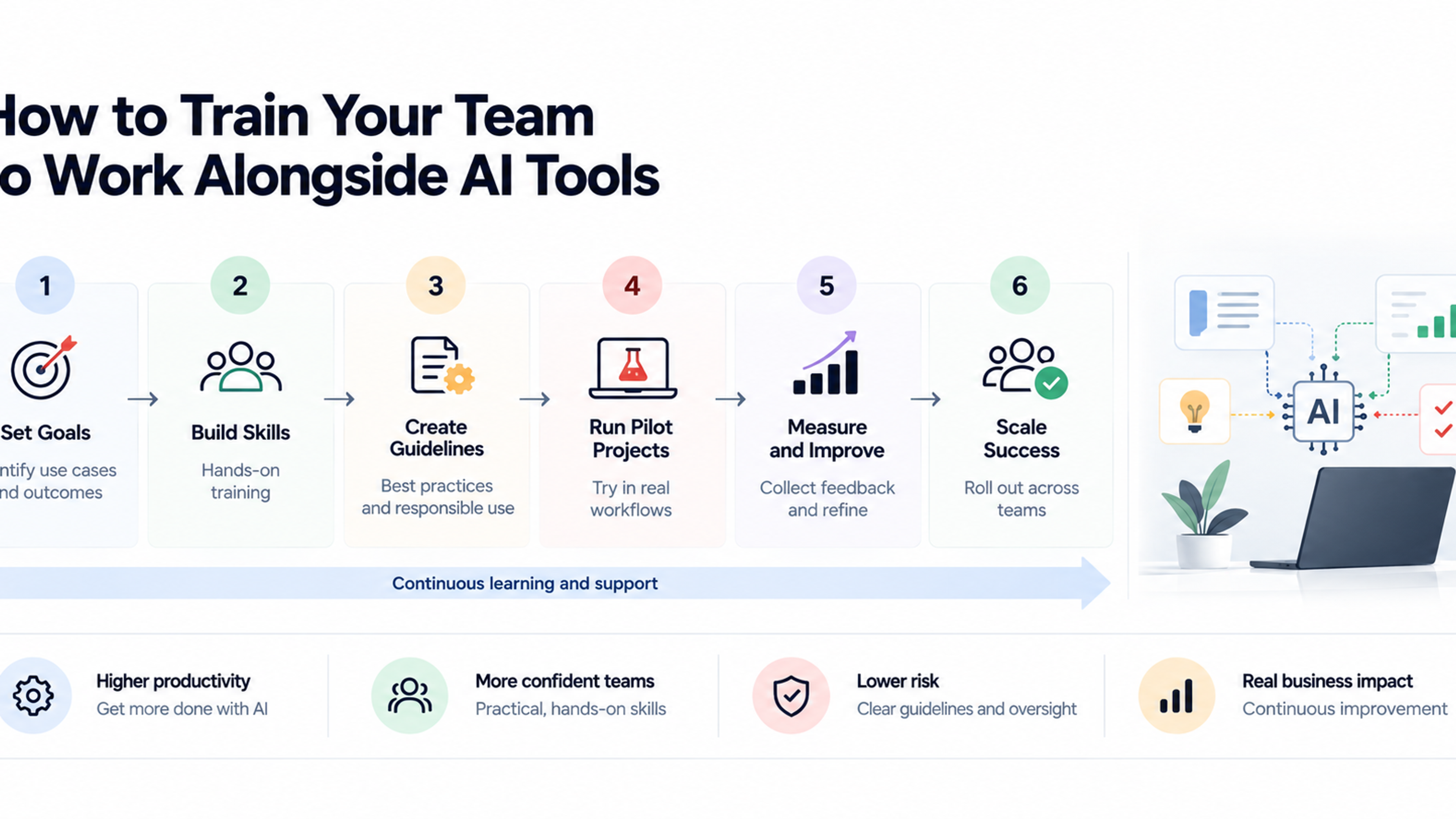
Most AI privacy incidents start with a person, not a system. Short, practical training on what the policy says and why it matters is worth more than any technical control. Under the EU AI Act, businesses using AI already have a duty to take measures to ensure sufficient AI literacy among their staff, so this is increasingly a legal expectation as well as good practice.
7.Review regularly
AI tools and the rules around them change quickly. Review your inventory, policy and high-risk assessments at least every six to twelve months, and whenever you adopt a significant new tool or a vendor changes its terms.
If you are planning to automate processes that involve customer or employee data, it is worth building these checks into the project from the start. Experienced AI and automation partners will treat privacy and governance as part of the design, which is far cheaper than retrofitting them later. (Internal link suggestion: an AI solutions or business automation services page, or a guide to planning an AI automation project.)
Common mistakes business owners make with AI and data
Banning AI instead of governing it. Outright bans rarely work. Staff who find AI useful tend to keep using it on personal devices and accounts, which pushes the activity out of sight and makes the risk worse. Approving a small set of business-grade tools with clear rules is usually safer than prohibition.
Assuming the vendor carries the responsibility. Under data protection law, your business is usually the controller for the personal data it puts into a tool, which means you remain accountable for how it is used. A vendor's marketing about being "secure" or "compliant" does not transfer that responsibility.
Missing AI features that arrive quietly. Software updates regularly add AI capabilities to existing products. Review the release notes and admin settings of your main platforms, and decide deliberately whether to switch new features on.
Treating the privacy notice as a one-off document. If you introduce AI into customer-facing processes, such as automated support, personalised offers or call analysis, your privacy information needs to reflect it. Customers who discover undisclosed AI use often react badly, even when the use itself was lawful.
Relying on AI for decisions it cannot justify. If you cannot explain why an AI tool reached a decision about a person, you will struggle to defend that decision to the person, a regulator or a court. Keep humans in the loop for anything consequential, and make sure they have the information to overrule the system.
Uploading more data than the task needs. A support assistant rarely needs a customer's full history, and an analysis tool rarely needs names alongside the numbers. Removing or masking personal details before data reaches an AI tool is one of the simplest ways to reduce risk.
Frequently Asked Questions
It can be, but only if you have a lawful basis, your privacy notice covers it, the tool's terms and security are appropriate, and you have a data processing agreement where the provider acts on your behalf. Business and enterprise plans are generally more suitable than free consumer accounts. If in doubt, remove personal details before using the tool.
It can. The Act applies to providers that place AI systems on the EU market and to deployers using AI in the EU, and it can also apply where the output of an AI system is used in the EU. A UK or US business serving EU customers with AI-driven products or decisions should check whether it falls within scope.
You need one when processing is likely to result in high risk to individuals. Regulators consider many AI uses involving personal data, particularly profiling, automated decisions and new technologies, to meet that threshold. Even when it is not strictly required, a DPIA is a practical way to think through the risks.
You can, but it is one of the highest-risk uses. Recruitment AI is classed as high-risk under the EU AI Act, automated decisions are restricted under data protection law, and employment discrimination law applies regardless of whether a human or software made the decision. Keep meaningful human review, test for bias and tell candidates how AI is used.
In most cases, the business that deployed the tool is responsible to its customers, and regulators will look to it first. You may have a contractual claim against the vendor, depending on your agreement, but that does not remove your responsibility to the people affected.
Find out which AI tools are already being used and what data goes into them. That inventory will show you where the real risks are and makes writing a short, practical policy much easier.