

 Gourav Dhiman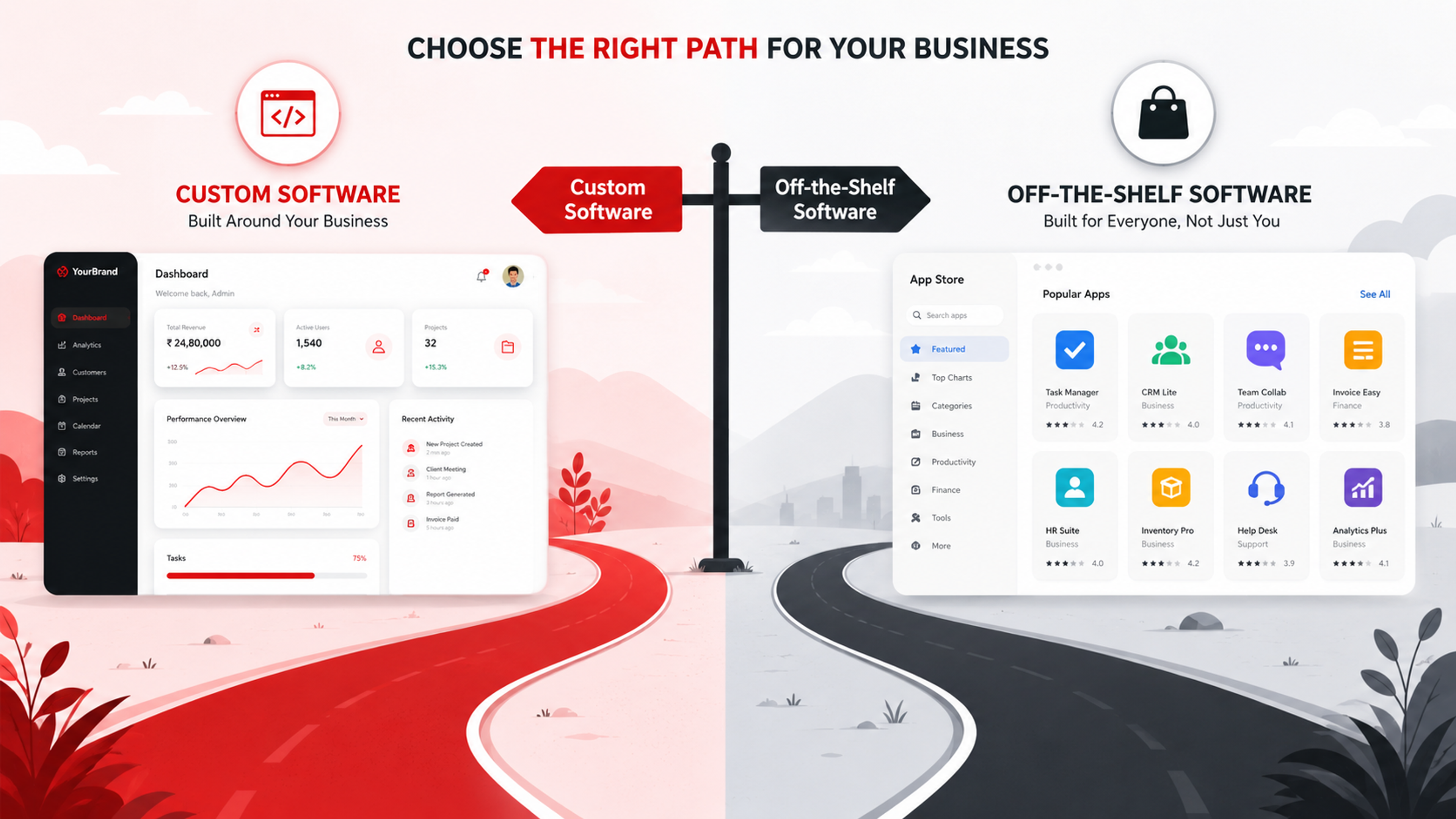
Every growing business eventually hits the same wall. The spreadsheets stop working. The off-the-shelf tool you started with three years ago now feels like it's holding you back instead of helping you move forward. And someone in a leadership meeting finally asks the question out loud: should we build our own software, or should we just buy something better?
It's a bigger decision than it looks. Get it right, and you save years of frustration and unlock real efficiency. Get it wrong, and you either overspend on a custom build you didn't need, or you spend years fighting a rigid system that was never built for your business in the first place.
This guide gives you a complete, practical framework for making that decision with confidence, not guesswork.

The Real Problem Behind This Decision
Most businesses don't wake up one day and decide to build custom software for fun. The decision usually gets forced by one of a few specific pains:
- The current tool doesn't do something the business genuinely needs, and there's no workaround left.
- The team is stitching together five different tools with manual data entry between them.
- Licensing costs have grown so much with headcount that the "affordable" SaaS tool no longer feels affordable.
- The business model itself is unusual enough that no existing software fits it well.
If none of these apply to you yet, that's actually useful information. It might mean you're not at the decision point yet, and that's fine. This framework will help you figure out exactly where you stand.
What's the Actual Difference?
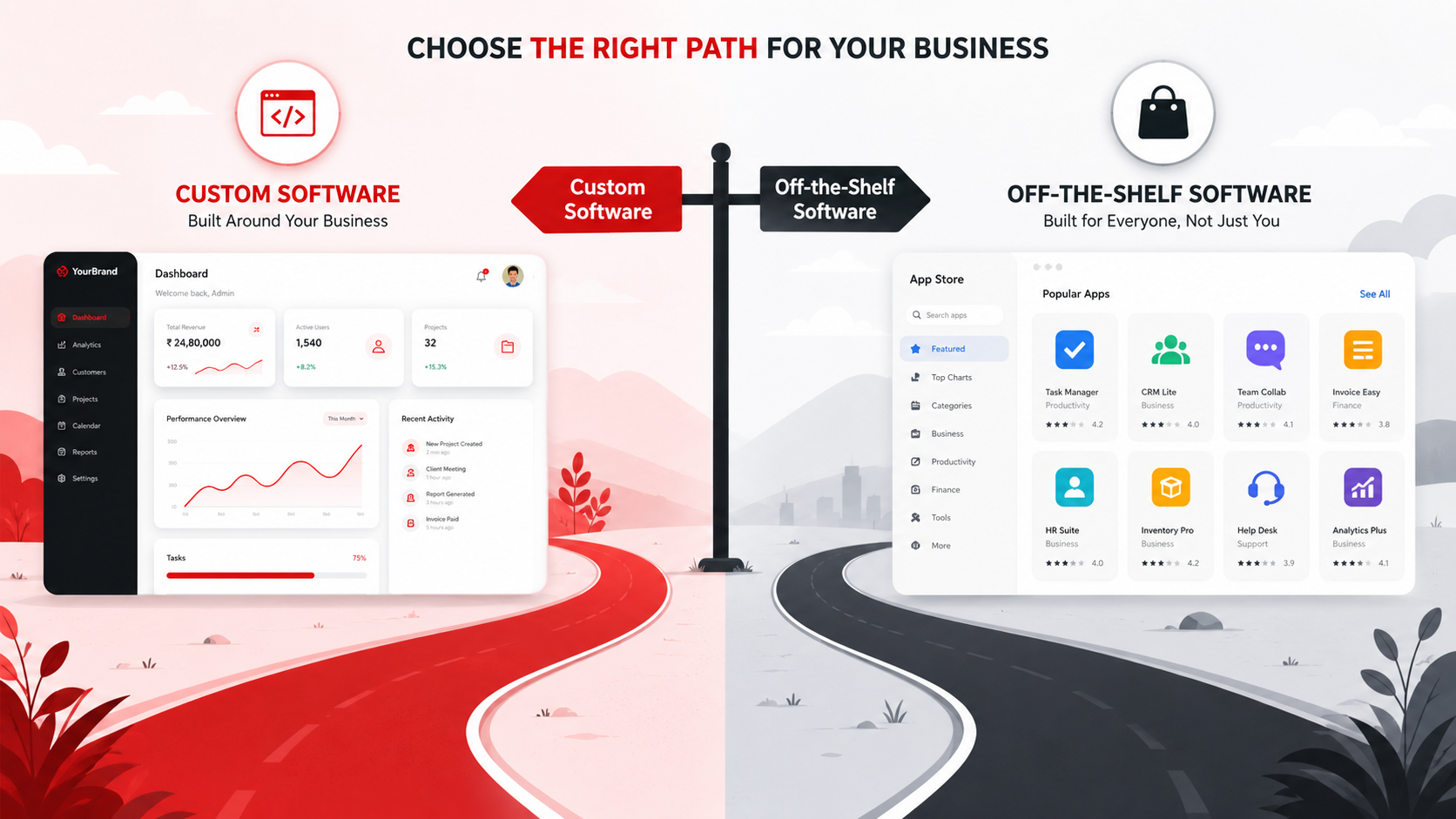
Off-the-shelf software is a pre-built product designed to serve many businesses at once. Think Zoho CRM, QuickBooks, Shopify, or Salesforce. You sign up, configure some settings, and start using it, usually within days.
Custom software is built specifically for your business, your workflows, and your data. It can look and function exactly the way your team needs, but it takes real time and investment to design, build, test, and maintain.
Neither one is universally better. The right choice depends entirely on your business stage, your budget, how unique your operations really are, and how much control you need over the system long term.
Off-the-Shelf Software: The Honest Pros and Cons
Advantages
Speed to launch. You can be up and running the same day. There's no development timeline to wait through.
Lower upfront cost. Most SaaS tools use a monthly or annual subscription model, which spreads cost out and avoids a large initial investment.
Proven and tested. These tools have already been used by thousands of businesses, so major bugs are usually already fixed, and the interface has already been refined through real-world use.
Regular updates included. The vendor handles maintenance, security patches, and new features, so your team doesn't need to manage any of that.
Disadvantages
Limited flexibility. You're working within someone else's design decisions. If your workflow doesn't match the tool's assumptions, you either adapt your process to the software or find a workaround.
Feature bloat or feature gaps. Off-the-shelf tools try to serve a broad market, so you often pay for features you never use, while still missing the one feature you actually need.
Recurring costs that scale with usage. Many SaaS pricing models charge per user or per transaction. As your business grows, the monthly bill can grow faster than you expect.
Data portability concerns. Moving away from a platform later, if you ever need to, can be difficult if your data is tightly locked into their format.

Custom Software: The Honest Pros and Cons
Advantages
Built around your actual workflow. The software adapts to how your business works, not the other way around.
Full ownership. You own the code, the data structure, and the roadmap. No vendor can suddenly change pricing or discontinue a feature you rely on.
Scalable on your terms. As your business grows, you can extend the system exactly where you need to, without waiting for a vendor's product roadmap to catch up.
Competitive advantage. If your workflow genuinely differs from your competitors, custom software can become a real operational edge that off-the-shelf tools simply can't replicate.
Disadvantages
Higher upfront investment. Custom development requires a real budget and a real timeline, typically weeks to months depending on scope.
You own the maintenance responsibility. Updates, security patches, and bug fixes become your responsibility, usually handled through an ongoing relationship with your development partner.
Requires clear planning. Vague requirements lead to scope creep, delays, and budget overruns. Custom software rewards businesses that can clearly define what they need.
Slower to launch. You won't be using the system tomorrow. Depending on complexity, a functional first version can take anywhere from six weeks to several months.
The Real Cost Comparison
This is where most business owners get the comparison wrong, because they compare the wrong numbers.
Off-the-shelf software looks cheaper on day one, and for many businesses, it genuinely is cheaper in year one. But subscription costs compound over time, especially as you add users, transactions, or premium tiers. A tool that costs a modest monthly fee at 5 users can cost significantly more at 50 users, often without adding proportional value.
Custom software has a larger upfront cost, but that cost is largely fixed. Once built, your ongoing costs are typically limited to hosting and maintenance, which usually scale much more slowly than per-user SaaS pricing.
A useful way to think about it: off-the-shelf software is renting, custom software is building equity. Renting is smart when you're small, uncertain, or need flexibility. Building equity makes sense once you know exactly what you need and plan to use it for years.
Practical rule of thumb: if your projected 3 to 5 year subscription cost approaches or exceeds the cost of a custom build, and your workflow is stable enough to define clearly, custom software usually becomes the financially smarter option.

A Step-by-Step Framework for Making This Decision
Step 1: Map Your Core Workflow
Write down exactly how your team currently completes its most important processes, from lead intake to delivery to invoicing. Be specific. Vague answers lead to vague decisions.
Step 2: Identify the Gaps
Compare your workflow against what existing off-the-shelf tools can actually do. Where do you hit friction? Where are you using manual workarounds, spreadsheets, or duplicate data entry to bridge a gap?
Step 3: Quantify the Cost of the Gap
Estimate how much time, money, or lost revenue those gaps are actually costing you each month. This number matters more than most people realize, because it's the real baseline you're comparing custom development costs against.
Step 4: Check How Unique Your Business Really Is
Ask honestly: is this workflow genuinely unique to our business, or is it just unusual to us because we haven't seen how other companies solve it? Many "unique" problems already have decent off-the-shelf solutions.
Step 5: Evaluate Your Growth Trajectory
If you expect to double your team or transaction volume in the next two to three years, model how your current software costs and limitations would scale with that growth. This often reveals problems that aren't visible yet at your current size.
Step 6: Get a Real Cost Estimate for Custom Development
Before deciding, get an actual quote and timeline from a development partner based on your mapped workflow, not a rough guess. This turns the decision from theoretical to concrete.
Step 7: Decide Based on a 3 to 5 Year View, Not Just Today
The right decision almost never depends only on this year's budget. It depends on where your business will be in three to five years, and which option serves that future version of your company better.

Real-World Business Scenarios
Scenario 1: A 10-person marketing agency. Standard project management and invoicing tools cover almost everything they need. Off-the-shelf software is clearly the right call here, since their workflow isn't unusual and their team is too small to justify custom development costs.
Scenario 2: A manufacturing company with a unique inventory and batch-tracking process. Off-the-shelf inventory tools don't support their specific batch traceability requirements, forcing the team to maintain a separate spreadsheet system alongside their software. This is a strong candidate for custom software, since the workflow is genuinely specialized and the inefficiency is measurable.
Scenario 3: A fast-growing SaaS startup. Early on, they use off-the-shelf tools for CRM, support, and billing to move quickly. As they scale past a certain size, they find themselves paying more per month for CRM licensing than a custom-built internal system would cost to maintain, at which point moving to a custom or hybrid setup becomes the logical next step.
Common Mistakes Businesses Make
Choosing custom software too early. If your workflow isn't fully defined yet, building custom software locks in assumptions that might change within months, leading to costly rework.
Sticking with off-the-shelf software too long. Many businesses tolerate years of inefficient workarounds simply because switching feels risky, even when the math clearly favors a custom solution.
Ignoring total cost of ownership. Comparing only the sticker price of a SaaS subscription against a development quote, without factoring in years of scaling costs, leads to decisions that look smart today and expensive in three years.
Underestimating internal requirements gathering. Custom software projects fail most often not because of bad developers, but because of unclear or constantly changing requirements from the business side.
Assuming custom means "build everything from scratch." Many successful custom solutions are actually hybrid systems: a custom core application integrated with a few best-in-class off-the-shelf tools through APIs.
Expert Tips Before You Decide
- Talk to your own team before talking to any developer. The people doing the daily work usually know exactly where the current system breaks down.
- Ask for a discovery phase, not just a final quote. A short paid discovery phase with a development partner clarifies scope and often prevents budget overruns later.
- Consider a hybrid approach. Many businesses get the best results by keeping off-the-shelf tools for standard functions like accounting, while building custom software only for the parts of the business that are genuinely unique.
- Don't let sunk cost keep you on a tool that no longer fits. The money already spent on a subscription doesn't justify continuing to lose efficiency in the future.
- Plan for maintenance from day one, not as an afterthought. Custom software needs a long-term relationship, either an in-house team or a reliable development partner, to stay secure and useful.
Frequently Asked Questions
Not necessarily over the long term. Off-the-shelf software often has a lower starting cost but higher cumulative cost as your team and usage grow. Custom software has a higher upfront investment but typically lower ongoing costs relative to scale.
It depends on complexity, but a functional first version typically takes anywhere from six weeks to several months. A clear discovery and requirements phase at the start usually shortens the overall timeline.
Yes, and many businesses do exactly this. It's common to start with off-the-shelf tools while the business is small and workflows are still evolving, then move to custom software once the business has stabilized and outgrown the limitations of the existing tools.
A hybrid approach uses custom software for the specific, unique parts of a business's operations, while continuing to use off-the-shelf tools for standard functions like accounting or email marketing, connected through APIs.
If your team regularly relies on spreadsheets, manual data entry, or workarounds to bridge gaps in existing tools, and this is costing measurable time or money each month, that's a strong signal your workflow may justify a custom solution.
No. Many businesses successfully use an external development partner for both the initial build and ongoing maintenance, without needing to hire and manage an internal engineering team.
Summary
There's no universally correct answer to custom software versus off-the-shelf software. The right decision depends on how unique your workflow really is, how fast you're growing, and whether the cost of your current limitations has become measurable and real.
Off-the-shelf software wins when speed, low upfront cost, and simplicity matter most. Custom software wins when your business has outgrown generic tools and the cost of continuing to work around their limitations is greater than the cost of building something that fits.
The framework in this guide, mapping your workflow, quantifying the gaps, checking your growth trajectory, and getting a real cost estimate, gives you a structured way to make this decision based on evidence rather than instinct.
Ready to Make the Right Call for Your Business?
If you're still unsure whether your business needs custom software or would be better served by the right combination of existing tools, that's exactly the kind of decision worth talking through with a technology partner who has no incentive to push you toward either answer.
Get an honest read on your workflow, your options, and a real cost and timeline estimate.
Request a Free Consultation With Zero One Creation