Gourav Dhiman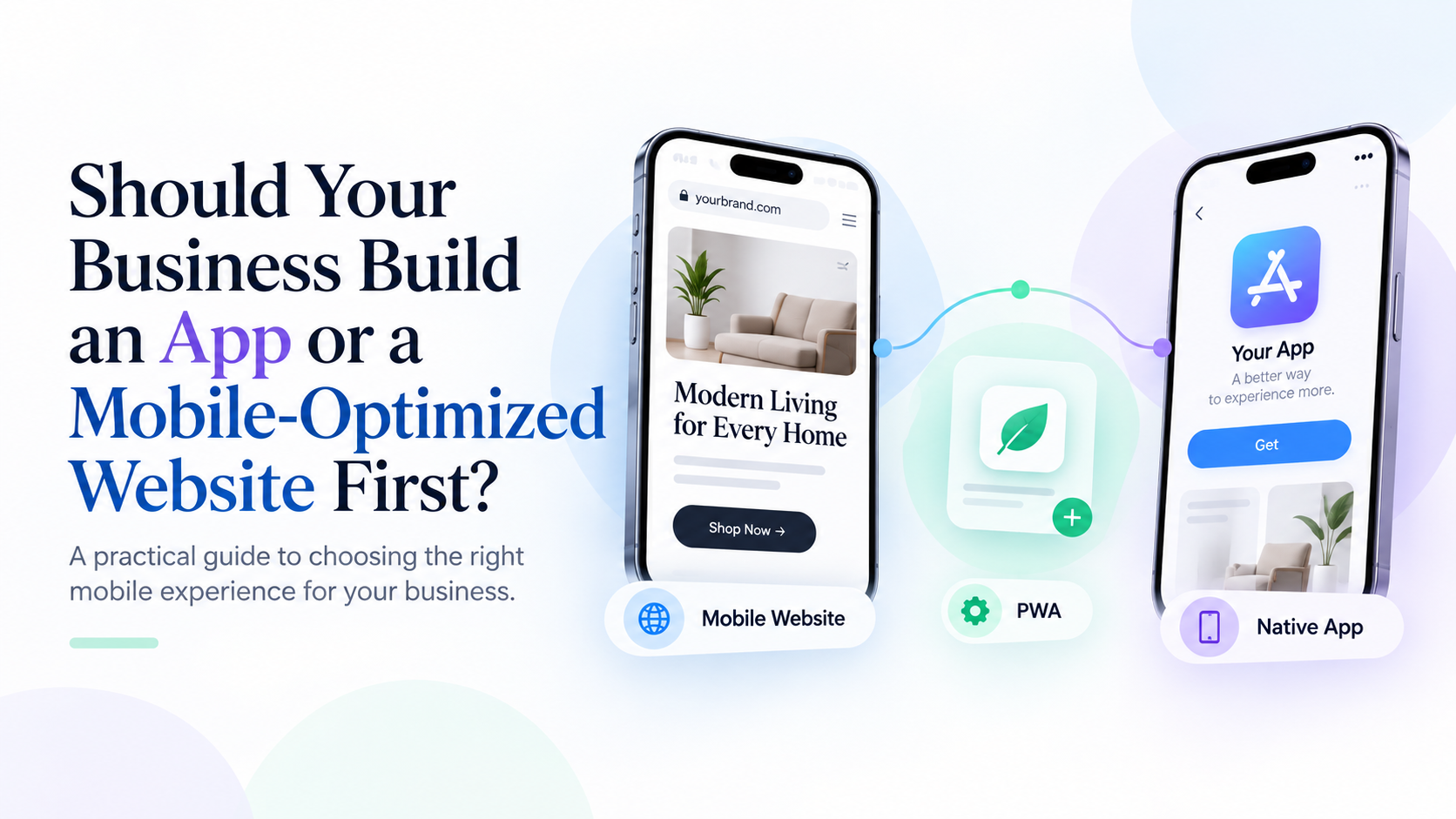
If you're weighing whether to build a mobile app or put that budget into a better mobile website, you're asking the right question at the wrong level of detail. The real decision isn't app versus website anymore. It's app versus website versus a progressive web app, and picking wrong can mean spending tens of thousands of dollars on something your customers never install.
This decision used to be simpler because the gap between a mobile site and a native app was wide. That gap has narrowed. A well-built progressive web app can now send push notifications, work offline, and sit on a customer's home screen without ever touching an app store, especially since iOS opened up meaningfully better PWA support in recent updates. That changes the calculation for a lot of businesses that assumed "app" was their only path to an app-like experience.
Here's how to actually work through this decision, based on what the technology can do today, what it costs, and what your customers are realistically going to use.
Three Options, Not Two
Most articles frame this as a binary choice. In practice there are three real paths, and understanding what each one is capable of matters more than picking a side.
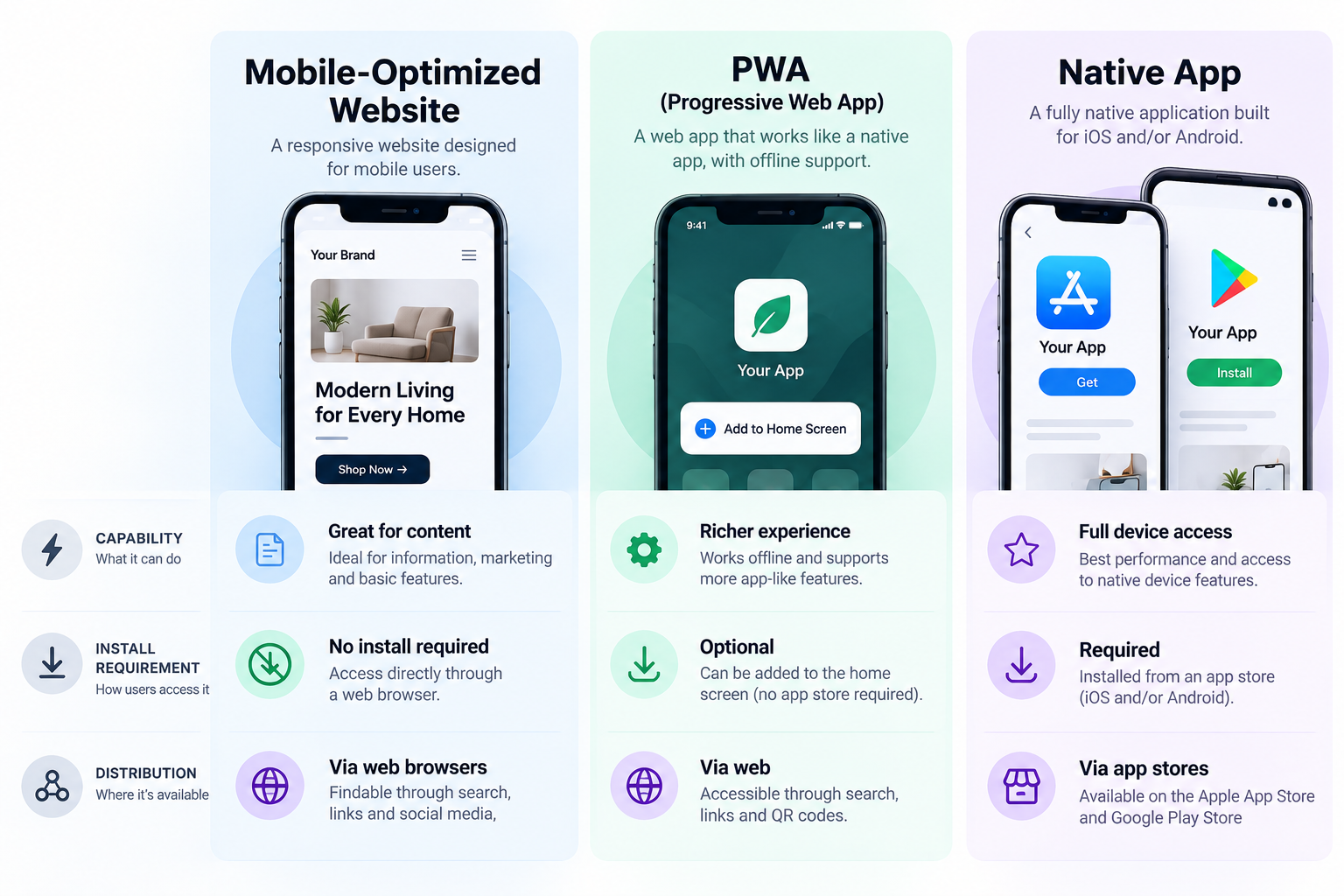
A mobile-optimized website is simply a website built and designed to work well on a phone: fast loading, thumb-friendly navigation, readable text without pinching to zoom. It lives in the browser, requires no install, and is what most people mean when they say "responsive design."
A progressive web app, or PWA, is a step beyond that. It's still a website technically, but it's built to behave like an app: it can be added to a home screen, it can work with limited functionality when offline, and on most platforms it can send push notifications. Since Apple expanded PWA capabilities in iOS 16.4 and continued that direction in more recent releases, the practical gap between a well-built PWA and a lightweight native app has gotten genuinely small for a lot of use cases.
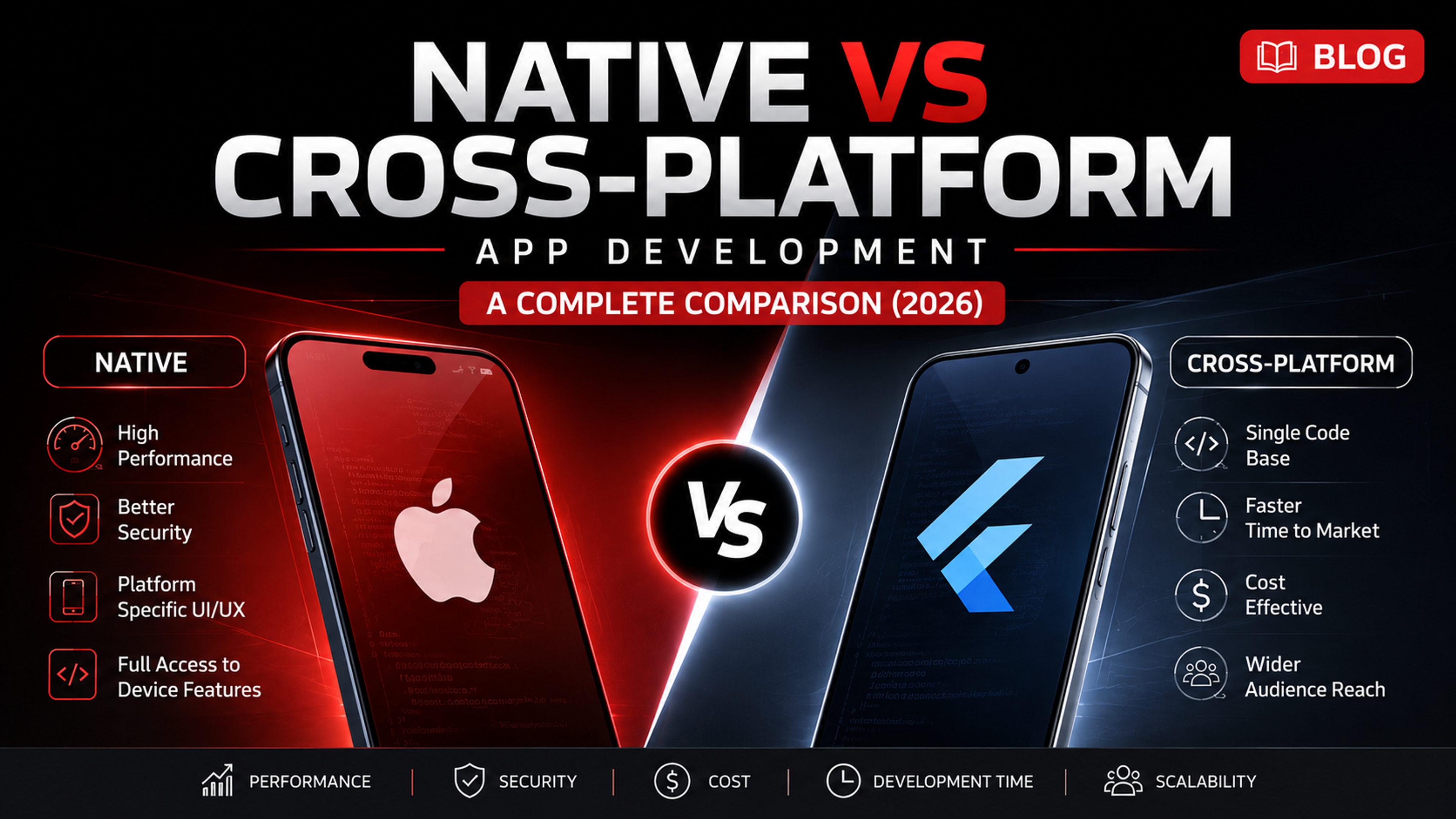
A native app is built specifically for iOS, Android, or both, distributed through the App Store or Google Play, and given full access to device hardware: camera, Bluetooth, background processing, biometric login, and deeper integration with the operating system than a browser-based experience can offer.
The honest starting point for most businesses is a mobile-optimized website or a PWA, with native reserved for cases where the business genuinely needs what only native can do. But "most businesses" isn't every business, and the exceptions matter.
What Each Path Actually Costs
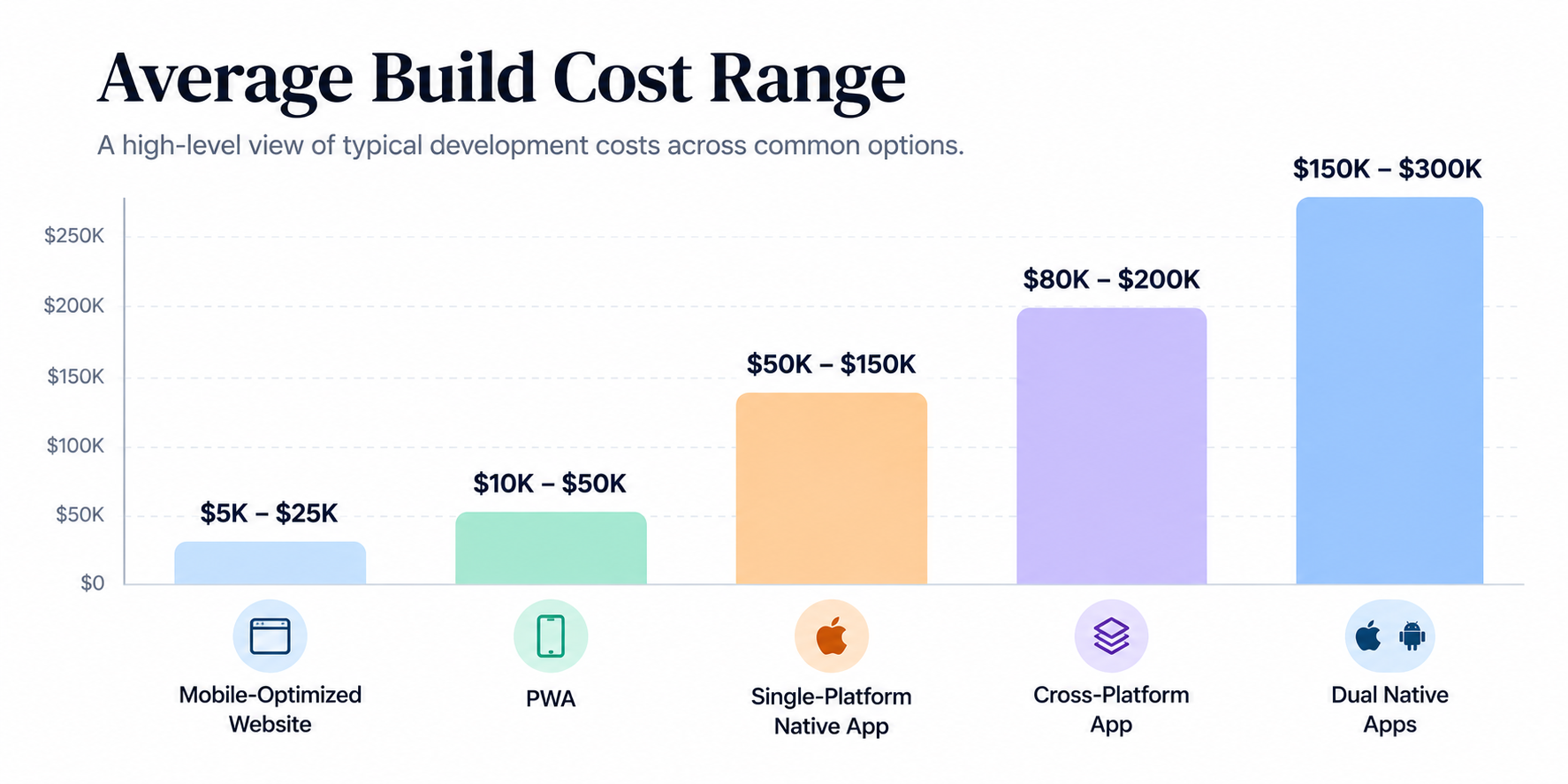
Cost estimates for app development vary wildly depending on who you ask, mostly because "an app" can mean a five-screen utility or a two-hundred-screen platform with real-time features. But the relative gap between options is fairly consistent across current industry estimates.
A solid mobile-optimized website typically starts in the low five figures for a small to mid-sized business. A PWA built on top of that same site, adding offline support, home-screen installability, and push notifications, usually adds a meaningful but not dramatic amount on top, since much of the underlying work is shared with the website build. A single native app, for just iOS or just Android, tends to start noticeably higher than either of those, and building for both platforms with a shared codebase through cross-platform tools like Flutter or React Native costs more again. Fully separate native apps for iOS and Android, each built and maintained independently, sit at the top of the range and are usually only justified by scale or by a genuine need for platform-specific performance.
The gap doesn't stop at the initial build. Native apps carry ongoing costs a website doesn't: app store review cycles for every update, separate testing across OS versions, and in many cases, developer account fees and revenue-share cuts on in-app purchases or subscriptions, which both Apple and Google currently apply at 15 percent for most developers under the first million dollars in annual revenue. A mobile-optimized website or PWA sidesteps nearly all of that. Updates go live the moment you deploy them, with no review queue and no platform fee sitting between you and your customer.
None of this means native is a bad investment. It means native is a bigger, longer commitment, and the decision should be made with that full cost in view, not just the number on the initial development quote.
What Your Customers Are Actually Going to Use
Here's where the decision gets genuinely business-specific, because customer behavior varies a lot by what the business does and who it serves.
On one hand, there's real data suggesting a strong pull toward native app usage for certain categories. The average smartphone user now spends somewhere in the range of four and a half to five hours a day inside apps rather than a mobile browser, and that share is even higher for younger users, with recent research finding roughly nine in ten Gen Z users saying they prefer apps over mobile websites for recurring tasks like messaging, banking, and shopping. If your business involves frequent, repeat interactions, daily check-ins, loyalty tracking, ongoing service use, that pull toward habitual app use is real and worth taking seriously.
On the other hand, getting a customer to install anything at all has gotten harder, not easier. App discovery increasingly happens outside the app store itself, through social platforms and AI-powered search rather than store browsing, and a meaningful share of installed apps get opened once and never again. Historical retention data has consistently shown that somewhere around one in four users abandon a newly downloaded app after a single use, and a large share of apps sitting in the App Store and Google Play haven't been meaningfully updated in years, some estimates put it at roughly a third of all listed apps, which suggests a lot of businesses built something customers simply never came back to.
Put those two facts together and the picture is less contradictory than it looks. Users who already have a reason to open your app repeatedly, an airline, a bank, a fitness routine, will use it heavily. Users who don't yet have that habit are unlikely to install anything at all, no matter how good the app is, until they've already decided your business is worth a recurring relationship. A mobile-optimized website or PWA meets that second group where they are: no install friction, fully discoverable through search, ready the moment someone taps a link.
When a Mobile-Optimized Website or PWA Is the Smarter First Move
For most businesses that are still validating demand, a mobile-optimized website or PWA is the more defensible first investment, for a few concrete reasons.
Search visibility is one of the strongest arguments. A website, including a PWA, can be crawled and indexed by search engines, and increasingly by AI-driven answer engines pulling in web content directly. A native app has none of that visibility outside its own store listing. If new customer discovery through search matters to your business at all, and for most local and service-based businesses it does, that alone tips the scale.
Speed to market and speed to iterate matter just as much in the early stages. A website update ships the moment you push it live. A native app update sits in a review queue, sometimes for days, before customers see it. When you're still figuring out what your product or service actually needs to do well, that faster iteration loop is worth more than the polish of a native interface.
There's also the practical reality of who you're building for early on. A local restaurant taking orders, a service business booking appointments, a content site, an e-commerce store still proving out demand: none of these strictly require hardware access, background processing, or offline functionality that only native can provide. A PWA covers push notifications and home-screen installation, which handles most of what businesses actually want from "being an app" without the build and maintenance overhead of two separate native codebases.
When Native Is Worth Building, Even Early
There are situations where waiting on native isn't the safer choice, it's the wrong one.
If your product genuinely depends on deep hardware access, continuous background location tracking, Bluetooth device pairing, advanced camera processing, offline-first functionality that has to work reliably with zero connectivity, native is often not optional. A PWA can approximate some of this, but the platform limitations are real, particularly on iOS, where background processing and certain hardware APIs remain more restricted for web-based apps than for native ones.
Native is also usually the right call if your business model depends heavily on habitual, high-frequency engagement from day one, and you already have strong evidence that customers want that relationship, not just a hope that they will. A company relaunching an existing product with an established, loyal user base is in a very different position than a new business trying to earn that first loyalty.
Finally, if app store presence itself is part of your credibility or discovery strategy, certain categories, particularly consumer fintech, health, and productivity tools, benefit from the trust signal and discoverability that comes from a polished app store listing with reviews and ratings, something a website simply can't replicate in the same way.
A Practical Way to Decide
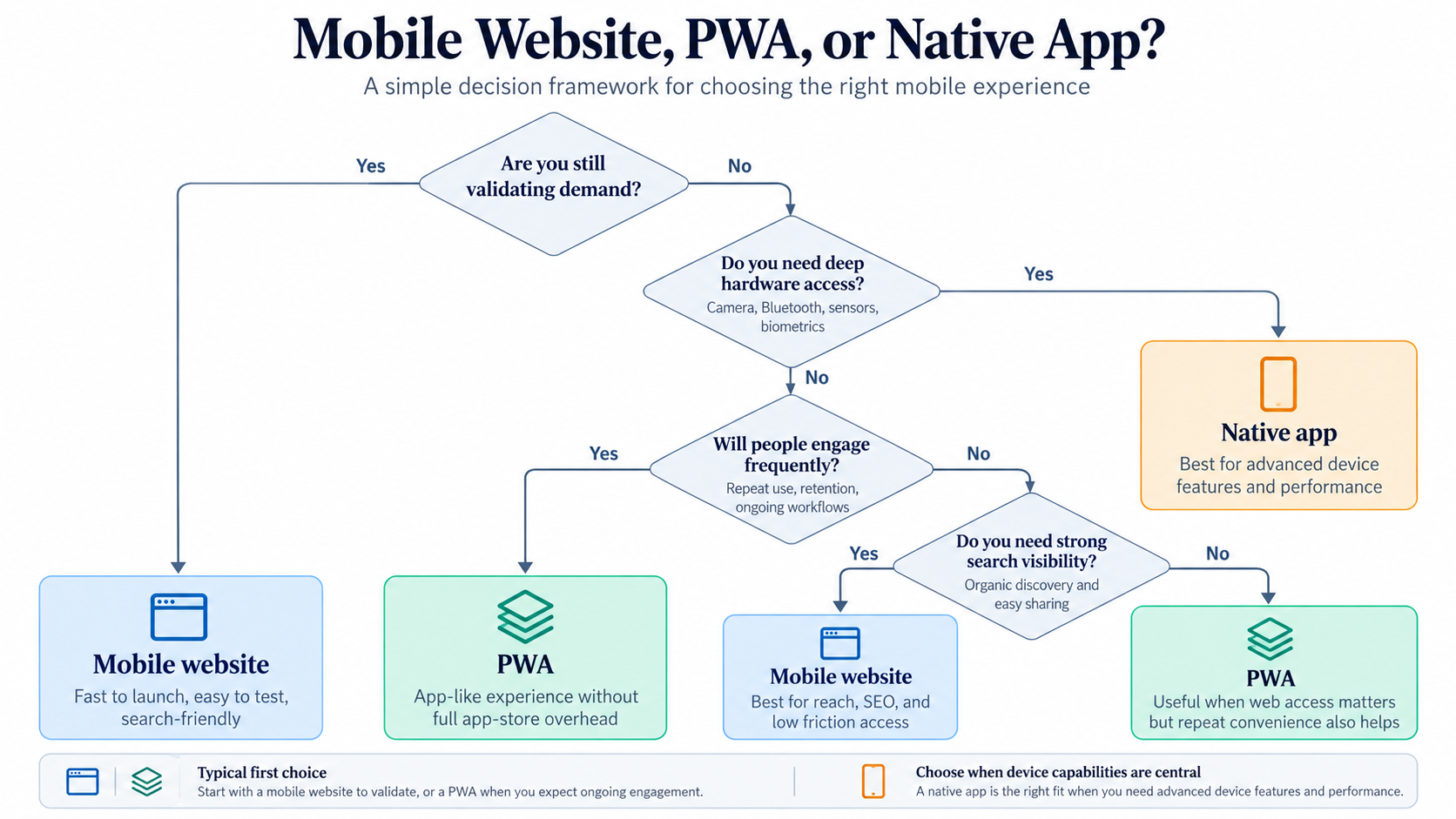
Rather than trying to predict your business's future needs from scratch, work through a short set of honest questions.
Do you already have evidence that customers will use this daily or weekly, or are you still testing whether they'll use it at all? If it's the latter, start with a website or PWA and let real usage data tell you whether native is worth the investment.
Does your core functionality require hardware the browser genuinely can't reach? If yes, native is likely necessary regardless of stage. If the honest answer is "it would be nice to have," that's usually not a strong enough reason on its own.
How much of your new customer acquisition depends on search or shareable links versus people actively browsing an app store? Businesses that rely heavily on search visibility give up a lot by going native-only.
What can your team realistically maintain? A native app on both platforms means two codebases, two review processes, and ongoing OS compatibility work. A website or PWA is a single codebase to maintain. Be honest about whether your team, or budget for outside development help, can sustain the heavier option long term, because an app that stops getting updated becomes a liability rather than an asset.
The Common Mistake: Building Native Too Early
The most expensive version of this decision goes like this: a business builds a native app before it has real evidence customers want a recurring relationship with it, spends a meaningful chunk of its budget on development and store submission, and then watches usage stay flat because the underlying reason to open the app daily was never there in the first place. The app itself wasn't the problem. The timing was.
This is exactly the pattern reflected in how many apps sit abandoned in the app stores today, still listed, technically installable, but no longer meaningfully maintained because the business behind them moved on once it became clear the investment wasn't paying off. A mobile-optimized website carries a far lower cost of being wrong. If a website underperforms, you improve it. If a native app underperforms, you've usually already spent the harder-to-recover money.
The businesses that get the most value from native apps are rarely the ones that started there. They're usually the ones that proved demand through a website or PWA first, watched real usage patterns emerge, and then built native once they had specific evidence, not just a hunch, that the investment would pay off.
A Reasonable Middle Path
For businesses genuinely unsure which direction to take, starting with a mobile-optimized website, then upgrading it to a PWA once the core experience is solid, is a lower-risk sequence than committing to native from day one. It lets you launch faster, stay visible in search, and gather real data on how customers actually behave before deciding whether the deeper investment in a native app is justified by that behavior. If the data eventually shows strong repeat usage and a real appetite for deeper functionality, native becomes a much easier decision to make, and a much easier one to justify to whoever is signing off on the budget.
Frequently Asked Questions
These let you build for iOS and Android from a largely shared codebase, which reduces cost compared to two fully separate native apps, though it doesn't eliminate app store review cycles or platform fees the way a website or PWA does. They're a reasonable middle ground once you've decided native is genuinely necessary.
Building a solid mobile website or PWA first is almost always cheaper in total, even accounting for a later native build, because the earlier work on design, content, and core functionality carries over rather than being duplicated from scratch.
The clearest signal is repeat behavior. If people are already returning to your website frequently on their phones, that's a stronger indicator of app readiness than any survey response, because it reflects real habit rather than a hypothetical preference.
For a growing number of use cases, yes, particularly for content, e-commerce, and service businesses that don't depend on deep hardware access. Where PWAs still fall short is background processing, certain hardware integrations, and the credibility boost of an app store listing in categories where that matters.
No. Search rankings are unaffected by whether a business has an app, and a well-optimized mobile website or PWA is fully indexable, which a native app on its own is not.