Gourav Dhiman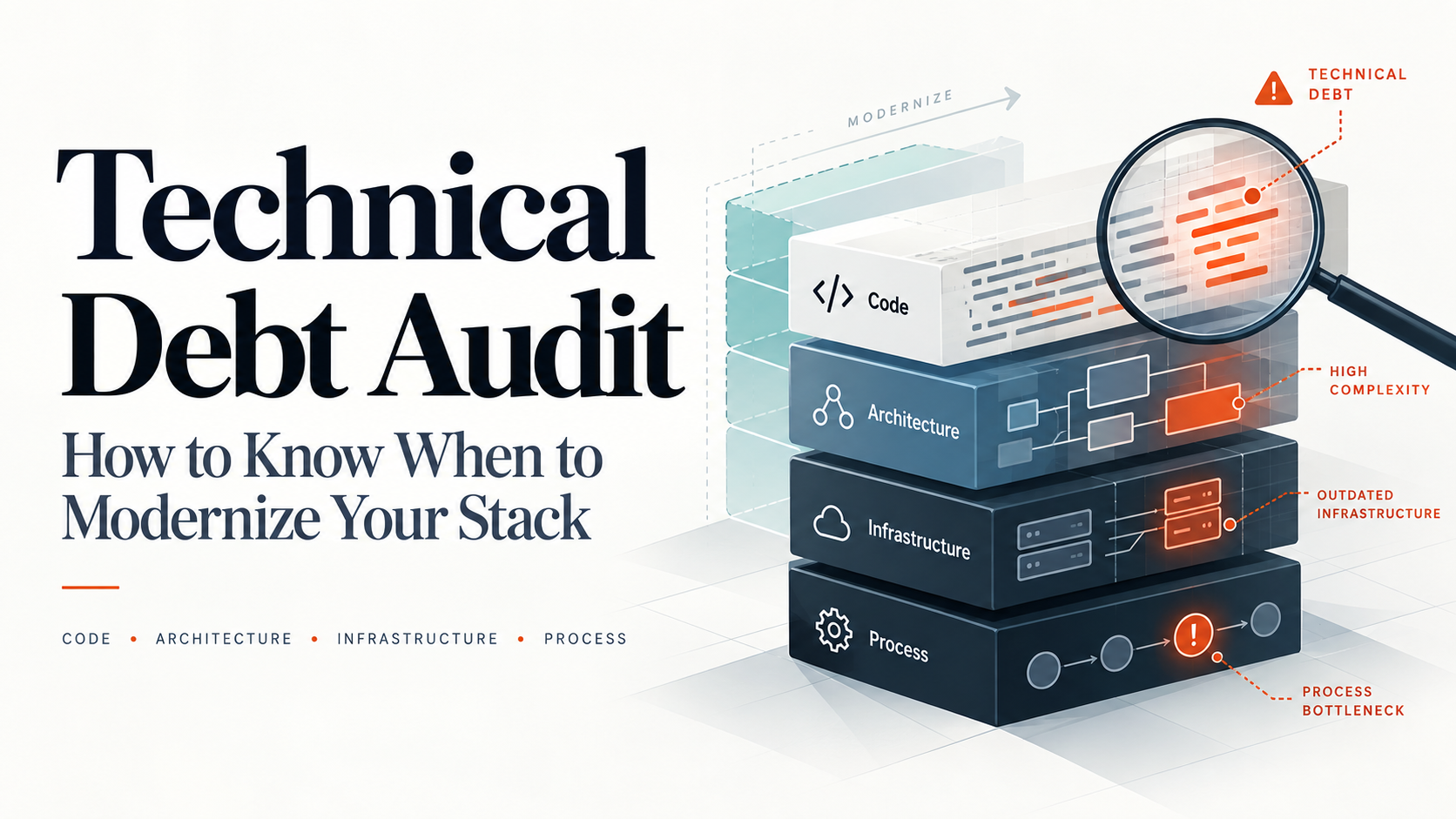
Most engineering teams don't wake up one day and decide to modernize their stack. It happens gradually. Deploys that used to take twenty minutes start taking two hours. A senior engineer spends a week onboarding before touching production code. A routine feature request turns into a three-sprint archaeology project because nobody fully understands how three different systems talk to each other anymore.
By the time leadership notices, the question isn't whether technical debt exists. It's how much of it there is, where it's concentrated, and whether the business can afford to keep ignoring it.
A technical debt audit is how you answer that question with evidence instead of gut feeling. Done well, it turns a vague sense of "our systems feel old" into a prioritized, defensible case for what to fix, what to leave alone, and what actually needs to be replaced.
What a Technical Debt Audit Actually Measures
Technical debt isn't just old code. It's any decision, shortcut, or unaddressed gap that makes future changes more expensive than they should be. That includes outdated dependencies, undocumented systems, brittle test coverage, manual deployment processes, security patches that were postponed, and architecture that made sense for a five-person startup but not for a two-hundred-person company processing real customer data at scale.
A proper audit looks at four layers, not just the codebase:
Code-level debt covers duplicated logic, inconsistent patterns, missing tests, and dependencies that haven't been updated in years. This is the layer most teams check first because static analysis tools can measure it directly.
Architectural debt is harder to see and usually more expensive. It shows up as tight coupling between services that should be independent, a database schema that fights every new feature, or a monolith that made sense in year one and now blocks every team trying to ship in parallel.
Infrastructure debt includes unpatched servers, manual provisioning, missing observability, and cloud configurations that were reasonable at a smaller scale but now create real security exposure or cost overruns.
Process debt is the one audits miss most often: no clear ownership for critical systems, tribal knowledge that lives in one person's head, and deployment pipelines that require a specific engineer to babysit them.
Auditing only the first layer and ignoring the other three is why so many "technical debt cleanups" fix surface symptoms without changing anything that actually slows the business down.
Why This Is a Business Problem, Not Just an Engineering One
It's tempting to treat technical debt as an internal engineering concern that doesn't need executive attention until something breaks. The numbers suggest otherwise.
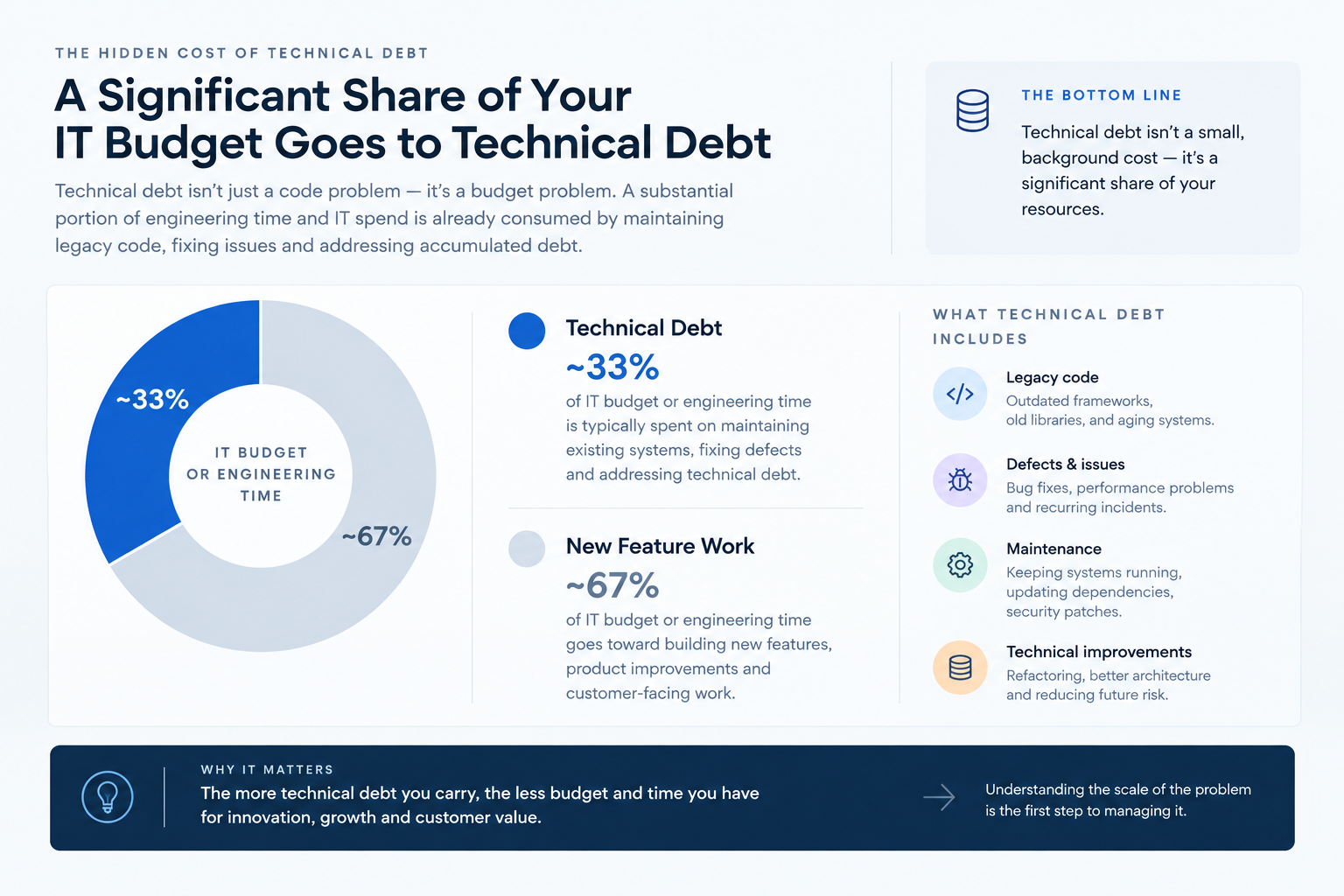
Deloitte's 2026 Global Technology Leadership Study estimates that technical debt accounts for 21% to 40% of an organization's IT spending. That's not a one-time cleanup cost. It's an ongoing tax that gets paid whether or not it shows up as its own budget line. Earlier research from McKinsey found a similar pattern: CIOs surveyed estimated technical debt at 20 to 40 percent of their technology estate's value, with 10 to 20 percent of the new-product technology budget diverted just to servicing it.
At the national level, CISQ put the annual cost of poor software quality in the US at $2.41 trillion, with roughly $1.52 trillion of that tied to accumulated technical debt. These aren't abstract figures. They represent real engineering hours spent working around problems instead of building new value.
The productivity effect is measurable too. A 2026 cost-benefit analysis published in the American Impact Review, which modeled technical debt against DORA delivery metrics across dozens of enterprise systems, found that a one-standard-deviation increase in an organization's debt-to-code ratio corresponded to a 23 percent reduction in delivery velocity and a 31 percent increase in defect density. In plain terms: the more debt accumulates, the slower you ship and the more bugs you ship with it.
This is also an old pattern, not a new one. Developer time-use research going back to 2018 found that of a roughly 41-hour work week, developers spent about 13.5 hours, or a third of their time, on technical debt and related maintenance rather than new feature work. That figure keeps getting cited because nobody has published a replication at the same scale since, and because most engineering leaders will tell you it still feels accurate.
Signals Worth Investigating, Organized by Where They Show Up
Generic checklists of "signs you need to modernize" tend to blur together because they mix symptoms from completely different parts of the system. It's more useful to group them by where the pain actually shows up, because that tells you where to start looking.
On the delivery side, watch for lead time creeping upward even though the team size hasn't shrunk. If a feature that would have taken three days last year now takes two weeks, and nobody added scope, that's architecture or process debt slowing things down, not a motivation problem. Frequent rollbacks and hotfixes are another marker. A team constantly patching production between planned releases is usually fighting fragile code, not bad luck.
On the security and compliance side, the clearest signal is a dependency or framework that's approaching or past its end-of-life date with no clear patch path. Security scanners flagging the same unresolved vulnerabilities release after release is another. So is a compliance audit that keeps surfacing the same finding because fixing it properly would require touching a system nobody wants to open.
On the cost side, cloud spend that grows faster than usage is one of the most underrated indicators. It usually means resources are being over-provisioned to compensate for inefficient code or missing autoscaling, rather than genuine growth. Rising maintenance costs relative to new development spend tell a similar story: if most of the engineering budget goes to keeping the lights on rather than building anything new, the stack is winning and the roadmap is losing.
On the talent side, pay attention to how long it takes a new engineer to become productive, and how often experienced engineers avoid certain parts of the codebase. When people route around a system instead of improving it, that's usually a sign the system is too risky or too poorly understood to touch safely, which is itself a form of debt.
None of these signals is disqualifying on its own. Every mature system has some of them. The audit exists to figure out which signals are isolated annoyances and which ones are compounding into something that will eventually force an unplanned, expensive fix.
Running the Audit: A Practical Framework
A useful audit produces a prioritized list tied to business impact, not just a spreadsheet of complaints. Here's a structure that works across most organizations, regardless of stack.
Step 1: Inventory before you judge anything
Start by cataloging systems, services, and dependencies without judgment. List what exists, who owns it, how often it changes, and how critical it is to revenue or operations. This step alone often surfaces the first real finding: systems nobody is confident they fully understand, or services with no clear owner. That ambiguity is itself a debt signal worth flagging.
Step 2: Classify debt by intent and awareness
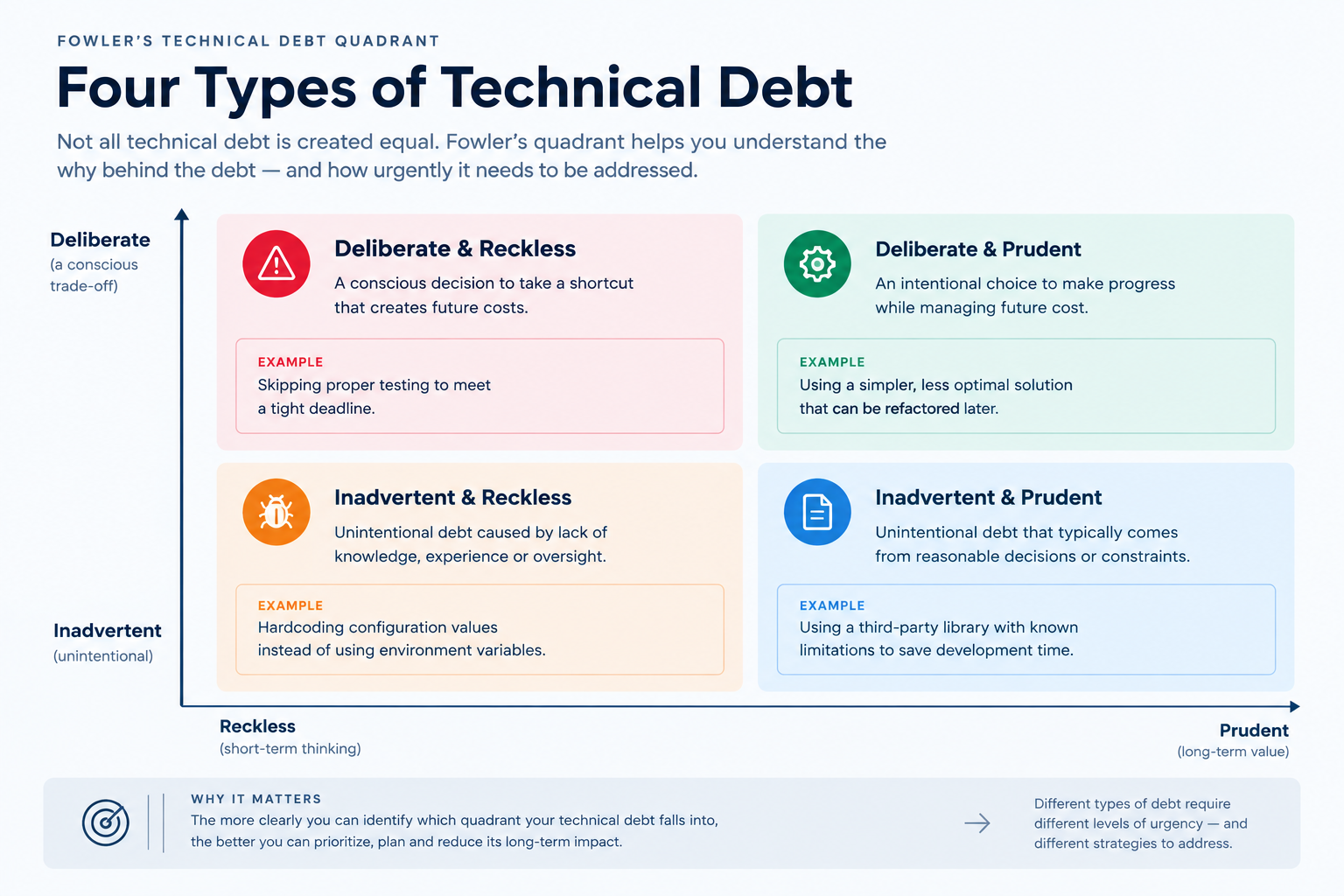
Martin Fowler's technical debt quadrant is still one of the most useful mental models for this step. It sorts debt along two axes: whether it was taken on deliberately or inadvertently, and whether it was a reckless decision or a prudent one made with full knowledge of the tradeoff.
Prudent, deliberate debt, like shipping a simpler version of a feature to hit a launch date, is often fine to leave as-is if it's documented and revisited later. Reckless, inadvertent debt, like a junior engineer copying a broken pattern because nobody explained the right one, is the kind that quietly multiplies across a codebase and deserves earlier attention. Sorting findings this way stops teams from treating every piece of debt as equally urgent.
Step 3: Score by risk and effort, not just annoyance
For each item in the inventory, estimate two things: the cost of leaving it alone (security exposure, likelihood of failure, drag on delivery speed) and the cost of fixing it (engineering time, risk of disruption during the fix, dependencies on other teams). Plotting findings on a simple risk-versus-effort grid usually reveals a small number of high-risk, moderate-effort items that deserve to move to the top of the list, separate from the long tail of low-risk items that can wait.
Step 4: Map findings to business outcomes
This is the step most technical audits skip, and it's the reason so many good audits never get funded. An engineering team can say "our checkout service has 40 percent test coverage" all day and nobody outside engineering will act on it. Translate that same finding into "a failure in checkout during a peak sales period would take an estimated six hours to diagnose and fix, based on how the last two incidents went," and it becomes a business risk statement that finance and leadership can actually weigh against other priorities.
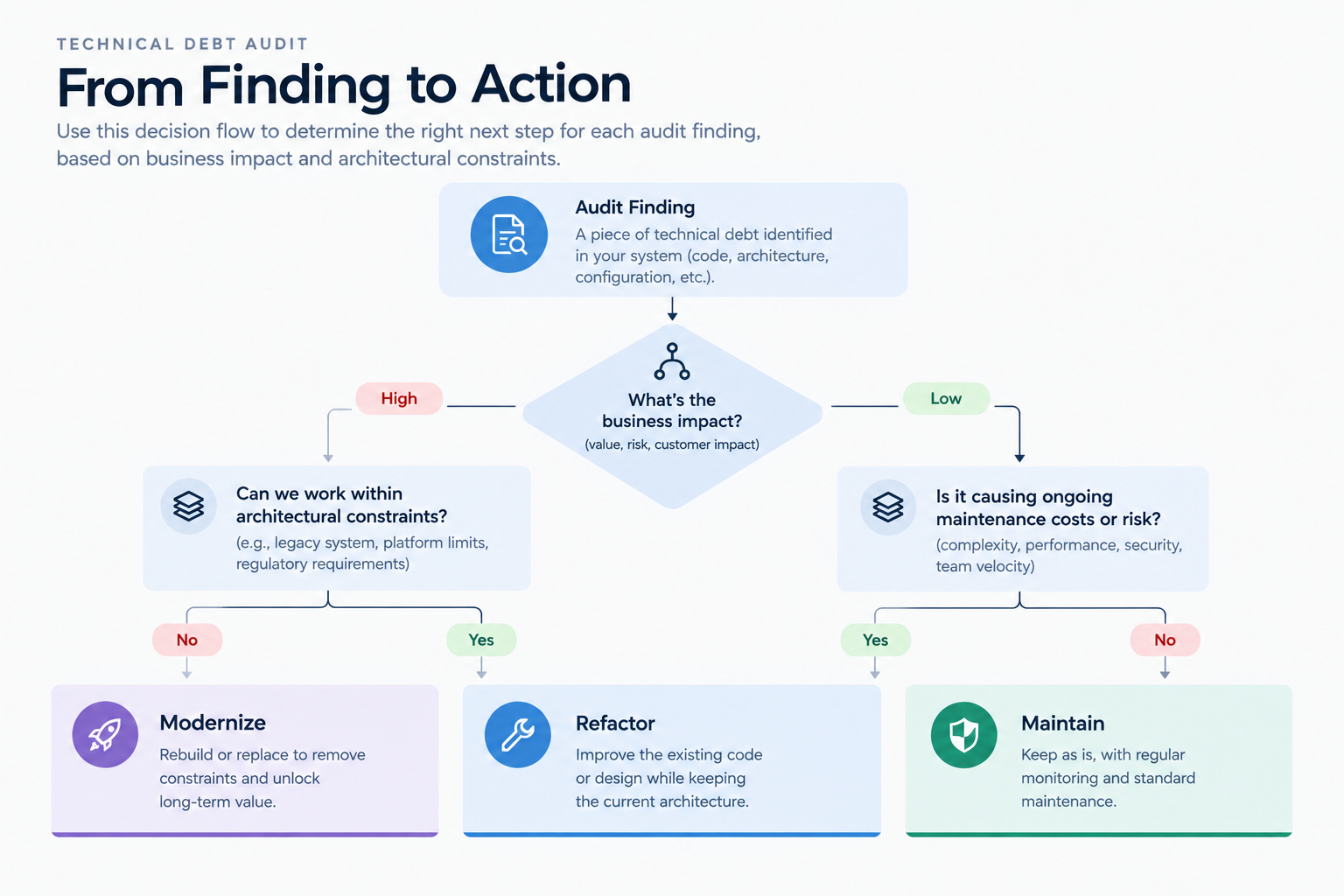
Step 5: Decide what actually needs modernization versus what needs maintenance
Not every finding requires a rewrite. This distinction matters enough to deserve its own section.
Modernize, Refactor, or Leave It Alone
The instinct after a thorough audit is often to modernize everything that scored poorly. That's usually the wrong call, both financially and operationally.
A full rewrite makes sense when the underlying architecture actively prevents the business from doing something it needs to do, like scaling to a new region, supporting a compliance requirement the current system can't meet, or integrating with modern tooling that the legacy stack simply can't talk to. It also makes sense when the platform or language is genuinely unsupported and the security exposure is severe.
A targeted refactor is usually the better choice when the underlying architecture is sound but specific components have degraded, or when test coverage and documentation gaps are the real problem rather than the design itself. Refactoring in place, service by service, tends to be safer and cheaper than a full replacement, and it lets the team keep shipping while the work happens.
Leaving something alone, at least for now, is the right call more often than audits tend to admit. A system that is stable, low-change, and isolated from the rest of the stack can be genuinely low priority even if it scores poorly on a code-quality scan. Spending scarce engineering time modernizing something nobody touches and nothing depends on is its own form of waste.
The strangler fig pattern, gradually routing traffic away from an old system into a new one service by service, is worth knowing about here because it lets teams modernize incrementally instead of committing to a risky big-bang replacement. It's slower than a full rewrite, but it dramatically lowers the chance of a modernization project stalling out halfway through with two half-working systems instead of one working one.
Common Mistakes Teams Make During a Technical Debt Audit
The most common failure is treating the audit as a one-time event. Debt accumulates continuously, so an audit that isn't revisited on a regular cadence, quarterly for fast-moving teams, annually at minimum for slower ones, goes stale within a year and stops reflecting reality.
Another frequent mistake is running the audit entirely inside engineering, with no input from product or finance. This produces a technically accurate list that nobody outside the team believes is worth funding, because it was never framed in terms they can act on.
Some teams also fall into the trap of trying to fix everything the audit surfaces before shipping anything new. That approach burns political capital fast. A better pattern is to bundle debt reduction into the roadmap alongside feature work, allocating a fixed percentage of each sprint or quarter to debt items rather than asking for a dedicated multi-month freeze.
Finally, teams sometimes measure only what's easy to measure, like code complexity scores, while ignoring the harder-to-quantify items like undocumented tribal knowledge or single points of failure in the deployment process. Those softer risks tend to cause the worst incidents precisely because nobody flagged them in time.
Where Cloud Infrastructure Fits Into the Decision
For teams already running in the cloud, a technical debt audit and a cloud infrastructure review tend to surface the same underlying issues from different angles. Over-provisioned resources, missing autoscaling, and outdated managed service versions are technical debt and infrastructure cost problems at the same time. Security groups that were configured years ago and never revisited are technical debt and a compliance risk simultaneously.
This overlap is useful. If an audit is already underway, it's worth pulling in whoever owns cloud cost and security posture rather than running two separate reviews later. Modernization efforts that touch infrastructure, moving from manually managed servers to infrastructure as code, for instance, often pay for themselves through reduced cloud spend well before the performance and security benefits are even counted.
Frequently Asked Questions
Most fast-moving engineering organizations benefit from a lightweight audit every quarter, with a deeper full audit annually. Debt accumulates continuously, so a one-time audit loses accuracy within a few months.
No. Prudent, well-documented debt that isn't actively causing incidents or slowing delivery can often be left alone. The goal of an audit is prioritization, not elimination.
Translate findings into business terms: revenue risk, security exposure, and delivery speed, rather than presenting raw code-quality metrics. A dollar figure or a concrete incident scenario moves budget decisions faster than a complexity score.
Refactoring improves the internal structure of existing code without changing what it does or the platform it runs on. Modernizing usually means replacing outdated platforms, languages, or architecture entirely, which involves more risk and cost but is sometimes the only way to remove a hard constraint.
They can speed up parts of it, particularly code-level analysis and dependency scanning, but architectural and process debt still require human judgment about business context that automated tools can't fully replace.