

 Gourav Dhiman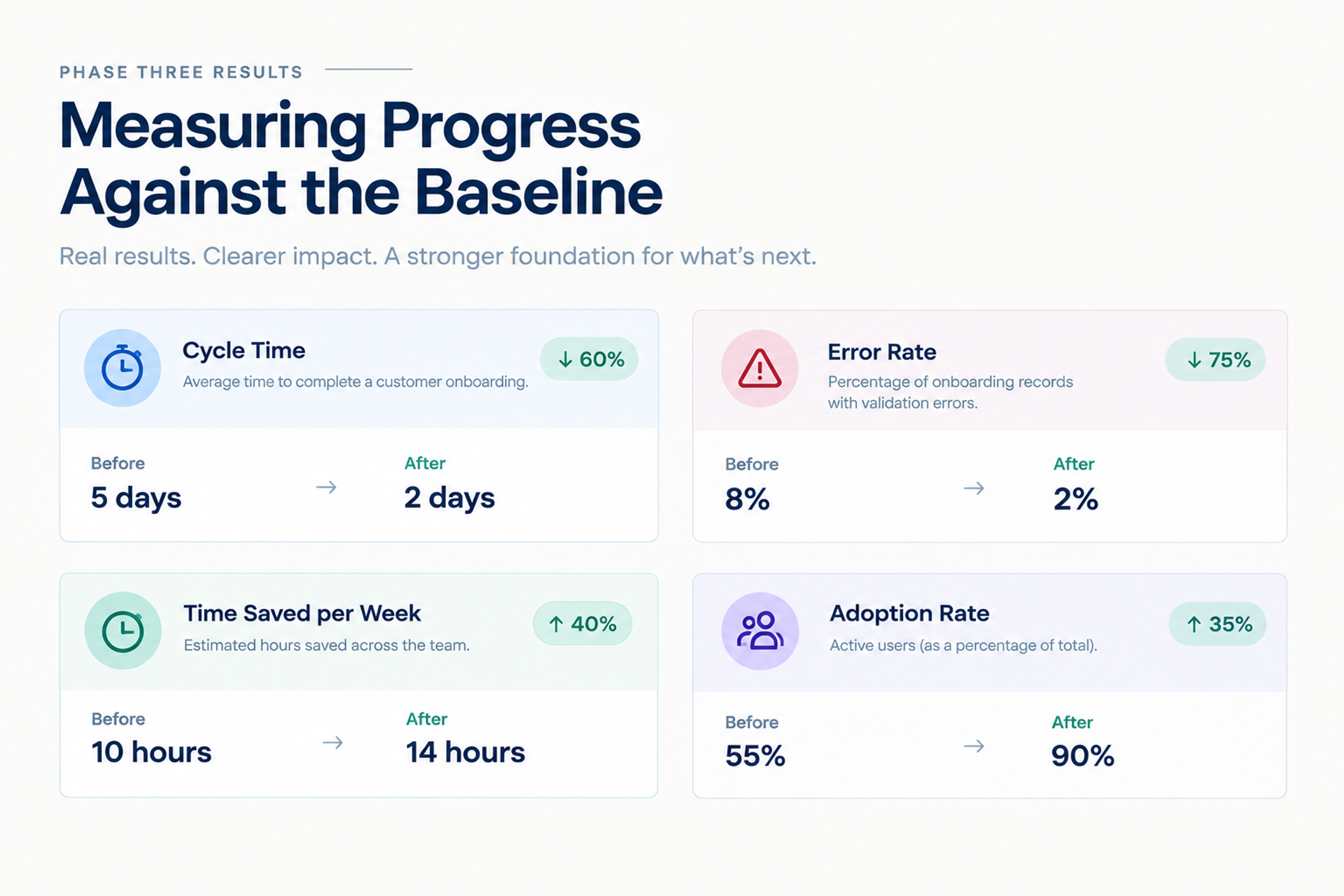
AI-Powered Accessibility Compliance: A Practical 90-Day Digital Transformation Plan for SMEs
Most small and medium-sized businesses don't fail at digital transformation because they picked the wrong software. They fail because they treat transformation as a shopping trip instead of a sequence. A new CRM goes in on Monday, a chatbot gets bolted on in March, an automation tool arrives in June, and by autumn nobody can explain how the pieces fit together or whether any of it moved the business forward.
Companies spent $1.6 trillion on digital transformation in 2022, a figure expected to climb to $3.4 trillion by 2026, yet the return on that spending is inconsistent at best. McKinsey research found that while 56% of organizations say they've achieved most or all of their transformation goals, only 12% report sustaining those gains for more than three years. For a small business, that gap between initial success and lasting change is the entire problem. You don't have the budget to relaunch a failed initiative next year. Whatever you build in the next 90 days needs to hold. techtargettechtarget
This plan is built around that constraint. It's not a strategy document or a technology wish list. It's a sequence: three 30-day phases that take a business from scattered tools and manual work to a connected, measurable operation, without requiring a dedicated IT department or a six-figure consulting budget.
Why 90 days, and why SMEs need a different approach than large enterprises
Enterprise transformation programs run in 18-month cycles with steering committees and change management teams. That model doesn't translate down to a 12-person business, and trying to force it usually backfires.
Small and medium-sized businesses are more vulnerable to failed digital initiatives than large enterprises for three specific reasons: limited resources mean there's no budget for years-long experiments, there's no time buffer so productivity drops are felt immediately, and heavy reliance on outside vendors means external tools and consultants often end up dictating decisions instead of the business itself. When a large company's transformation stalls, it absorbs the cost. When a small business's transformation stalls, it hits finances, the team, and leadership focus all at once. yarandinyarandin
Ninety days is long enough to make real structural change and short enough that momentum doesn't die. It also forces a discipline that longer timelines don't: you can't do everything, so you have to decide what actually matters first.

The mistake to avoid before you start
Before laying out the phases, it's worth naming the trap most SMEs fall into first: buying tools before defining the problem.
Many organizations jump into multiple digital initiatives without a unified vision or prioritization, which creates fragmented systems, duplicated data, and confusion across teams. This shows up constantly in small businesses. A sales manager gets a CRM, but keeps a personal spreadsheet because nobody explained why the CRM matters or how it changes their daily work. The moment a team member reverts to their old notebook because a new system feels like "complicated reporting for the boss" is the exact moment the transformation has already failed, even if the software itself is running perfectly. mozon-techyarandin
The deeper issue is usually structural rather than technical. In most small and mid-sized businesses, processes are undocumented, decisions get made intuitively, responsibility is blurred, and outcomes depend on specific people being around. That's a normal state for a growing business. The problem is what happens when you automate on top of it. If that disorganization gets hard-coded into a new system before anyone untangles it, automation doesn't create order, it just locks the existing chaos in place. yarandinyarandin
That's why Phase One isn't about tools at all.
Phase One (Days 1-30): Audit, prioritize, and set a baseline
The first month has one job: understand what you actually have before you decide what to change.
Map how work really happens, not how it's supposed to happen. Sit down with each function, whether that's you and two employees or five separate departments, and document the actual sequence of steps someone follows to close a sale, onboard a customer, or process an order. Note every handoff, every spreadsheet, every point where someone has to remember something instead of the system remembering it for them. This single exercise usually reveals more waste than any software demo will.
Identify your two or three highest-friction processes. Not the most interesting ones, the highest-friction ones. Signs worth flagging: a task that takes multiple people to complete something one person should be able to do, information that has to be re-entered in more than one place, or any process where the answer to "how do we know this happened correctly" is "we don't, really."
Set a measurable baseline for each of those processes. If your invoicing process currently takes an average of eleven days from job completion to payment, write that number down. If it takes 40 minutes to onboard a new customer, write that down too. Ninety days from now, you need something to compare against, and "it feels faster" isn't evidence.
Decide what "done" looks like before you touch a single tool. This is the step most businesses skip, and it's the one that causes teams to stall: when there is no clear outcome defined in advance, nobody knows what success actually looks like once the project is technically finished. A goal like "streamlined order processing" only becomes useful once it's attached to a number, a deadline, and a person responsible for hitting it. sparkouttech
Have the ownership conversation early. Whoever runs point on this transformation, even if that's the owner working it in alongside everything else, needs real authority to make calls on tools and timelines. Digital transformation is a business transformation, not a software upgrade, and when it gets delegated entirely to whoever is "good with computers" without executive involvement, technology ends up sitting as an expensive layer on top of the same broken processes. mozon-tech
By day 30, you should have a short list, ideally no more than three processes, a written baseline for each, and a plain-language description of what success looks like on day 90.

Phase Two (Days 31-60): Build the core systems, in order
With a baseline and a short list in hand, month two is about implementation, but in a specific sequence that most SMEs get backward.
Fix your system of record first. Before adding automation or AI on top of anything, you need one place where customer, order, or project data actually lives, rather than being split across email threads, spreadsheets, and someone's memory. For most SMEs this means a CRM or a project management platform, chosen for how well it fits the process you mapped in Phase One, not for how many features it has.
Connect the systems you're keeping. Almost no small business is starting from zero. You likely already have accounting software, an email platform, maybe a scheduling tool. The goal in this phase isn't to replace everything, it's to make what you have talk to each other so data entered once shows up everywhere it's needed. A customer's details entered at the point of sale shouldn't need to be typed again into the invoicing system three days later.
Train before you launch, not after. Communicating the reason behind a change and training users early and continuously is the difference between a tool that gets adopted and one that gets quietly abandoned within a month. Block real time for this. A 15-minute walkthrough on launch day is not training, it's an announcement. mozon-tech
Pilot with one team or one process before rolling out company-wide. Digital transformation initiatives often start strong in a single department but fail when it comes time to scale across the whole organization, usually because the rollout wasn't flexible enough to handle how other teams actually work. Running a two-week pilot with your highest-friction process, using the real people who'll use the system daily, surfaces problems while they're still cheap to fix. businessmap
Check in against your baseline weekly, not at the end of the month. If the invoicing process was taking eleven days and it's still taking eleven days two weeks after go-live, that's information you want immediately, not on day 60 when the budget's already spent.
A common failure point here is disconnected initiatives that create duplicated data and confusion because nobody prioritized which pieces needed to connect to which. Resist the urge to add a fourth or fifth new tool in this phase. The goal is depth on the priorities from Phase One, not breadth across every department at once. mozon-tech
Phase Three (Days 61-90): Automate, measure, and lock in the gains
By month three, the core systems should be running and adopted. This phase is where the real efficiency gains show up, but only if the earlier phases were done properly.
Automate the parts of the process that are now clean. This is the point where automation actually helps rather than hurts, because you're automating a process that's been mapped, simplified, and is running on a single system of record rather than automating the chaos that existed on day one. Good starting points: automated follow-up emails after a sale, automatic invoice generation on job completion, or automatic status updates that remove the need for someone to manually check in.
Introduce AI tools narrowly, where they solve a specific problem. There's a strong temptation to bolt an AI chatbot or AI-generated reporting dashboard onto everything because the technology is available and cheap to try. Applying AI to a process that's still inefficient or broken doesn't fix the process, it just makes the same mistakes faster. Use AI where you have clean data and a defined task, such as summarizing customer feedback or drafting first-pass responses to common support questions, and hold off elsewhere until the underlying process is solid. sparkouttech
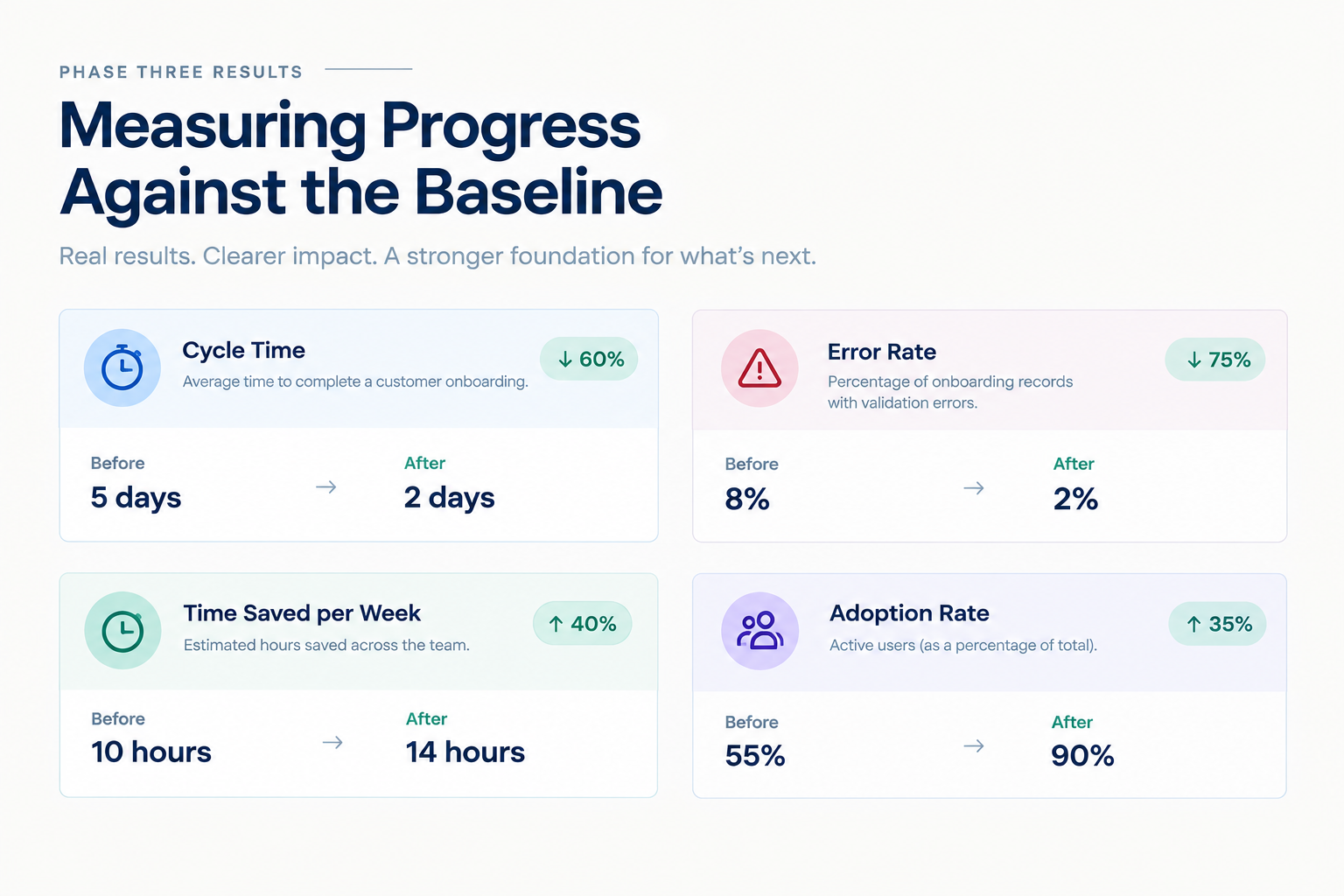
Measure against the baseline you set in month one. This is the step that separates a real transformation from a technology purchase. Pull the actual numbers: did the invoicing cycle drop from eleven days to six? Did onboarding time fall from 40 minutes to 15? Having no clear way to measure ROI is one of the most common strategic failures in transformation projects, and it's entirely avoidable if the baseline work from Phase One was done. sparkouttech
Document what changed, and why, for the next person. Small businesses have high staff turnover relative to their size, and institutional knowledge about why a process works a certain way tends to walk out the door with whoever built it. A simple internal document, even a page per process, protects the work you just did.
Set the next 90-day cycle before this one ends. Transformation isn't a single project with a finish line. The gap between digitally mature businesses and businesses that stall tends to widen over time rather than close on its own, which means the businesses that keep improving are the ones that treat this as a repeating cycle rather than a one-time initiative. Identify the next highest-friction process while the current one is still fresh, and start the audit again. Digital Chiefs

What realistic outcomes actually look like
It's worth being honest about the range of outcomes here, because overpromising is part of why digital transformation has a credibility problem with small business owners who've been burned before.
A 2026 survey of 700 UK-based SME owners and managers found that 60% reported efficiency gains from digitalization, and 43% reported an increase in profitability as a direct result, which suggests the financial upside, while real, isn't universal or automatic. At the same time, a majority of German companies surveyed by Bitkom in 2025, 53%, reported that their digitalization efforts were struggling not because of the technology itself but because of how the initiative was managed, up sharply from just a third of companies three years earlier. BecertifiedDigital Chiefs
The pattern in both findings points the same direction: the technology is rarely the limiting factor. Management, sequencing, and follow-through are. A 90-day plan doesn't guarantee results, but it forces the kind of structured management that separates the businesses reporting real gains from the ones reporting stalled projects.
Common questions
Do I need to hire a consultant to run this?
Not necessarily. A consultant can help with the audit phase if you genuinely don't know where to start, but the ownership and follow-through has to sit inside the business. Heavy reliance on outside vendors and consultants to make decisions is one of the specific reasons SMEs are more vulnerable to failed transformation than larger companies, so treat outside help as a temporary accelerant, not a permanent driver. yarandin
What if I only have time to fix one process in 90 days?
That's a completely reasonable outcome, and arguably a better one than trying to fix five processes badly. The framework scales down. Run all three phases against your single highest-friction process, measure it properly, and start the next 90-day cycle on the second process once the first is stable.
How much should a small business expect to spend on this?
It varies enormously by industry and current tooling, but the bigger risk for SMEs usually isn't overspending on software, it's underspending on training and process design. Underestimating the resources and budget required, particularly for ongoing maintenance and support after the initial rollout, is a common reason initiatives fail to scale. Budget time and attention as seriously as you budget money. businessmap
Should AI be part of the first 90 days?
Only in narrow, well-defined places. Get the system of record and the core process fixed first. Layering AI onto disorganized data or an undefined process tends to amplify the existing problems rather than solve them.
How do I keep the team from reverting to old habits after 90 days?
Ongoing measurement is the main defense. If people can see, in numbers, that the new process is genuinely faster or more accurate than the old one, adoption tends to stick. If nobody's tracking it, reverting to the familiar spreadsheet is the path of least resistance.
Digital transformation for a small business isn't really about the tools at all. It's about deciding, in order, what to fix, how to measure it, and who's accountable for the outcome. A 90-day cycle just makes sure that sequence actually gets followed instead of dissolving into whatever tool happens to get pitched next.