Gourav Dhiman
Your application needs an update. A security vulnerability has been fixed, a new feature is ready, or a performance improvement needs to reach production. But deploying that change could temporarily make your website or software unavailable.
For a business running an e-commerce store, SaaS platform, customer portal, or other critical application, even a short interruption can create problems.
Customers may abandon transactions, employees can lose access to essential tools, and users may encounter errors while performing important tasks.
Zero downtime deployment is a software release approach designed to keep an application available while a new version is introduced. Instead of taking the existing application offline, teams use techniques that allow old and new versions to operate during the transition.
The objective is straightforward: users should be able to continue accessing the service while updates are deployed, verified, and gradually introduced.
However, zero downtime deployment is not achieved simply by choosing a particular cloud provider or enabling an automatic deployment setting.
It requires careful coordination between application architecture, servers, traffic routing, databases, monitoring, and recovery processes.
Understanding how these pieces work together helps businesses reduce release risk, improve software availability, and make more informed infrastructure decisions.
What Is Zero Downtime Deployment?
Zero downtime deployment refers to releasing a new version of software without interrupting the application's availability for users.
Traditionally, some applications must be stopped before their files, services, or dependencies can be replaced.
During that process, users may encounter a maintenance page, failed request, or temporary loss of access.
With zero downtime deployment, the existing version continues handling requests while the new version is prepared.
Traffic is moved to the updated software only when it is ready to serve users.
For example, imagine an online booking platform running on several application servers.
Instead of shutting down every server to install a new release, the deployment process updates a subset while the remaining servers continue operating.
Once the updated servers pass health checks, they begin receiving traffic. The remaining servers are then updated.
The application can remain available throughout the process if sufficient healthy capacity exists and its dependencies support the transition.
Does Zero Downtime Mean Absolutely No Errors?
Not necessarily.
Zero downtime describes the intended availability outcome during deployment. It is not a guarantee that every request will succeed or that every feature will behave correctly.
An application might remain reachable while a newly introduced defect causes a particular function to fail.
Users may also experience problems caused by database migrations, external services, network conditions, or incompatible application versions.
For this reason, engineering teams should define availability using measurable service-level indicators rather than relying solely on the phrase "zero downtime."
The real objective is to minimize user-visible interruption and deployment-related failures while preserving the ability to recover quickly.
Why Zero Downtime Deployment Matters for Businesses
Software updates are a normal part of running digital services.
The more frequently an application changes, the more important its release process becomes.
A business that depends on maintenance windows for every update may eventually find those interruptions difficult to accommodate.
1.It Helps Protect Revenue and Transactions
For an online store, deployment downtime can interrupt checkout, payment authorization, and order submission.
Even after the application returns, customers may not complete the transactions they abandoned.
For SaaS businesses, outages may affect subscribed customers who rely on the service during their working hours.
The financial impact depends on transaction volume, customer behavior, service agreements, and the affected functionality.
There is no reliable universal cost per minute of downtime that applies to every business.
A more useful approach is to examine your own transaction data, customer activity, support workload, and operational dependencies.
2.It Improves the Customer Experience
Users generally expect digital services to remain available when they need them.
They do not necessarily know when a deployment is occurring.
An interruption during account registration, document submission, or payment can create uncertainty about whether the action succeeded.
Zero downtime techniques help reduce these disruptions by keeping healthy application instances available throughout the release.
3.It Supports More Frequent Software Updates
Businesses often delay updates because releasing them requires a maintenance window.
This can create a growing backlog of features, bug fixes, and security improvements.
A controlled deployment process reduces the operational disruption associated with releases.
That can make smaller, more frequent changes practical.
Smaller releases may also be easier to investigate because they introduce fewer changes at once.
4.It Reduces the Risk of Large-Scale Release Failures
Zero downtime deployment strategies commonly use gradual traffic changes, health checks, and rollback procedures.
These controls can limit how many users encounter a problematic release.
They do not prevent every defect, but they improve the team's ability to detect problems before the new version serves all production traffic.
How Zero Downtime Deployment Works
The underlying principle is that a healthy version of the application remains available while another version is introduced.
This typically requires multiple application instances, reliable traffic routing, health checks, and a deployment process that can coordinate them.
Consider an application currently running version 1.
The development team prepares version 2 and deploys it to available infrastructure without immediately removing version 1.
The new instances start, connect to required services, and complete readiness checks.
Once they are ready, traffic begins moving toward version 2.
During the transition, both versions may operate simultaneously.
If monitoring indicates that the new release is healthy, the deployment continues until version 2 handles production traffic.
If problems appear, the team pauses the rollout or directs traffic back to the earlier version, provided that version remains compatible with the current system state.
This process is often automated through a continuous integration and continuous delivery pipeline, commonly called CI/CD.
The exact implementation depends on whether the application runs on virtual machines, containers, Kubernetes, managed application platforms, or another hosting environment.
Three Common Zero Downtime Deployment Strategies
Several deployment strategies support continuous availability.
The most common are rolling deployments, blue-green deployments, and canary releases.
Each balances infrastructure cost, operational complexity, rollout control, and recovery options differently.
1.Rolling Deployment
A rolling deployment replaces application instances gradually rather than updating all instances simultaneously.
Suppose an application runs on multiple servers.
The deployment system removes a subset from active service, updates them, and waits until they are healthy.
Those instances return to service before the next subset is replaced.
The process continues until every instance runs the new version.
Kubernetes supports rolling updates through its Deployment resources.
Its configuration includes maxUnavailable, which limits how many application Pods may be unavailable during the update, and maxSurge, which controls how many additional Pods can be created temporarily.
Kubernetes
These settings help engineers balance available capacity against deployment speed.
Rolling deployments are often suitable when:
- The application runs multiple interchangeable instances.
- Old and new versions can operate simultaneously.
- Infrastructure costs need to remain relatively controlled.
- Updates can be applied incrementally.
Their main limitation is that rollback may require replacing updated instances again.
A rolling deployment can also affect availability when readiness checks or capacity settings are incorrect.
2.Blue-Green Deployment
Blue-green deployment uses two production-capable environments.
The blue environment runs the current application version.
The green environment runs the updated version.
While blue continues handling production traffic, the new software is deployed and tested in green.
Once the new environment is ready, production traffic is directed toward green.
The earlier environment may remain available temporarily in case a rollback is required.
AWS describes blue-green deployments as a method for reducing downtime and release risk by running two environments and switching traffic after validation.
Blue/Green Deployments on AWS
This strategy provides a relatively clear separation between the existing and updated software.
However, maintaining two environments during deployment can increase infrastructure costs.
It also introduces considerations around database compatibility, traffic switching, sessions, and stateful components.
A rollback is straightforward only when the old environment can still operate correctly with any changes made during the new release.
3.Canary Deployment
A canary deployment introduces a new application version to a limited portion of production traffic.
The rest of the users continue using the existing version.
Engineers monitor the canary population to determine whether the update is behaving correctly.
If results are acceptable, exposure increases gradually.
If errors or performance problems appear, the rollout can be stopped before the new version reaches the entire user base.
Google's Site Reliability Engineering guidance defines canarying as evaluating a partial, time-limited deployment before deciding whether to continue the release.
Canary Release: Deployment Safety and Efficiency
Canary releases are particularly useful for applications serving substantial traffic or introducing potentially risky changes.
Their effectiveness depends on accurate monitoring and choosing an appropriate group of users or requests.
A small canary may not reveal problems affecting rare workflows or specific customer configurations.
The Infrastructure Requirements Behind Zero Downtime
Selecting a deployment strategy is only one part of the solution.
An application must be designed and operated in a way that allows updates to happen safely.
Multiple Healthy Application Instances
A single application instance creates an obvious challenge.
If that instance must stop to update, there may be nothing available to handle user requests.
Running multiple instances provides capacity while individual instances are replaced.
Alternatively, a platform may start a replacement instance before retiring the existing one.
The infrastructure must have enough capacity to handle production traffic during the transition.
If an application normally operates close to its resource limits, removing instances during deployment can create performance problems.
Load Balancing and Traffic Routing
A load balancer distributes incoming requests between application instances.
During deployment, it can stop sending new requests to instances being replaced and route traffic toward healthy instances.
For blue-green or canary deployments, traffic-routing controls determine which application version receives requests.
The routing method matters.
For example, changing DNS records does not necessarily redirect every client immediately because DNS responses may be cached. AWS documentation notes that DNS time-to-live settings and client caching can affect traffic migration and rollback timing.
Blue/Green Deployments on AWS
Teams should verify how routing changes behave in their actual environment.
Readiness Checks and Graceful Shutdown
An application process being active does not always mean the application is ready to serve users.
It may still be loading configuration, establishing database connections, or preparing internal components.
Readiness checks indicate whether an instance should receive traffic.
Kubernetes distinguishes readiness probes from liveness probes. Readiness controls whether a Pod can receive traffic, while liveness checks can trigger a restart when a container has become unhealthy.
Kubernetes
Graceful shutdown is equally important.
When an instance is removed from service, it should stop accepting new work while allowing appropriate in-flight requests to complete.
For example, terminating a server halfway through an order submission could leave a customer uncertain whether the transaction was processed.
The application should also handle retries safely, particularly for operations that must not be duplicated.
Database Changes Are Often the Hardest Part
Application servers can frequently be replaced without losing important information because their persistent data lives elsewhere.
Databases are different.
They maintain state that must remain accurate across releases.
A deployment might introduce a new database column, change a field's meaning, or replace an existing table structure.
If the old application version cannot understand the new database schema, keeping both versions online becomes difficult.
This is one of the most common limitations of otherwise well-designed zero downtime deployments.
Use Backward-Compatible Database Migrations
A safer approach is to separate database changes into stages.
This is commonly called the expand-and-contract pattern.
Suppose an application needs to replace an existing customer-name field with separate first-name and last-name fields.
Rather than immediately deleting the old field, engineers can first add the new fields without removing the existing structure.
The application can then be updated to work with both representations during a transition.
After the new version is fully deployed, data has been migrated and verified, and the earlier version is no longer required, the old structure can be removed in a later release.
The exact sequence requires careful handling of reads, writes, and data consistency.
The goal is to ensure that old and new application versions remain compatible during the period when they coexist.
HashiCorp's deployment guidance specifically identifies stateful workloads, including databases, as requiring additional consideration for rolling, blue-green, and canary deployments.
HashiCorp Developer
Rollback Does Not Automatically Reverse Database Changes
This distinction is especially important.
An application rollback might restore the previous software version, but it should not be assumed to restore the previous database contents.
Reversing a database migration can risk losing information written after the deployment.
Consequently, a reliable release plan should distinguish between reverting application traffic, restoring application code, and recovering database state.
Each requires its own strategy.
How to Implement Zero Downtime Deployment Step by Step
A dependable implementation begins with assessing the existing application rather than immediately adopting a new deployment tool.
Step 1: Audit the Current Architecture
Identify where downtime currently occurs during releases.
Determine whether application instances can operate in parallel and whether any components require exclusive access to shared resources.
Review the database, authentication sessions, background jobs, storage, third-party dependencies, and existing deployment scripts.
A web application may appear stateless while still relying on local file storage or in-memory sessions.
These dependencies need to be addressed before instances can be replaced safely.
Step 2: Define Availability Requirements
Establish the level of availability the business needs.
A customer-facing payment platform may justify more investment in deployment resilience than a low-usage internal reporting tool.
Define which user journeys must remain functional during a release.
For example, a service might need to preserve login, checkout, and order creation even if a nonessential administrative function is temporarily restricted.
A measurable service-level objective gives engineering teams a clearer definition of success.
Step 3: Choose an Appropriate Deployment Strategy
Select rolling, blue-green, or canary deployment based on the application's architecture and business requirements.
Rolling updates may be practical for replicated services with compatible versions.
Blue-green deployments may be useful when teams want a separate environment that can be tested before traffic is switched.
Canary releases may provide additional control when exposing changes gradually is important.
The most sophisticated strategy is not automatically the best.
Step 4: Automate Testing and Deployment
Create a controlled release pipeline that builds the application, executes required tests, and deploys the approved version.
The pipeline should verify the health of new instances before shifting traffic.
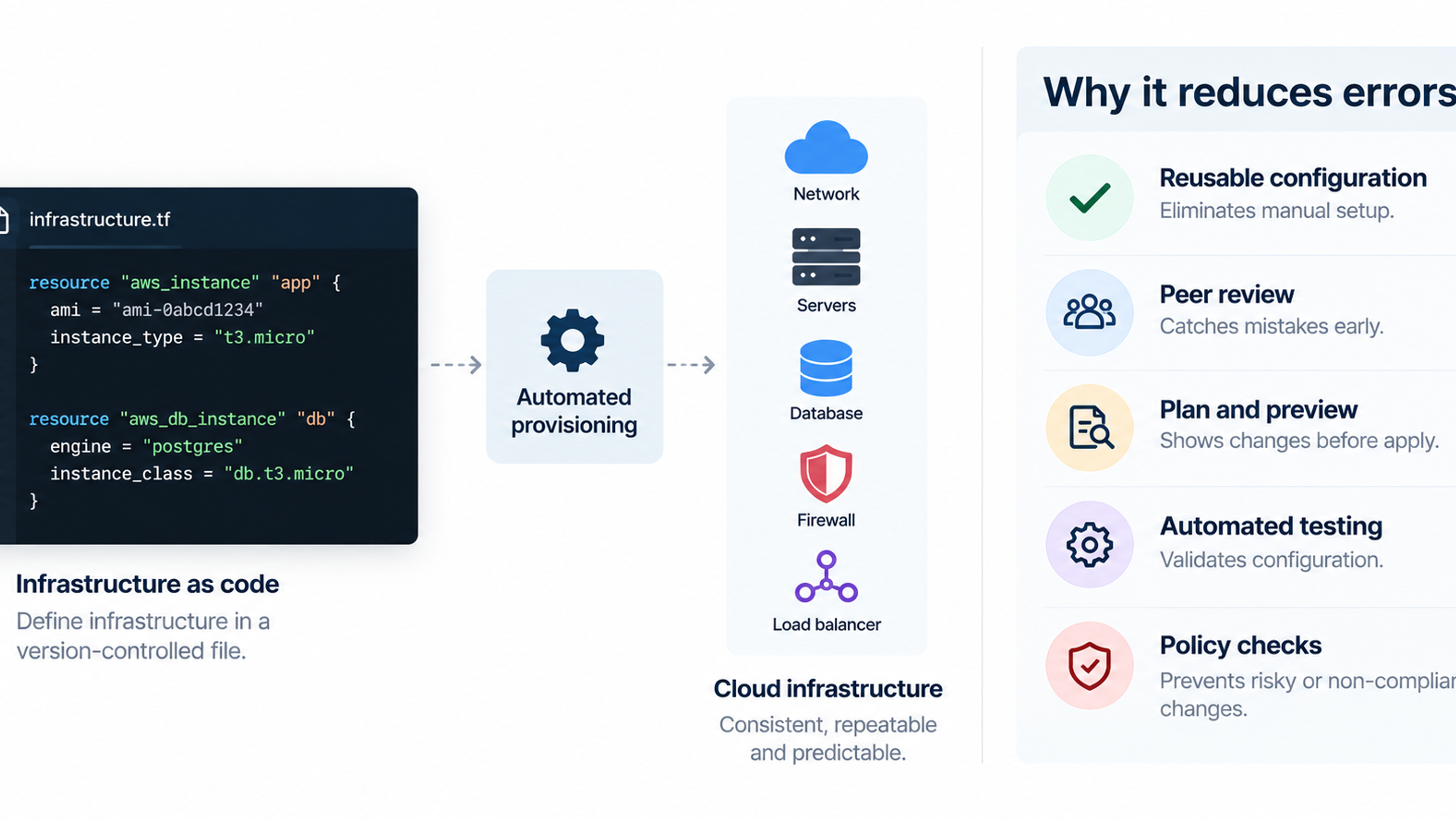
Release configuration should be version-controlled, and manual production changes should be minimized where practical.
Automated deployments also need defined permissions and safeguards.
An incorrect configuration deployed automatically can cause problems just as quickly as an incorrect manual change.
Step 5: Monitor the Rollout
Observe errors, latency, application health, and important business operations during deployment.
For canary releases, compare the new version with the existing version rather than relying only on aggregate system metrics.
Google's SRE guidance explains that an unhealthy canary may be difficult to detect when its traffic represents only a small fraction of total requests. Version-specific monitoring helps reveal those problems.
Canary Release: Deployment Safety and Efficiency
The deployment should pause or revert when predefined failure conditions are met.
Step 6: Verify Recovery Before Relying on It
A rollback plan should be tested, not simply documented.
Check whether traffic can be returned to the previous version, whether sessions remain valid, and whether both application versions can operate with the current database state.
Also establish who has authority to stop a release.
After deployment, continue monitoring for delayed failures and collect evidence for future improvements.
Common Mistakes That Cause Deployment Downtime
Even when a platform supports zero downtime deployment, implementation mistakes can still interrupt users.
One common mistake is replacing application instances before their replacements are ready.
Another is configuring health checks that only confirm a server responds, without verifying whether essential dependencies are functioning.
Teams may also introduce incompatible database changes while old application instances are still running.
Other recurring problems include insufficient temporary capacity, background jobs running twice, sessions stored only in the memory of an instance being terminated, and application updates that cannot tolerate requests from older frontend clients.
Rollback procedures can introduce additional risk when they have never been exercised.
It is important to test failure scenarios deliberately.
For example, what happens if the new version passes its startup check but begins failing payment requests under real traffic?
What happens if a database migration succeeds but a later application step fails?
These scenarios reveal whether the deployment process is genuinely resilient or merely automated.
Zero Downtime Deployment and Security
Security updates are an important reason to improve deployment reliability.
A business that requires long maintenance windows may delay installing urgent fixes.
A controlled, low-interruption release process can reduce the operational barriers to deploying security improvements.
However, deployment techniques do not replace secure software development practices.
New releases still require appropriate testing, dependency checks, access controls, and configuration management.
In particular, a blue-green environment should not become a permanent copy of production with outdated security controls or unmanaged credentials.
Both environments need appropriate protection while they are operational.
Security-sensitive changes may also require additional planning.
For example, rotating encryption keys, changing authentication protocols, or migrating user credentials can affect compatibility between application versions.
These changes should be designed for a controlled transition rather than treated as ordinary code replacements.
How to Measure Deployment Reliability
The most useful measure is not simply whether a deployment pipeline reports success.
Teams should examine what users experienced during the release.
Important indicators include application availability, request failure rates, response time, deployment duration, and recovery time.
Business-specific checks are also valuable.
For an e-commerce system, a deployment should be evaluated against checkout and payment success, not just whether the homepage loads.
A SaaS platform may prioritize login success, API reliability, and completion of important customer workflows.
Measure the Impact of Failed Releases
Track how frequently deployments create incidents and how quickly the team restores normal service.
These observations can help identify weaknesses in release testing, monitoring, or rollback processes.
Avoid measuring success solely by the number of deployments completed.
A team shipping frequently while repeatedly disrupting users has not achieved a dependable release process.
The purpose of zero downtime deployment is to make changes safer, not merely faster.
Is Zero Downtime Deployment Worth the Investment?
Not every application requires the same level of deployment sophistication.
A small internal system used during limited working hours may tolerate scheduled maintenance.
For such a system, implementing a complex multi-environment deployment architecture could cost more than the interruptions it prevents.
However, the calculation changes for applications that support continuous business operations.
Customer-facing websites, SaaS platforms, booking systems, digital marketplaces, and business-critical APIs often benefit from stronger availability controls.
Before investing, consider the frequency of releases, operational cost of interruptions, expected growth, recovery requirements, and complexity of the existing architecture.
Blue-green deployments may temporarily require substantial additional capacity because two environments operate at once. AWS notes that this can increase resource usage during deployment.
Amazon Elastic Container Service
Rolling updates may use fewer additional resources but introduce different recovery and compatibility challenges.
The right decision balances the business impact of downtime against the cost of preventing it.
Businesses modernizing their cloud infrastructure can often introduce these capabilities gradually, starting with reliable health checks, multiple application instances, automated testing, and clearer release controls
Final Thoughts
Zero downtime deployment is about making software changes without unnecessarily interrupting the people who depend on the application.
Its business value comes from improving availability, reducing release risk, supporting timely updates, and preserving important customer workflows.
But reliable deployment requires more than an automated release button.
Application instances must remain healthy, traffic must be managed correctly, databases must support compatible changes, and monitoring must identify problems before they become widespread.
Rolling, blue-green, and canary deployments provide different ways to achieve these objectives.
The right choice depends on application architecture, infrastructure cost, operational requirements, and the consequences of an unsuccessful release.
For businesses investing in cloud infrastructure and long-term software performance, zero downtime deployment is an important capability to evaluate as systems become more critical.
The goal is not simply to deploy new software without stopping servers. It is to introduce change while maintaining the availability, correctness, and reliability that users expect.
Frequently Asked Questions
Zero downtime deployment means updating an application while keeping it available to users. It is typically achieved by running healthy application instances during the transition and routing traffic away from components being updated.
No. High availability focuses on keeping systems operational despite failures or disruptions. Zero downtime deployment focuses specifically on avoiding interruptions during software releases. A high-availability architecture often makes zero downtime deployment easier, but the two are not identical.
Blue-green deployment runs two environments and redirects traffic from the existing version to the new one. Rolling deployment updates application instances in batches. Both can reduce downtime, but they differ in infrastructure requirements, rollout behavior, and rollback complexity.
Yes, Kubernetes supports rolling updates, readiness checks, and related mechanisms that help applications remain available during updates. However, application design, capacity, database compatibility, and correct configuration are still essential.
Many database changes can be introduced with little or no interruption through backward-compatible migrations. More complex changes may require additional coordination, staged migrations, or a maintenance period, depending on the database and application architecture.
It can eliminate the need for many planned application deployment outages. However, certain infrastructure operations, database changes, or external dependencies may still require controlled maintenance.
There is no universal best strategy. Rolling deployments are often practical for replicated application services. Blue-green deployments provide separate environments and clear traffic switching. Canary releases offer gradual exposure and additional production validation.