Aisha Sharma
A custom CRM project should not be judged by whether the software launched on time.
It should be judged by whether the business works better because of it.
That sounds obvious, but many CRM case studies still focus on the wrong things. They describe screens, integrations, dashboards, workflows, and technical scope without proving whether the system improved sales execution, data quality, customer response, forecasting, or operational efficiency.
A strong custom CRM case study starts with a measurable business problem, establishes a baseline, explains what changed, and then shows evidence of improvement.
That framework is useful whether you are evaluating a CRM project internally, documenting a client implementation, or deciding whether custom CRM development has actually delivered value.
Microsoft's Dynamics 365 implementation guidance makes the same principle explicit: CRM initiatives should begin with the business value expected from the investment, not the technology itself. It recommends defining tangible KPIs such as opportunity conversion rate, sales cycle length, customer growth, and service turnaround time before implementation. Microsoft Learn
The key question is not:
Did we build the CRM successfully?
It is:
Did the CRM change the business process in a measurable, sustainable way?
Start the Case Study Before the CRM Is Built
The strongest CRM case studies begin before implementation.
If you wait until three months after launch to decide which metrics matter, you may discover that you never captured the "before" data needed for comparison.
Before development starts, document the current state.
That might include:
- average lead response time
- opportunity conversion rate
- sales cycle length
- percentage of deals with an assigned next step
- number of duplicate customer records
- time spent building reports manually
- overdue follow-ups
- forecast accuracy
- customer response time
- number of systems employees use to complete one workflow
Microsoft recommends agreeing on tangible KPIs during the implementation strategy phase so the delivered scope remains tied to business expectations and measurable return. Microsoft Learn
That baseline becomes the foundation of your case study.
Without it, statements such as "reporting improved" or "sales became more efficient" are difficult to evaluate.
With it, you can say:
Before implementation, sales managers spent six hours every Monday consolidating pipeline spreadsheets. After the new CRM reporting workflow was adopted, that manual reporting process was reduced to 45 minutes of review and exception handling.
The first version is marketing language.
The second is evidence.
A Good CRM Case Study Has Five Parts
A useful case study can usually be structured around five questions:
- What was the business problem?
- What evidence showed the problem was significant?
- What changed in the CRM and surrounding workflow?
- Did employees actually adopt the new process?
- What business outcomes changed after implementation?
This sequence matters.
It prevents the case study from jumping directly from "we had a problem" to "we built a custom CRM" without proving causation or adoption.
1.Define the original business problem precisely
Avoid vague starting points such as:
"The company needed a better CRM."
That does not explain anything.
A stronger problem statement would be:
"Leads arrived through the website, email, referrals, and paid campaigns, but were manually copied into three separate spreadsheets. Sales managers could not see which enquiries had been contacted, and unassigned leads regularly went more than one business day without follow-up."
That immediately gives you potential success measures:
lead capture completeness, assignment speed, response time, overdue follow-ups, and pipeline visibility.
Your CRM case study becomes much stronger when the problem itself is measurable.
Measure Success in Four Different Layers
One metric rarely proves that a CRM project succeeded.
A system can have excellent login numbers and poor data quality.
It can have clean data but no effect on conversion.
It can improve sales reporting while making sales representatives slower.
A more useful framework measures four layers:
Adoption, data quality, operational performance, and business outcomes.
Adoption
Adoption asks whether people actually use the CRM as intended.
Microsoft recommends measuring adoption after transition through mechanisms such as sign-ins, transaction counts, interviews, surveys, and more operational indicators such as forecast accuracy. Microsoft Learn
For a custom CRM, better adoption metrics include:
- percentage of opportunities updated weekly
- percentage of customer interactions logged
- percentage of deals with a next action
- percentage of required workflows completed inside the CRM
- reliance on spreadsheets or parallel tools after launch
- number of active users performing meaningful actions
A person logging into the system does not prove adoption.
A salesperson consistently updating opportunities, recording activity, and moving deals through the agreed sales process does.
Data quality
A CRM only becomes useful when people trust its data.
Microsoft's implementation guidance emphasizes that CRM data should remain accurate, complete, reliable, and current after migration. It also recommends ongoing profiling, cleansing, validation, and clear data governance ownership. Microsoft Learn
Useful metrics include:
- duplicate record rate
- required field completion
- invalid or incomplete contact data
- percentage of deals missing an owner
- percentage of deals missing a next step
- stale records
- mismatches between integrated systems
This is especially important in custom CRM projects because customization often creates new fields, rules, integrations, and workflows.
More flexibility can create more data quality risk if governance is weak.
Operational performance
Operational metrics show whether the CRM improves the way work is done.
Examples include:
- lead response time
- quote turnaround time
- case resolution time
- manual reporting hours
- time to assign a lead
- number of manual handoffs
- time spent on CRM administration
- percentage of follow-ups completed on time
These measures are often the first place a custom CRM produces visible value.
Business outcomes
Business outcomes connect the system to commercial performance.
Depending on the project, these may include:
- lead-to-opportunity conversion
- opportunity win rate
- average sales cycle
- pipeline coverage
- average deal value
- customer retention
- renewal rate
- service satisfaction
- revenue per salesperson
Microsoft specifically recommends metrics such as opportunity conversion, sales cycle duration, customer additions, call handling time, and service turnaround when defining implementation success. Microsoft Learn
Connect Every Feature to an Outcome
A case study should not list functionality without explaining why it mattered.
For example:
"Built automated lead routing."
That is a feature.
A stronger version is:
"Automated lead routing assigned each incoming enquiry to the correct salesperson immediately, replacing a manual allocation process that sometimes left leads unassigned until the following day."
Now there is a clear relationship:
Feature → process change → measurable outcome
The final case study can then test whether the desired result occurred.
For example:
"Median lead assignment time fell from 3.4 hours to under five minutes."
The same framework applies across the system.
Instead of writing:
"Implemented dashboards."
Write:
"Created a live pipeline dashboard so managers no longer needed sales representatives to submit separate weekly spreadsheets."
Instead of:
"Integrated email."
Write:
"Automatically logged customer emails against the relevant account, reducing manual activity entry and giving account managers a complete communication history."
Custom development is valuable when it changes the operating model, not merely when it adds functionality.
Use a Metric Map Before Development Starts
One of the most useful exercises in a custom CRM project is mapping each major problem to a feature and a success metric.
For example:
Business ProblemCRM ChangeSuccess Metric
Leads sit unassigned
Automated routing
Time to assignment
Follow-ups are missed
Tasks and reminders
Overdue follow-up rate
Managers cannot trust pipeline reports
Required stages and validation
Pipeline completeness
Duplicate contacts cause confusion
Matching and deduplication
Duplicate record rate
Reports take hours to prepare
Live dashboards
Manual reporting time
This table is valuable during requirements gathering because it helps prevent unnecessary customization.
If a proposed feature does not support a measurable business objective, ask why it is being built.
Microsoft's implementation guidance similarly recommends connecting requirements and testing to business processes and overall project success criteria. Microsoft Learn
Custom CRM Success Depends on Workflow Fit
A custom CRM is not successful simply because it is more flexible than an off-the-shelf product.
The custom system must accurately reflect how the business should operate.
That distinction is important.
If you recreate every inefficient legacy process inside a new CRM, you have automated the wrong workflow.
Before development, map the process as it currently works and then design the process you actually want.
For a lead workflow, that might be:
Current process
Website form → shared inbox → spreadsheet → manual assignment → salesperson emails lead → notes stored in email
Desired process
Website form → CRM record → automatic source attribution → routing rules → first-response task → salesperson action → centralized activity history
The case study should explain both.
It should show that the custom CRM did not merely replace software. It changed how work moved through the organization.
Adoption Is Part of the Product
Poor adoption is often treated as a training failure.
Sometimes it is.
But sometimes the CRM itself is badly designed.
Microsoft warns that business applications can meet technical requirements yet still fail to produce expected business outcomes when there is a gap between the technology and the user experience. Microsoft Learn
That means adoption metrics can reveal product-design problems.
Suppose sales representatives frequently skip a required field.
There are several possible explanations:
- they do not understand why it matters
- the field appears at the wrong stage
- the information is not available yet
- completing it takes too long
- the field is not useful
- the workflow was designed around management reporting instead of sales reality
A good CRM case study should not hide these issues.
It should explain what changed after user feedback.
For example:
"Initial adoption data showed sales representatives were leaving the 'next step' field blank in 43 percent of open opportunities. Interviews showed the field was buried below information used only by finance. The opportunity layout was redesigned, and the next step was moved into the main sales workflow."
That demonstrates an important kind of success: the system improved because the team measured real behavior.
Data Quality Should Be Treated as a Business Metric
Data cleanup is often discussed as a migration task.
It should also appear in the case study results.
Microsoft notes that organizations commonly overestimate the quality of their existing data and underestimate how much effort is required to improve it. Its guidance recommends ongoing validation and reporting after migration, not just a one-time cleanup. Microsoft Learn
For a CRM case study, consider reporting metrics such as:
Before
18 percent of customer records missing phone numbers
9 percent duplicate accounts
27 percent of open deals missing a next step
Different naming conventions for the same lead source
After
4 percent missing phone numbers
Less than 1 percent duplicate accounts
95 percent of active opportunities include next-step data
Lead sources standardized through controlled values
Do not invent impressive improvements.
Use real measured results.
A modest improvement backed by credible data is stronger than an extraordinary number nobody can verify.
Build the Case Study Around a Timeline
CRM results rarely appear immediately.
A useful case study shows how performance changed over time.
For example:
Before implementation
Baseline metrics are captured.
Go-live
Users switch to the new CRM.
30 days
Early adoption, data quality, and support issues become visible.
60 to 90 days
Workflow consistency begins to stabilize.
6 months
Operational and sales outcomes become easier to evaluate.
12 months
Longer-term results such as retention, forecast reliability, and total administrative savings can be assessed.
This prevents the common mistake of claiming major business transformation two weeks after launch.
Microsoft's implementation framework treats operation, adoption, support, and optimization as part of the implementation lifecycle rather than assuming value is fully realized at go-live. Microsoft Learn
Separate Correlation From Causation
CRM case studies often overclaim.
Revenue increased after the CRM launch, therefore the CRM caused the increase.
That conclusion may be wrong.
Other things may have changed at the same time:
- pricing
- market demand
- sales headcount
- advertising spend
- product quality
- territory structure
- compensation plans
- economic conditions
A credible case study distinguishes direct operational effects from broader business outcomes.
For example:
Directly attributable
Lead assignment time decreased because routing became automated.
Manual report preparation fell because dashboards replaced spreadsheet consolidation.
Duplicate records declined because matching rules were introduced.
Associated but not exclusively attributable
Revenue increased 12 percent.
Win rate improved.
Customer retention increased.
You can still report those results, but explain that several factors may have contributed.
This makes the case study more credible, not less impressive.
Use Control Groups When the Business Allows It
For larger CRM programs, phased rollout can create better evidence.
Suppose the company has four regional sales teams.
The new CRM workflow is rolled out to two regions first while the other two remain temporarily on the previous process.
Now you can compare:
- response time
- activity completion
- conversion
- data completeness
- reporting effort
This is not always practical, but where it is possible, it produces stronger evidence than a simple before-and-after comparison.
Pilot groups are also useful for identifying workflow, permissions, migration, and training issues before a wider rollout.
Microsoft recommends thorough testing against business processes and includes user acceptance testing, migration validation, usability, performance, security, and operational readiness within its implementation guidance. Microsoft Learn
Do Not Hide Failed Assumptions
The most useful case studies include what did not work.
Perhaps an automation produced too many notifications.
Perhaps the original lead scoring model was ignored by sales.
Perhaps management requested 40 mandatory fields and adoption collapsed.
Perhaps an integration introduced duplicates.
Documenting those problems makes the case study much more useful because CRM implementation is rarely perfect on the first attempt.
A strong format is:
Assumption: Sales representatives would update probability percentages manually.
What happened: Users entered arbitrary numbers because the percentage did not affect their workflow.
Change: Probability became automatically mapped to pipeline stages, with manual override available only for managers.
Result: Forecast inputs became more consistent.
That is much more instructive than presenting the implementation as a flawless sequence of decisions.
Calculate ROI Carefully
CRM ROI can include both direct financial returns and operational savings.
A simplified model is:
CRM value generated + cost savings - total CRM cost
Total cost should include more than development.
Depending on the project, include:
- implementation
- migration
- integrations
- cloud infrastructure
- licenses
- training
- maintenance
- CRM administration
- future enhancements
Benefits may include:
- additional gross profit from improved conversion
- hours saved through automation
- lower reporting effort
- reduced duplication
- improved customer retention
- avoided software subscription costs
- reduced administrative headcount growth
Avoid treating every saved minute as guaranteed cash savings.
If automation saves five hours per employee per month but those employees simply spend the time on more valuable work, describe it as productivity capacity rather than direct cost reduction.
That distinction keeps the case study credible.
A Practical CRM Case Study Template
A publishable case study can follow this structure:
Company context
Industry, team size, CRM users, sales or service model, and relevant operational complexity.
Business challenge
What was broken and why it mattered.
Baseline
Specific metrics before implementation.
Requirements
The capabilities needed to improve the process.
Solution
What was built, integrated, automated, or redesigned.
Rollout
Migration, testing, training, pilot approach, and go-live.
Adoption
How employees actually used the system.
Results
Measured improvements at appropriate time intervals.
Lessons
What required adjustment and what the team would do differently.
Next phase
What the company plans to improve next.
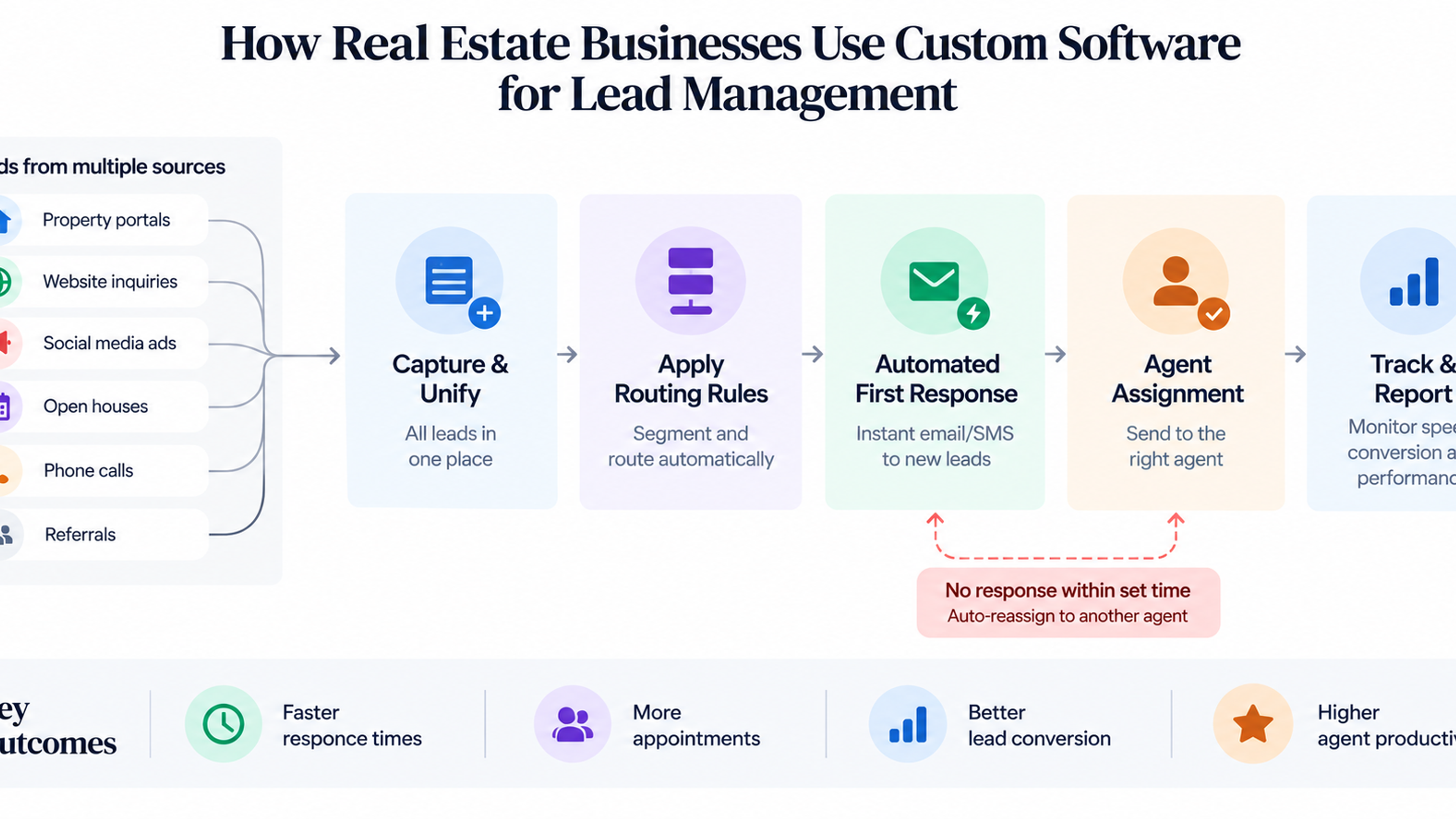
This framework works for sales CRM, customer service systems, real-estate lead management, field sales platforms, account management systems, recruitment CRM, and many other custom customer-management applications.
What a Strong Result Section Looks Like
The result section should be easy to scan.
For example:
Lead response
Before: 5.2 hours median
After: 18 minutes median
Data completeness
Before: 62 percent of active opportunities contained a next step
After: 94 percent
Reporting
Before: approximately seven staff hours per week spent consolidating reports
After: under one hour spent reviewing dashboard exceptions
Adoption
Before: sales activity stored across CRM, spreadsheets, email, and notebooks
After: 91 percent of active opportunities updated inside the CRM each week
Sales cycle
Before: 71 days average
After: 63 days after six months
These numbers are illustrative examples only. A real case study should use actual measured results from the implementation.
That final sentence matters.
Never manufacture a result because it makes the project sound successful.
Success Is More Than Revenue Growth
Revenue is attractive because executives understand it immediately.
But CRM projects often create value before they increase revenue.
A successful CRM may first produce:
better data
clearer accountability
faster response
more reliable forecasting
less manual administration
fewer missed follow-ups
better customer history
more consistent processes
Those are not secondary outcomes.
They are often the mechanisms that eventually improve commercial performance.
A useful case study therefore shows the chain:
CRM change → employee behavior → process improvement → business outcome
That is much stronger than simply saying the company implemented a CRM and sales increased.
The Best Custom CRM Case Studies Show a Business System Becoming Better
A custom CRM case study should prove more than technical delivery.
It should show that the organization moved from one way of working to a better one.
The strongest case studies make that transformation measurable.
They establish the baseline before implementation.
They connect features to business problems.
They measure adoption and data quality.
They track operational performance.
They evaluate commercial outcomes over an appropriate time period.
They acknowledge what did not work.
And they avoid claiming that every positive business result came from the CRM alone.
That is what makes a case study credible.
More importantly, it gives future CRM projects something useful to learn from.
Frequently Asked Questions
The most useful case studies combine adoption, data quality, operational, and business metrics. Examples include active workflow usage, record completeness, duplicate rates, lead response time, sales cycle length, conversion rate, forecast accuracy, customer retention, and manual reporting time. Microsoft recommends linking implementation KPIs directly to business goals and processes. Microsoft Learn
Establish baseline business metrics before implementation, track relevant improvements after launch, calculate operational and commercial value, and compare those benefits with implementation and ongoing ownership costs. Avoid attributing unrelated business growth entirely to the CRM.
Yes. Explaining what did not work, why it failed, and how it was corrected makes the case study more credible and useful.
Adoption and data-quality indicators can be measured within the first few weeks. Process improvements often become clearer within 30 to 90 days. Revenue, retention, and longer-term performance metrics usually require several months of comparable data.
There is no universal metric. The most important KPI depends on the problem the CRM was designed to solve. A sales CRM may prioritize conversion and response time, while a service CRM may focus on resolution time, case quality, and customer retention.
No. High usage can still coexist with poor data or inefficient processes. Adoption should be evaluated alongside data quality, workflow performance, user feedback, and business outcomes.